Showing posts with label Goryeo Dynasty. Show all posts

Wednesday, December 25, 2019

Songs of the Dragons

Songs of the Dragons Flying to Heaven, translated by James Hoyt (1979), was a compilation of 125 cantos compiled to establish the legitimacy of King Sejong's lineage. King Sejong (1397-1450), 4th king of the Joseon Dynasty (1392-1910) ordered the compilation to extol the merits of the Yi (Lee) lineage in the new dynasty, and printed the compilation with the newly-made hangeul script made for all people of the nation to easily read. Songs of the Dragons was the first book to be printed in Sejong's new "alphabet".  


Three Reasons for the Compilation

(1) Extolling the great accomplishments of the six generation of founders of the new Yi, or Chosun/Joseon Dynasty. The heroic actions of the Six Ancestors are compared to the flights of dragons symbolic of the throne, hence the title of the work. Of the Six Ancestors, only two actually sat on the throne of Korea. The other four generations of the House, preceding the establishment of the dynasty, are designated as chamnyong, or "submerged dragons," and their residences as chamjo, or "submerged palaces," after Chinese usage. [When Yi Seong-gye took the throne, he had to justify through ancestry that he was eligible for the throne. Ancestry was of need traceable back by at least four generations; thus, when Yi Seong-gye established his Dynasty, he brought with him the bones of his four primary ancestors.]
  • The ancestors of the Yi family lived in Jeonju, Jeolla-do, and their prominence dates from Mokcho (Yi An-sa, d. 1274), the First Ancestor, who served the Goryeo Dynasty (918-1392) in various capacities in a number of provinces. Mokcho's descendant in the fourth generation, Yi Seong-gye, became King Taejo, the founder of the Yi Dynasty after overthrowing the Goryeo Dynasty.
  • The Second Ancestor, Ikcho (Yi Haeng-ni), was noted for his difficulties with the Jurchen tribesmen in the North.
  • The Third Ancestor, Tojo (Yi Ch'un, e. 1342), a skillful bowman.
  • The Fourth Ancestor, Hwanjo (Yi Cha-ch'un, 1315-1361), based the growing power of his family on the imminent collapse of the Mongol empire in China (1368) and the concomitant weakening of the Mongolized dynasty of Korea.
  • The Fifth Ancestor, Taejo (Yi Seong-gye, 1335-1408), wielding military power as a result of his expeditions against both the Jurchen tribesmen and Japanese freebooters and for espousing a program of land reform and alliance with the Ming, he established himself as king and ruled until his abdication in 1398.
  • Chongjo, an ineffectual son of Taejo and who was a caretaker-king during a period of rivalry over succession (1399-1400), does not merit qualification to be listed as one of the Ancestors of the dynasty.
  • The Sixth Ancestor, Taejong (1401-1418), completed the work of establishing a firm dynasty, which would last until 1910.
First four kings of the Yi/Lee Dynasty / Joseon Dynasty:
  1.   Fifth Ancestor: Taejo (r. 1392-1398)
  2.   Jeongjong (1398-1400)
  3.   Sixth Ancestor: Taejong (1400-1418)
  4.   The Great King Sejong (1418-1450)

(2) Providing inspiration for King Sejong and subsequent kings on the Yi line by recalling the vicissitudes and tenacity of the Six Ancestors. No less than 15 of the 125 cantos end with the hortatory refrain, "Let Your Majesty not forget this!"

(3) Proclaiming to the world that the accession of the Yi family to power was in accordance with the Chinese concept of the Mandate of Heaven. This concept of the Mandate of Heaven is an ancient one, formulated by Tun Chung-shu (2nd century BC), who declared that when a ruler commits unjust acts, Heaven shows its displeasure by such calamities as earthquakes, famines, and floods. If these warnings are not heeded, Heaven seeks to admonish rulers by means of such portents as eclipses and comets. If these are not needed, the ruler loses the Mandate, and Heaven selects another to mount the throne. The attainment of the Mandate of Heaven's divine plan is the much repeated theme of Songs of the Dragons Flying to Heaven, and the word "Heaven" in the title refers to Heavenly favors bestowed upon the six heroes. The writing of the work is, in short, a written legitimization of the Yi rule.

CONTENTS

All of the cantos are focused on the assertion that the Six Ancestors have the favor of Heaven. The earlier cantos speak of the exploits of the first four Ancestors, aiming to support the Fifth Ancestor Taejo, who took the throne. The cantos XXVII to XCV (68 or 54% of the cantos!) were of the exploits of King Taejo, how mighty he was and how he repeatedly saved the country through his valorous deeds in battle or in the hunt. No cantos were given to Jeongjong (1398-1400), the ineffectual son of Taejo who ruled briefly during a period of political instability and fighting for the throne. Cantos XCVII to CIX (13 cantos) were dedicated to the Sixth Ancestor, Taejong (1400-1418). Those 13 cantos primarily reflected the time of instability and mostly sang of assassination plots and recognition of loyalty. Cantos CX to the end of the songs, Canto CXXV, sang of the merits and righteousness of the Great King Sejong, the Sixth Ancestor. These cantos were a series of admonishments. Admonishments:
  • to not forget the hardships of his Ancestors and to be steadfast in purpose
  • to not forget the contrast between the magnificence of his palace and the crudeness of his Ancestor's shelter
  • to not forget the contrast of his embroidered belt of office with the crude armor of his Ancestors
  • to not forget his Ancestor's hunger as he dines of the finest of food and richest of drinks
  • to not forget his Ancestor's fierce battles as he presides over a brilliant and peaceful court
  • to rule with clemency, an important quality of kingship
  • to have compassion
  • to be humble lest he become a tool of conniving ministers
  • to act in a manner befitting a king
  • to overcome with benevolence the plot of evil ones
  • to maintain a strong economic basis for the state
  • to be forgiving to his advisors as was Taejong
  • to respect scholarship and beware of trouble-makers
  • to evade slander mongers and those who embroider the truth
  • to despise Buddhism and revere Confucianism
  • to emulate the Flying Dragons
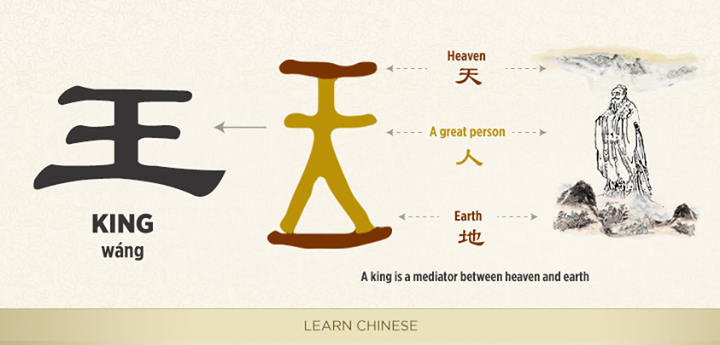
Opening canto - the opening assertion of the Six Ancestors aka dragons flying in the Heavens, the symbolic statement that the Heavens validates their auspicious right to be elevated above men and below the space of universe authority. Reference the meaning of "king" in Chinese character.
meaning of the Chinese character "wang" or "king"
King Taejo, found of the Yi Dynasty, is valorous in war and in the hunt. He is powerful, righteous, blest by the Heavens, and therefore deserves the role of king and ruler/caretaker of the nation.
The last canto, the canto that affirms King Sejong, the fourth king of the dynasty, as the right to continue to rule, as based on the righteous foundation of the Six Ancestors.
Final Comments

Songs of the Dragons was the first book to be printed in the newly developed hangeul writing. Printing was executed with wooden block in October 1447, about two years after its compilation, and 550 copies were presented to various ministers. The editions that are presently extant include those printed in 1612, 1659 and 1735.

The compilation is now recognized as a monument to the cultural independence of Korea from China, a most important source for the study of the Korean language, and the beginning of Korean national consciousness and of vernacular literature.

For more information regarding the translation, reference a 1977 JSTOR preview of the book, by Peter H. Lee. 

Friday, February 1, 2019

Kansong Art Museum at the DDP

Selected priceless artifacts from the Kansong Art Museum are currently on display at the DDP, Dongdaemun Plaza or Dream Design Play. The Kansong Art Museum was first opened in 1938 as Bohwagak, the first private art museum in Korea. The collector "Kansong" Jeon Hyeong-pil, born 1906, died in 1962 and so the museum name was changed to Kansong Art Museum and since 1971 has only opened twice a year for a brief time in the spring and again briefly in the fall. "Gansong" Jeon Hyeong-pil (1906-1962), a young wealthy landowner during the colonial period, collected the art treasures of Korea's past to keep them within Korea rather than see them be taken most notably to Japan, the then colonizing country of Korea.

The Kansong Art Museum is the home to 12 national treasures, 10 treasures, and 4 Seoul tangible cultural assets, and according to the Joongang Daily, the Kansong Art Museum since January 2014 has posted a few of its treasures online to share the glorious history of the Korea's rich past. If one clicks on the pictured art treasures at the Kansong Art Museum and Culture Foundation site, one can read about the treasure, and in many cases even learn what Jeon Hyeong-pil paid for the artifact.

To give a little background to Jeon Hyeong-pil, before the age of 25 he inherited a huge fortune, and being a man of leisure and having what can be regarded as a keen interest in art, he began to collect art treasures. During the 1930s and 1940s is when he collected the majority. Legendary stories evolved from his purchases, one in particular in 1935 concerns the now famous National Treasure No. 68, the Celadon Prunus Vase with inlaid Cloud and Crane Design, which was in the process of being sold to a Japanese. Jeon Hyeong-pil paid a huge sum (according to the museum web site: 20,000 won) which was equivalent to 20 decent houses of the time!

National Treasure No. 68, the Celadon Prunus Vase with inlaid Cloud and Crane Design
"Kansong", Jeon Hyeong-pil's pen-name, is also known as promoting the Korean language when the Japanese colonial rulers decreed that all Koreans must speak Japanese and the Japanese language became the language of education in the limited number of schools. Jeon Hyeong-pil purchases and supported Posung High School, the first private school established by a Korean citizen. It was through this high school and another purchase, the Hannam printing press that Mr. Jeon promoted great resistance against the colonial rulers. 
1906 July 29 - born
1921 March - graduated from Eouidong Primary School (now Hyojae Elem Sch)
1926 March - graduated from Whimoon High School
1930 March - graduated from law school, Waseda University, Japan
1934 - opened Bukdanjang in Seongbuk-dong and set up Geosan Stupa
1935 - purchased Celedon Prunus vase with inlaid cloud and crane design (Nat'l Treasure No 58) from Maeda Sayichiro
1936 - Hannam Bookstore and Publishing Company
1936 - purchased Blue and White Porcelain Bottle with Chrysanthemum Design in Underglaze Iron and Copper (Nat'l Treasure No. 294) at Gyeongseong Art Club, the Mori Koichi's collection auction
Blue-and-white Porcelain Bottle with Chrysanthemum Design in Underglaze Iron and Copper (Nat'l Treasure No. 294)

"The elongated neck of this elegant bottle and the globular body reflect the spirit of the age. The body is painted in blue, brown, and red by using cobalt, iron and copper oxides as pigments. This extremely rare bottle, painted in three different pigments, is recognized for its exceptional quality utilizing every color pigment and carving technique of the era.

Kansong purchased this masterpiece through heated bidding battle against Japanese art dealers in Gyeongseong Art Club in 1936. The final bidding price was record breaking, 14,580 won!

1937 - purchased Nat'l Treasure No. 65, 66, 74, 270, and Treasure No. 238, 286, 349, 1955, 1954
1938 - opened the first private art museum, Museum Bohwagak, in Bukdanjang
1940 - established the school foundation Dongsung, taking over the Posung Middle School
1940 - collected the Huminjeongeum Hyeraebon (Nat'l Treasure No. 70)
1945 Oct - 1946 Sept - worked as principal of Posung Middle School
1947 - selected as member of Historic Assets Preservation Committee
1950 June 25 - outbreak of the Korean War
1954 - delegated to first and second subcommittee member of the Cultural Properties Protection Committee
1956 - awarded with Education Service Commendation
1960 January - established the Art and Archaeology Society
1962 Jan 26 - "Kansong" passed away
1962 Aug 15 - posthumous honors of Order of Cultural Merit conferred on "Kansong"
1964 Nov 13 - posthumous honors of Order of Civil Merit Republic of Korea on "Kansong"
1965 - establishment of The Center for the Study of Korean Arts
1971 - Bohwagak renamed Kansong Art Museum, and project exhibition opened to the public every spring and autumn

Kansong Art Museum opens every May and October for a brief time. Be sure to visit this museum with exceptional masterpieces!

Thursday, February 8, 2018

The Royal Tombs of Joseon Dynasty

Jinny Hwang Inhee presented on the Royal Tombs of Joseon. She is an expert and has made an in-depth study of the Joseon Dynasty royal tombs, and in her expressive slide show she explained many of the characteristic features of the tombs. Jinny Hwang Inhee, a graduate from the Civics Education Department, Ewha Womans University, spoke in Korean and Kim Jaebum, a RAS Council member, provided English translation. Jinhee is a writer and an educator. Since 2013 she has been serving as President of the Durumari History Education Institute.

A write-up of her presentation is as follows: 

The Joseon Dynasty, the last period in Korean history before the Japanese annexation, was founded by General Yi Seonggye in 1392 and forcibly annexed to the Japanese Empire in 1910. While the dynasty lasted for 519 years, 27 kings and 45 queens reigned, including the last two with the title of “Emperor” with their empresses in the Daehan / Korean Empire. In all, 42 Joseon royal tombs including two in Gaeseong, presently North Korea, are preserved, virtually all that were built. The 40 of them located in South Korea are registered by UNESCO as a World Cultural Heritage not only for the aesthetic value of their sculpture but also for the entirety of their preservation. 
It is also amazing to note that the royal ancestral rituals jerye have been observed continuously for 623 years. The main Jeonju Yi family Jongyagwon had to overcome difficulties following the demise of the dynasty to continue the ritual at the graves, while that held at the main shrine of Jongmyo, which is now held once on the first Sunday of May each year, is also a UNESCO World Cultural Heritage.
JOSEON DYNASTY
  • last of the Korean traditional dynasties
  • founded by General Yi Seonggye in 1392
  • 27 kings & 45 queens
  • from 1392 - 1910, a span of 519 years
  • royal tombs - a graveyard exclusive for kings and queens
Joseon Royal Tombs
  • 42 tombs in total = 40 in South Korea + 2 in Gaeseong, present-day North Korea
  • the 40 tombs in South Korea are UNESCO World Culture Heritage, and they are protected for their aesthetic value and must be preserved in their entirety
  • all within 44 kilometers of Seoul, the capital
  • 2 in Yeoju, Gyeonggi-do
  • ? in Yeongweol, Gangwon-do 
  • Jongyagwon, for the main Jeonju Yi family
  • rites at royal tombs continued even during Japanese occupation
  • Jongmyo Jerye 
  • 1st Sunday of May each year
  • UNESCO World Cultural Heritage
  • continued for over 600 years
King or Queen Dies
  • establish gukjangdogam
  • place corpse in jaegung and keep it at binjeon
  • observe rites and mourn for 5 months
  • no preservatives or cooling facilities
  • cultivate juniper for incense
Constructing Tombs
  • select site
  • form mound and excavate 3 meters deep
  • make room for stones or lime walls
  • stone sculptures to decorate
  • build jeongjagak at entrance
  • erect hongsalmun gate 
(read more about tombs and their terms)
Burial and Rites
  • 5 months after demise
  • take soul in shinju back to the palace
  • rites in honjeon every morning and evening for 3 years
  • move shinju to Jongmyo
  • royal name, the myoho, is given
  • queen's soul to Jongmyo 3 years after king's death
Location and Feature
  • best location: big mountain to the north, low hills to the south, views to the east and west
  • features differ between each era based on:
  • state law
  • extent of royal power
  • political circumstances
  • economic conditions
  • topography of the site
Basic Structure
  • jaeshil at entrance
  • geumcheongyo bridge
  • baewi

Chamdo: Path for Worship
  • long stone path for hongsalmun
  • left: shindo - soul, tomb owner
  • right: eodo - lower status on up to ancestors
  • soul-tablet in yellow cloth on shindo
Staircases
  • left: luxurious patterns for souls
  • right: without ornaments for kings
  • down staircase behind the palace
  • soul to neungchim to fall quietly to sleep, no stairway to come down
Jeongjagak
  • exclusive for royal tombs (if at other tombs, people arrested and killed as traitors)
  • entrance and exit:
  • direction decided and must connect to chamdo
  • enter from the east: sunrise, beginning, birth, spring, etc.
  • leave toward the west: death, extinction
Smaller Annexes
  • subokbang - on right before jeongjagak; for tomb keeper and night duty
  • suragan - royal kitchen on left; prepare food and offerings
  • bigak - a little further inside and on the right; tombstone etching on whose tomb
Sachoji or Gang
  • hill behind jeongjagak
  • unique style of Joseon royal tombs
  • 2 meanings of gang:
  • tank for storing vigor streaming into the soil
  • demonstrate dignity as power
  • hiking precluded - somewhat open to the neungchim at the front
Museogin and Munseogin
  • stages divided by stones on top of sachoji
  • lower stage: museogin and maseok - have warrior-shaped generals with swords
  • middle stage: munseogin and maseok - have officials, most of whom are scholars
  • interpretation: "The pen is mightier than the sword" meaning literary preference over military 
  • reign continues posthumously
  • variations in garments by king:
  • museogin placed only in royal tombs
  • civilian graves considered treacherous
Neungchim
  • top stage - burial mound neungchim
  • gokjang:
  • walls and roof tiles surrounding 3 sides
  • sun, moon, stars
  • resemble palace buildings' back walls
  • royal tombs as epitomes of the palace
Seogmul and Honyuseok
  • seogmul - in front of gokjang
  • yangseok - sheep = obedience; repel evil
  • hoseok - tiger = loyal; patron neungchim
  • honyuseok - in front of neungchim
  • for offerings in ordinary graveyards
  • "stone where the soul plays"
Goseok and Mangjuseok
  • goseok - stones supporting honyuseok look like drums
  • guimyeon - faces of ghost or goblin
  • mangjuseok - on each side of honyuseok: "observing stone poles" with several hypothesis about their use:
  • sign for soul from body to find neungchim
  • device to harmonize yin and yang
  • instrument to hold vigor from being scattered 
  • columns a division between this world and the next
Seho and Jangmyeongdeung
  • seho embossed on stone poles
  • shape of ear with holes
  • developed into animal shapes
  • some not like tigers but wizards
  • jangmyongdeung to honyuseok
  • to pray for souls of the departed
  • shape altered in each era
Conclusion
  • scale gradually shrank - later kings were more pragmatic
  • initial period of the kingdom:
  • conscripted manpower 5,000 for each tomb
  • construction work - up to 5 months
  • mobilized personnel to carry food
  • construction bothered people
  • great agony on people in Gyeonggi where a large number of royal tombs have been built
  • their endeavor and perseverance enables us to possess World Cultural Heritage today
Books Published:


Other notes:
  • gukjangdogam - nation-wide royal funeral 
  • In inclement weather when the body began to smell, the court spread juniper branches.
  • 일월성신 - sun, moon, star decorations on the wall that surrounds the tombs
  • 선장릉 - When UNESCO came to evaluate the tombs as a future UNESCO World Culture Heritage site, the Korean government didn't want to show the 선장릉 because there was no body inside. Eventually they did and it was highly regarded, especially as it was on very valuable land.
  • The Silla and Koryeo Dynasty tombs were traditionally built on flat ground, but in the Joseon Dynasty, tombs were built on the top of artificial mounds.
  • Today, there are three places where royal ancestor worship are held - the dates:
  • 1st Sunday of May (solar calendar)
  • each ancestor's memorial day

Sunday, November 26, 2017

Korean Story-telling: Ancestral Memorial Rite for General Kim Bang Gyeong

Story-teller Seung Ah Kim and her extended family hosted a very unique trip to the Andong Kim family ancestor memorial rite ceremony for the Andong-Kim branch founder, General Kim Bang Gyeong. Ancestor General Kim dates back to the Goryeo Dynasty in the 13th century. The Andong Kim family gathers annually for the sije rite and this year opened the rite to the public.

Sije is the seasonal rites held for ancestors up to five generations past and is typically performed annually on the tenth lunar month, the best month of the year's harvest. To run smoothly, it needs financial support so the family prepares for three things: wito (money for the food and setting the table), seonsan (mountain for ancestral tombs), and jaesil (place for food preparation and rest). These three components do vary from family to family.
Sije for General Kim Bang Gyeong is held every October 9 (lunar calendar) in front of the tomb in Andong. If its rains it is held at Eumsujae, the main building, in Neungdongjaesa established only for General Kim. The day before sije the ritual team gets together to discuss the important agendas and select three eldest males for offering rice wine three times one after another with rituals assistants. 
Kangshinrye - greeting rituals to call the spirit down. Choheongwan (the first host) burns incense and pours rice wine over the burial mound three times and then bows twice.
Chamshinrye - all the participants bow twice 
Choheon - Choheongwan (the first host) offers the first rice wine and bows twice
Dokchuk - Chukgwan (reciter) recites an eulogy 
Aheon - Aheongwan (the second host) offers the second rice wine and bows twice 
Jongheon - Jeongheongwan (the final host) offers the final rice wine and bows twice 
Yusik - food offering rituals to the spirit. An assistant sticks a spoon into the center of the rice bowl facing eastward and puts a pair of chopsticks on top of the bowl also facing eastward 
Sashin - farewell ritual, bowing twice 
Eumbok (drink blessings) - participants share the ritual food and drinks as it symbolizes the receiving of the blessings bestowed upon the family 
Bunchuk - burn out all chukmun (eulogy)
I was very curious why such a private family ceremony would be opened to the public, and the answer is that "History needs to be shared!" Great answer! 

In particular, three of the elderly men of the clan have done extensive research on the family and published articles and books on the family history, specifically that of General Kim Bang Gyeong and his descendants. I commented that almost the entire clan that had gathered was over the age of 50 and was probably 80% male. Yes, I had identified a problem! But the elderly male who guided the tour in conjunction with Seung Ah Kim, the lead story-teller, said that when he was young he hadn't been interested in the family history but now he is, and so he believes that the younger generation will get interested later. He also added that his generation of people doing research have made it easy for subsequent generations. They just have to read the books published. The young generation now doesn't have much knowledge of complicated Chinese characters, the format used to write in older generations, so the published books not only compile the ancient family history, but translate it to modern Korean.

Sachon Village

Located in Sachon, Jeomgok-myeong, Uiseong-gun, Gyeongsannamdo, Sachon is the ancestral village of General Kim Bang Gyeong, and is named after the Sachon village near China, "Sajinchon". The village is surrounded by beautiful nature and the people have inherited the spirit of seonbi (virtuous scholars) of the Joseon Dynasty and led uibyeong (army raised in the cause of justice) against Japan. One of the most famous scholar-officials of the Joseon Dynasty, Ryu Seong-ryong, was born in Sachon in 1542; his mother was an Andong Kim.

Historic Sites in Andong
Manchuidang (Treasure No. 1825) is one of the oldest wooden buildings of a Joseon Dynasty private house. It is used as a living space for the head family and a gathering space for the Andong Kim family members. Manchidang was a pen name of Kim Sa-won, the old student of the prominent Korean Confucian scholar, Han Seok-bong, who composed calligraphy for the royal court. 
Seorim (West Forest) was planted by the Kim clan to fill an empty space to the west of the village. Originally 10 different species of trees were planted, and now it is a dense flourishing forest with 300-600 year-old trees. Seorim is the oldest forest of its kind in Korea. 
Jidang Pond is an artificial pond in the middle of the village. In olden days people believed in geomancy / feng shui, and according to it, with the character of "fire" in written Sachon, it was believed that by building a pond, the "fire" of Sachon would be neutralized.
The Andong Kim family clan village is located in Sachon, Andong, Gyeongsangnamdo.

the white spirit papers with ancestors names propitiously waving in the wind
the main gate to the ancestor's home, Manchuidang
story-teller Seung Ah Kim in her representative Goryeo Dynasty attire
representatives of the Andong Kim clan (note that most are men and over 50)
the main building strung with the ancestor's papers to the right;
the walkway up to the gi-filled tombsites seen between the buildings
climbing to the tomb site(s)
last-minute preparations for the ritual: arranging the spirit food correctly
during the ceremony everyone was to bow (but because it was so crowded, only the representative members in ritual white were obligated to bow; everyone else could from necessity remain standing)
as soon as the ceremony was over everyone descended on the ritually arranged food to eat (Eumbok)
Removing the food from the ancestor's altar.
It's now possible to see the multi-grave arrangements that extend up the hill.
NOTE: the picture in the lower left corner was actually off to the right of the tomb and is the food set out for the Sanshin (the mountain god), a practice that is rarely seen anymore!
A few representative families with the foreigners (15-20) who had accepted the invitation to attend the ceremony.
The tomb arrangement after the place cleared of people and ritual materials.
It's hard to believe that one hour earlier this place was crammed with people, 
ground sheets, photographers, tons of food, and a large speaker system!

a view from this highest tomb ... very propitious gi-filled site!

Other famous places related to the Andong Kim family heritage:


3 of the Most Famous Historical Descendants of Kim Bang Gyeong

Kim Sa-hyeong (1341-1407)
One of the founders of the Joseon Dynasty. In 1336, Korean official Kim Sa-hyeong led a campaign into Tsushima.

Sim Si-min (1554-1592)
Most famous for having defended Jinju Castle with untrained fighters against the Japanese invaders during the Seven Years' War. Since he was one of the greatest generals of Joseon Dynasty, he received the title "Chungmygong", Duke of Loyalty and Warfare like Naval Commander Yi Sun-shin.

Kim Gu (1876-1949)
Better known by his pen name "Baekbom", Kim Gu's autobiography "Baekbeomilji" has inspired many Korean people. He was a Korean nationalist politician, the sixth and later the last Premier of the Provisional Government of the Republic of Korea, a leader of the Korean independence movement against the Japanese Empire, and a reunification activist after 1945.
"My Desire" 
At the end of his autobiography, Kim expressed his desire which he carried throughout his lifetime: 
"If God asked me what was my wish, I would reply unhesitatingly, "Korean independence." If He asked me what my second wish was, I would again answer, "My country's independence." If He asked me what was my third wish, I would reply in an even louder voice, "My wish is the complete independence of my country, Korea". 
"... I want our nation to be the most beautiful in the world. By this I do not mean the most powerful nation. Because I have felt the pain of being invaded by another nation, I do not want my nation to invade others. It is sufficient that our wealth makes our lives abundant; it is sufficient that our strength is able to prevent foreign invasions. The only thing that I desire in infinite quantity is the power of a noble culture. This is because the power of culture both makes us all happy and gives happiness to others."

Saturday, November 25, 2017

Jinkwansa Temple: Cooking Class and Tea with a Monk

Jinkwansa Temple hosted a special food exhibition and contacted Sonja Glaeser, Founder and CEO of Hippie-Korea, a private travel group based in Suwon, to see if she could organize a group for the event. One reason Jinkwansa contacted Sonja is because she had told them about her travel group when she had very recently applied to do volunteer work with them, and the second reason was they needed a travel group who would be willing to be filmed for an upcoming Buddhist program while experiencing Jinkwansa's famed temple food.


About 25 people attended this spontaneously organized program, and I rather doubt anyone regretted it, despite the pouring rain. The food was fabulous, but then of course it was. Jinkwansa is a biguni (Buddhist nun) temple that is renowned as a temple food mecca. The head nun-monk, Ven. Gyeho, is around 70 years old and is the epitome of positivity, good health and food knowledge. While demonstrating the fine-cutting of veggies, she challenged anyone to compete with her cutting speed. No one did, and the only person who ever did and out-cut her was when former US President Obama recently came on tour to the temple and his private chef accepted the challenge. The chef not only out-chopped the monk but his cuts were even finer! To test how fine the finely cut veggies are, they are flung against a whiteboard and in such fine pieces they don't have much weight to make them fall off. Obama's chef's veggie whisps stuck for an impressively long time!


The Garden of Mind, Jinkwansa Temple (so-called on the brochure)

Jinkwansa Temple, located to the west of Seoul, is one of the four major temples around Seoul. The temple was dedicated to Preceptor Jinkwan in 1010 BC by King Hyeongjong, the 8th king of the Goryeo Dynasty. The temple is not situated amidst the beautiful surroundings of Bukhansan National Park, but also contains an impressive collection of cultural and historical properties.

Jinkwansa Temple is known for its temple food - natural homegrown veggies, prepared in person and with no commercial elements. As everything done at the temple is considered part of religious practice, from growing nuts and preparing doengjang, monastic practitioners give thanks while preparing and while eating. 
Sachal-mandoo (temple veggie dumplings) 
1 zucchini
3 dried shiitake mushroom (traditional belief - more vitamins in the dried ones)
1/4 tofu brick
2 T pine nuts
1 handful mung bean sprouts
1/4 carrot
salt and black pepper
sesame oil
sesame seeds
dumpling wrappers
  1. Soak shiitake mushrooms in water then drain by squeezing. Thinly slice and stir-fry with salt.
  2. Thinly slice zucchini and carrot. Also stir-fry in salt.
  3. Blanch mung bean sprouts and remove water by squeezing.
  4. For tofu, wrap in cheesecloth and squeeze out excess water.
  5. Mix all ingredients and season with salt, sesame oil, sesame seeds and black pepper = filling
  6. Place about 1 T of filling in the center of a dumpling wrapper. Fold the wrapper in half, lightly wipe wrapper perimeter with water to help create a seal, then pinch and crimp together the folded edges.
  7. Steam dumplings for 15+ minutes until wrappers become somewhat transparent.
After the head monk demonstrated how to make sachal-mandoo, we went back to long tables and in groups of four cut up our small bunch of veggies and tofu, seasoned everything and experienced wrapping the filling with store-bought mandoo-wraps (too tlabor-intensive for us to mix our own dough, let it set for a few hours, then pound it out flat). Then in teams we brought our contributions to the front and put them in the large communal pot for steaming. 

After we had all prepared our mandoo, we then were taken to another hall and experienced a huge spread of vegan temple food! The food was laid out in two long tables, one table for the fruit desserts and dessert drinks like sikkye, while the other table was a huge spread of food dishes organized by fermented dishes, kimchis, root veggies and then green veggies. The perilla leaves in a soy and Asian pear sauce was the best! Never saw that dish before and too bad!


After eating and listening to an informative lecture on temple practices, we then enjoyed a very stylized tea with a monk, who explained the traditional practices of holding, serving and drinking tea. The monk was very specific about what is commonly taught as tea ceremony as being incorrect. One example she was most specific about is the taught practice of pouring the tea with one hand while gracefully holding the lid of the pot with the other. She said this would be absolutely rude as the sleeve or sleeves of one's robe would then be dragging or sometimes touching the tea cup or the food. 


This isn't a traditional tea service but is an individual arrangement.
Everyone had their own pot of tea and could pour their own tea at will, something that certainly would be unacceptable in the traditional tea ceremony where a person is designated to pour and serve using correct etiquette. Quite the nice modern tea ceremony, however!

Sunday, September 3, 2017

UNESCO tentative list for S. Korea

UNESCO World Heritage Center has a transparent posting of the tentative world heritage sites for each country. As I understand it, much paperwork is needed to even apply to put one's own country's site on the tentative list, and many tentative sites remain just that ... tentative for many years. Here is the tentative list with the most recent updates being January 24, 2017. Note that South Korea added one more (Stone Buddhas and Pagodas at Hwasun Unjusa Temple) since the last updating of the UNESCO website. 

Tentative list for Republic of Korea:

Tentative list for Democratic People's Republic of Korea:


Friday, September 1, 2017

UNESCO Heritage Sites in Korea

Thank you, Duyong, for sharing your PowerPoint presentation. This was a very exemplary lesson plan that your designed for foreigners to have raised awareness regarding the many UNESCO sites within Korea and what their value means to the nation. Really well put together!