Showing posts with label Imjin War. Show all posts

Sunday, April 17, 2016

Daeheungsa, a Seon Center for Buddhistic Philosophy

Daeheungsa on Duryun Mountain in Jeollanamdo is a major Seon center for teaching Buddhistic philosophy for the Chogye order. Daeheunsa means "Great Flourishing Temple" and is said to have a history spanning more than a millenium. There's a bit of head-scratch on who the founder is as three monks have been named as the temple's possible founders: Venerable Jeonggwan in 426, Monk Ado in 514 and National Preceptor Doseon during the Baekje Dynasty (18 BCE - 660 CE). According to Joseon Dynasty records, the temple flourished then at its highest peak, which is ironic as common oral history discounts the acceptance and adherence to Buddhism during the Joseon period. That said, this temple is in the southern-most regions of Jeollanamdo, one of the most remote regions at the time during the dynasty (and even afterwards).

Great Master Seosan (1520 - 1604)

The temple preserves robes and bowls of the Great Master Seosan, his name meaning "West Mountain" because he resided at Mt. Myohang for a long time. (He is also known by his Dharma name, Hyujeong, not his secular name Choi Yeo-sin.) In fact, to commemorate Seosan's patriotism and heroic battles during the Japanese invasion of 1592 King Jeongjo bestowed the honorable signboard of "Pyochungsa" upon the temple in 1789, making it one of the homes of "Korea's patriotic Buddhism". The temple also nurtured 13 patriarchs and 13 teaching masters following the Dharma lineage of the Great Master Seosan, bringing together both Seon (meditation) and Gyo (scriptural) schools. Since, the temple lays claim to being called "the Buddhist scholastic center of the whole country".

Great Master Seosan

A Great Master carried a staff used for transferring Dharma. The staff is his symbol of power and when he speaks, he first raises the staff over his head, briefly holds it horizontal to the ground, then lowers it to the ground in a vertical position before laying it on the ground in front of him. Only then will he speak Dharma wisdom.

The whisk was used much like that in Jainism, to respect the animal world and sweep the bugs and insects and spirits in front of him out of the way so as not to step on them or give harm to their life.
Seosan was orphaned early but was able to go to the capital to study thanks to the patronage of a local administrative chief. At 15 he applied for the state examination but failed to pass, so took to the road. In his wanderings he met Sungin Jangro in Jiri Mountain and became his apprentice. Following that he became fully ordained by Ilseon and was taught by Seon Master Buyong Yeonggwan (1485 - 1571). At 33 he passed the state examination for Buddhist monks and by 36 was a Great Master in Seon practice, eventually rising to the highest monastic position of Great Master of Doctrinal Studies and Seon Practice. He later renounced all titles and dedicated himself to teaching disciples in Geumgang, Duryun and Myohang Mountains.

Accused in 1589, the 22nd year of King Seonjo's reign, of being involved in Jeong Yeo-lip's uprising, Seosan was imprisoned but upon being proven innocent was released by King Seonjo's decree. The Japanese forces of Toyotomi Hideyoshi invaded Korea three years later, and when the capital was sacked and the court fled to Euiji, Master Seosan, at the age of 73, answered King Seonjo's desperate plea and accepted the position of National Monastic Chief and rallied the whole Buddhist community to the challenge of defending the besieged country. His disciples became a catalyst in forming monk militias all across the country, eventually numbering 5,000. 

Monk soldiers under his command distinguished themselves at the siege of Pyeongyang and retook the capital. Master then Seosan stepped down from his position, passed the responsibilities to his disciples Samyeong and Cheonyoung and returned to Mt. Myohang.

In 1604, at the age of 85 he entered pari-nirvana at Wonjeok-am Hermitage. After greeting his 85th new year's day, he bathed, garbed himself in full monastic regalia, and summoned the Sangha of Tt. Myohang to hold a Dharma Assembly. When the Assembly was over, he picked up his funerary portrait and wrote on the back "This is me 80 years ago. I am this 80 years afterward." Then he settled himself into a lotus position and quietly closed his eyes, and according to text, the room was filled with fragrance which did not dissipate for 21 days. His cremated remains were enshrined in funerary stupas and erected in Bohyeon-sa, Ansim-sa and Daeheung-sa Temples. His golden ceremonial robe and bowl were sent to Daeheungsa Temple according to his will and are still extant today at the temple along with the funerary stupa. His writings include: Seonga geuigam, Seongyoseok, Seongyogyeol, Unsudan and Cheongheo dangjip. Seosan is particularly venerated as he left a great book for practitioners to read and know how to lead a great life.

Cultural Properties

The temple is a wealth of cultural properties. The temple compound consists of the North Court, South Court, and Annexed Court. In the North Court are found the Daeung-bojeon Hall and the 3-story Stone Pagoda of Eungjin-dang (Treasure No. 320). One thousand smiling Buddha statues (Local Tangible Cultural Property No. 52) are enshrined in the Cheonbul-jeon Hall (Local Tangible Cultural Property No. 48) of the South Court where the Yonghwa-dang Hall (Local Tangible Cultural Property No. 93) is also situated. In the Annexed Court are the Pyochungsa Shrine (Local Monument No. 19; the shrine built in 1669 by King Hyeonjong to honor Master Seosan's patriotism and achievement as a reviver of Seon Buddhism at Daeheung-sa Temple), the Daegwangmyeong-jeon Hall (Local Tangible Cultural Property No. 94) and the Buddhist Treasure Museum. Also housed are he Buddhist cultural treasures: the Seated Buddha Image inscribed on the cliff at Bukmireuk-am hermitage (National Treasure No. 308) about 1.5 hours walk deeper into the mountains, the 3-storey Stone Pagoda of Bukmireuk-am hermitage (Treasure No. 301) and the Stupa of Great Master Seosan (Treasure No. 1347).

The temple is very proud of the image of the seated Buddha near Bukmileuk-am hermitage (National Treasure No. 308). The hermitage is about a 1.5 hour hike deeper into the mountains behind Daeheungsa, but the museum at Daeheungsa has a replica (pictured below) scaled down to 50% the size of the original which was about 4.85 meters in height and 3.5 meters wide on a 8 by 12 meter cliff face. Four heavenly beings also in relief make offerings to him. This image is one of the oldest remaining works of this kind from the Goryeo Dynasty and is considered one of the largest and most artistically accomplished pieces from this period. 


History of Tea Culture at Daeheung-sa Temple

Haenam, the area in which Daejeung-sa Temple is located, is listed as one of Korea’s tea producing districts both in Sinjeung dongguk yeoji seunglam, revised and published in 1530, and Gosacholyo by Eo Suk-gwon, a scholar from the mid-Joseon Dynasty. Yeojidoseo and Gosainseo also describe Haenam’s tea cultivation. The first person who wrote about the tea of Daeheung-sa Temple not as a part of topographical surveys was Cheongheo Hyujeong in his book Cheongheodangjip. Either Cheongheo or Master Seosan must have been exposed to the tea drinking at the temples in Jiri Mountain and Daejeung-sa Temple. By the time Master Seosan was teaching at Daeheung-sa, tea grown in Duryun Mountain in Haenam must have been an integral part of the monastic life. Poems on tea written by great masters and teachers of Daeheung-sa following Master Seosan confirm tea drinking as part of meditation practice.

Out of 13 Great Masters of Daeheung-sa, seven Masters left tea poems while two out of the 13 Great Teachers of Daeheung-sa left tea poems. The 13th Great Master, Choeui Euisun, was the most prolific on composing about tea. He wrote 25 poems in 29 verses, two essays as well as the two books Dongdasong and Dasinjeon.

The philosophy of Korea's tea drinking culture started to develop during the Silla Dynasty, but its influence can be traced back to the Korean Buddhism traditions promoted by Wonhyo, the many poems and books on tea by Lee Gyu-bo and Jeong Mong-ji of Goryeo, and by Master Seosan. 

 The Four Arts: Poetry, Calligraphy, Painting and Tea

In Joseon Korea, those who were experts in the arts of poetry, calligraphy and painting were referred to as the virtuoso of three arts. Seon Master Choeui was exceptionally gifted at all three as well as being an esteemed master of tea art as a means of meditative reflection and artistic expression.

Almost all of the extant Buddhist paintings at Daeheung-sa Temple and nearby temples in the Haenam area are attributed to Seon Master Choeui, attesting to his artistic mastery.

Seon Master Choeui (1786 - 1866)

Seon Master Choeui's painting of Avalokitesvara of 42 Arms at Daeheung-sa is a great masterpiece, designated Tangible Cultural Property. He also administered dancheong for the Vairocana Hall, the Dharma Hall and the Thousand Buddha Hall at Daeheung-sa (then Daedun-sa). He painted the landscape of Dasan’s hut, scenes from tea offering ceremonies, and the images of arhats and the Avalokitesvara at Mihwang-sa in Dalma Mountain. Seon Master Choeui’s calligraphy is not limited to a particular style, but his works exude vigor, creativity and unpretentious beauty. In his lifetime, as a poet he composed over 180 poems, but his literary genius spanned many different genres and he was a prolific writer—funeral orations, messages for ridge-beam-raising ceremonies, and prefaces and eulogies to books of other Buddhist authors. Diversely talented, he excelled in many subjects and fields—Buddhist painting, dancheong, music for Buddhist rituals and preparation of temple cuisine. Seon Master Choeui left his encyclopedic knowledge in his book Subangbo, the content of which ranges from robe making, temple food recipes, orchid cultivation, landscaping, medicine, fortune telling to carpentry and pottery.

Born in Jeollanamdo to the Jang family of the Heungsun clan, he later took the Dharma name Euisun and wrote under the nom de plume of Choeui. At the age of 5, he almost drowned in a rapids but was rescued by a passing monk who recommended to him a monastic career. At 15 entered monk apprenticeship at Unheung-sa Temple in Naju city and received full monastic precepts at 19 from Wonho at Daeheung-sa (then Daedun-sa). Particularly gifted as a painter and calligrapher, his calligraphy was praised as "flowing as naturally and graciously as the seamless garment of heavenly maidens", an expression used to describe pure beauty with no trace of artifice. Sochi Heoryeon, the most famous Korean painter of the modern era, was his student.

Regardless of people's religious backgrounds, he was a good friend to many of the greatest scholars of his time including Wondang Kim Jeong-hee. At 39 he restored Ilgi-am Hermitage behind Daeheung-sa and wrote many books such as Choeui seongua, Dongsasong, and Dasinjeon there. in 1866 at 81 he sat in a full lotus position facing the west and entered pari-nirvana, 66 years after entering the monkhood.


The Story of Jang-gun Saem

It seems that temple grounds are so busy listing their tangible properties and giving them names and dimensions that the smaller stories that flesh-out a place get lost. Daeheung-sa has a story based on old traditions and cultural folk beliefs that makes the temple grounds more reflective of the people who visited. Jang-gun saem is a small spring of water bubbling from an underground pool a few meters from Choeui's statue.

Jang-gun saem is said to have been cool in summer and warm in winter, and once a year the spring flowed so abundantly that it created a pond in front of a temple. The water rose and dripped from protruding corners of the temple. At approximately midnight a temple monk drank the water and was cured of all of his diseases. Since, as long as people can remember, this spring has been regarded as the best for boiling down herbs and brewing tea. The name of this spring was derived from Yun Sundo (who was a Korea poet, scholar, high-ranking bureaucrat and politician during the Joseon kingdom. When he saw the wisdom and spirit of the monks in this temple, he thought that the water of this spring made them like that, so he drank the spring water every day without skipping a day, naming the spring "Jang-gun" meaning "general". [Perhaps the name implies the power of mental acuity of great leadership, but the actual reason for naming isn't clear. Too bad, but great folk story.]


The Summary

After the invasion of Korea by the Japanese in 1592 Seon Master Seosan stated that Daeheung-sa was never to suffer from by samjae, the three disasters of wind, flood and fire, and it should never be destroyed so as to remain the center of Buddhist spirit and ideals. He asked that his own ceremonial robes and monk bowls and his relics should be kept there, which has been carried out, and Daeheung-sa has prospered since. Although the Joseon government attempted to suppress Buddhism, Daeheung-sa managed to produce thirteen Seon Monks as well as thirteen high monks of education (Great Teachers) to become the leading Seon Buddhist center. It was also the place where Seon Master Choeui, regarded as the person who re-introduced Korean tea culture, met the great thinkers of the time who exchanged their views on the ideas of the doctrines of Confucianism, Buddhism,and realism, and discussed their poetry, paintings and tea flavors.

Saturday, April 16, 2016

Sinheung-sa Temple and Jang Bogo

Sinheungsa meaning "newly emerging temple" was founded and originally named Bulnosa or "not aging temple" by Venerable Kim Seongyeol in 1932. Though having such a short history, its foundation spirit dates back to one of the greatest admirals in Korean history, the commoner Jang Bogo (787-846) from Unified Silla (676-935).

Not only a strong believer in Buddhism, Jang was a powerful maritime figure who for several decades effectively controlled the West Sea and Korean coast between southwestern Korea and China's Shandong peninsula. His impressive fleet of ships was centralized on the island of Wando off Korea's southernmost tip. So influential a figure did Jang become in late Silla politics that he was granted official office as Maritime Commissioner of the Cheonghaejin Garrison. With increasing power, he became rather contentious with the Silla king and its related political powers, and in a bold step to marry his daughter to the king of the Silla kingdom, he overstepped his power and was assassinated in 846. In death, he was worshipped as a god, especially on the small island of Jangdo. The shamanistic temple on the island worships "Great General Song", who is, according to islanders, the title for Jang Bogo.

He was the founder of the now defunct Beophwasa, "Dharma prospering temple", on Wando and he helped Buddhism grow in the region. In fact, many places on the island were named after Buddhist terminology. Though Beophwasa was later destroyed, its historical legacy was passed down to Sinheungsa, which is an important temple to the islanders.

Jang used Buddhism as a tool to educate and unify people. His influence is evident in the Beophwawon temple in China, which he built, and several other temples having the same name and which he also built—in Kyoto Japan, in Zhejang China, on Jeju island Korea.

Jang sponsored the Korean monks who were studying Buddhism in China. After returning to Korea, they became forefathers in a new Buddhist movement that started to shift the method of mind enlightenment from sutra study to Seon/Zen practice. In the southwestern part of the Korean peninsula, he gave large support to three key temples of the nine newly opened Seon temples. This Seon Buddhism grew to become a mainstream for teaching Korean Buddhism throughout history. 

Of particular interest in Sinheung-sa is the Wooden Seated Medicine Buddha in the main Buddha hall. It is thought that the medicine Buddha is one of a Triad of Medicine Buddhas in Simjeok-am Hermitage if Daeheung-sa, and which was later moved to Sinheung-sa by Monk Eungsong. According to record being kept inside the Buddha, this medicine Buddha was carved out of wood in 1628 and coated with gold in 1865. It was created in peace time after the end of the period of Japanese invasions, the aftermath of war when Buddha statues began to be produced nationwide in large quantities.

Walking distance from Sinheung-sa

The temple is located high on a sharp hill overlooking Dadohae Haesang National Park, which is heavily dotted with islands amid expansive sweeps of water. What a view! About 30 minutes hike down the mountain-hill is a fish market teaming with fresh fish pulled that day from the ocean, and a bit further is the tall Wando Tower that climbs into the sky to give a powerfully impressive view of a waterscape of the national park.


Korean Buddhists don't eat fish or seafood because it's taking life. I do wonder, however, when this practice started because historically Korea has had a lot of dependence on the duality of agricultural and maritime food fare.
Temple-stay at Sinheung-sa

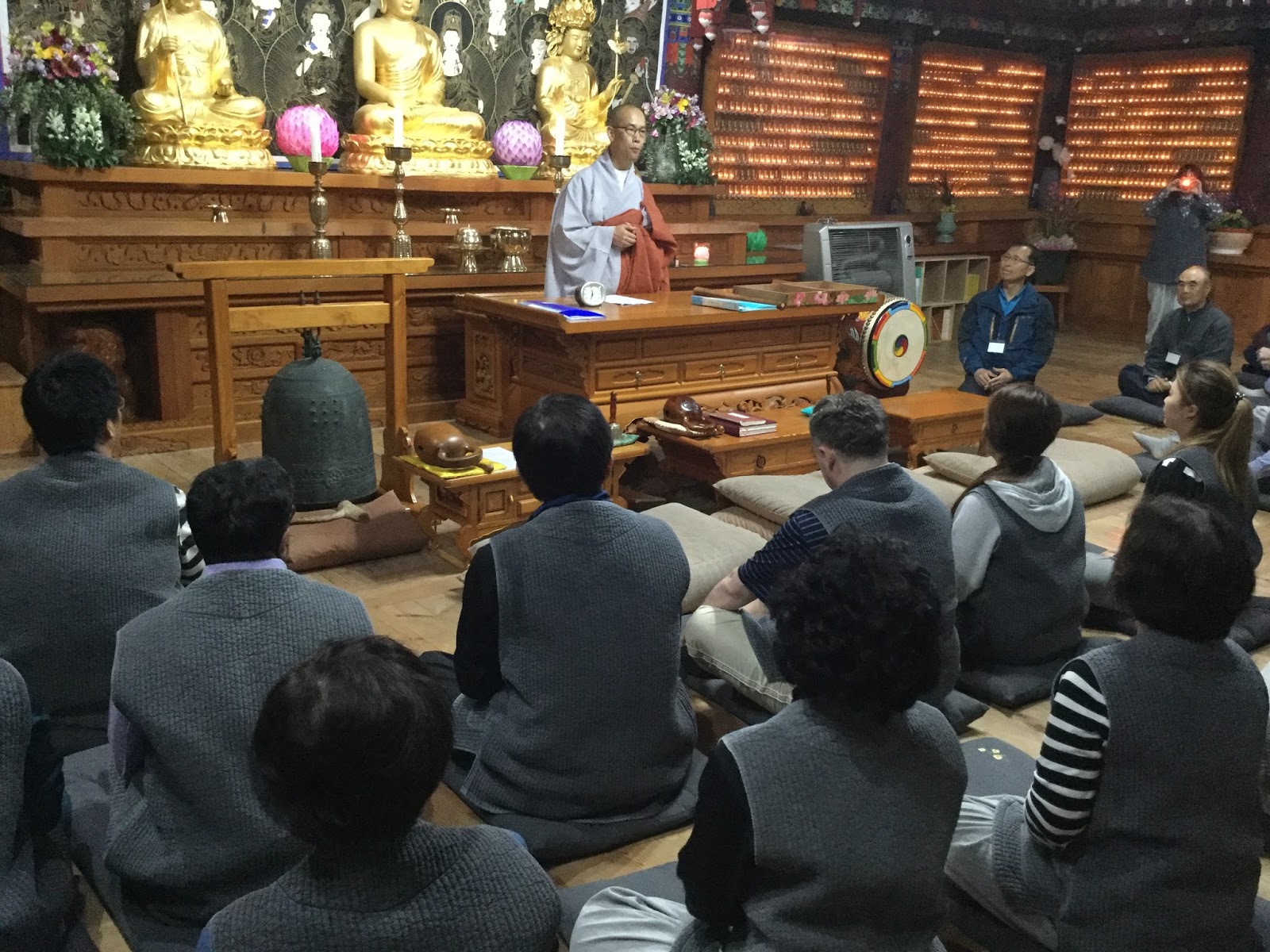
About 35 people participated in the temple-stay offered by Dongguk University Seon Center. As a guess, about half of the people were Buddhist and 11 of us were foreigners (USA, Poland, Brazil, Spain, China, Japan, India).


Amazingly huge! Dragons are the protectors of Korean Buddhism,
but I'd never seen a dragon sitting on the ground before. They're always been portrayed as celestial creatures
of the air as they represent the space between earth and heaven. 
The celestial phoenix also plays a central role in Korean Buddhism.
The blue and the yellow dragons over the Buddha. One day I'll understand the significance of these two colors which invariably play a central part in the Korean temples.
The Buddha of the main hall. I'm not sure if this is the famed medicine Buddha or not.
108 Prostrations

The number of 108 is a number important in Hinduism and Buddhism. The number represents the number of defilements in the mind, or as some look at it, the number of compartments in the mind. Each prostration opens a compartment and clears consciousness, and by bowing the full 108 times, the mind and the body become one. Consciousness is slowly restored this way. As one source says, "Our bowing takes away our karma mind, our thinking mind, and helps us to find our true nature and save all things from suffering". The last part is very disconnected, but ultimately the bowing is supposed to help the individual and the earth keep from suffering. I'll have to think about this. At the moment it makes no sense. Here's another quote related to bowing 108 times:
"The practicer of Buddhism is the never-ending humbling of the ego. Humbling yourself before the world, by lowering your body you realize that you are one with everything. Performing 108 prostrations is yet another path towards the realization of the True Self."

And then a look at the 108 bows as expressed as a mathematical equation:
We have 6 doors of perception: sight, sound, smell, touch, taste and thought.
There are 3 aspects of time: past, present and future.
There are 2 conditions of the heart/mind: pure or impure.
There are 3 possible attitudes: like, dislike and indifference.
Korean Buddhists use this formula 6 x 3 x 2 x 3 = 108 bows to cut through our Karma.
Supposedly temple-stay is about helping people find or restore their True Self. During temple-stay there are three meals (some temples offer only two, but Korean monks really like to eat so the two-meal temples are rare) and three meditations, one of which usually involves prostrating one's self 108 times.

The ceremony begins with the ringing of a large bell inside the main Buddha hall.
The repetitious ringing of the bell is to, as I understand, relieve the sufferers in hell.
Each strike is supposed to offer some relief. The ringing is performed while chanting. 
The head monk then moves in front of the Buddha statue and, while chanting (the lotus sutra?) begins the 108 bows.
At first the rhythm is slow and then it picks up.
Bow to the floor, left foot overlapping right foot slightly, lift hands palm upwards past the ears to lift up prayers or thoughts? Your forehead, elbows and knees (the five points of the body) are to touch the floor simultaneously.


And following the 108 bows when supposedly the mind and body are pure and unified, a Dharma talk is given.

Saturday, March 12, 2016

Comfort Women Issue in Historical Context

Every Wednesday, for the past 24 years, in front of the Japanese Embassy in South Korea, protests have demanded Japan recognize its war crimes, establish an official fact-finding mission, and provide official reparations for the sexual slavery of the Japanese Imperial Army. Last year, Japan and South Korea settled on a “final and irreversible” agreement without consulting the victims. Professor Han, Hong-gu will explore this issue along with South Korea and Japan’s relationship within a historical and political context.

A History of the Sexual Slavery by the Japanese Military

In the words of Professor Han (translation), "In regard to the Korean-Japanese history, it (the comfort woman issue) is very complicated. Korea was more advanced economically and culturally in the 1700s than Japan, but we started to fall behind, which ultimately led to being colonized by Japan."
  • In 1592 Japan attacked (the Imjin War) but after those battles Korea and Japan had peaceful court relations
  • In 1872 a Japanese ship forced the opening of Korea to Japanese trade
  • In 1895 the queen was assassinated by the Japanese
  • In 1905 Korea lost the right to diplomacy. Korea fought against Japanese attempts at colonization. There was a lot of resistance, example, Ahn Jung-geun
Though many might criticize Korea as not fighting the Japanese hard enough to retain their freedom, the feasibility of resistance was very small. Unlike in India where 2,000 Brits controlled the country and in Vietnam where 28,000 French people occupied and controlled that country making resistance virtually impossible, 1,000,000 Japanese were in residence with military might in the Korean peninsula. And because Japan were so proximal to Korea, they could easily send more numbers for settlement and to express authority and power; their control was strong and the Japanese were expanding their empire.

In their occupation, they used assimilation policies. They wanted to treat the Koreans like Japanese with Koreans taking Japanese last names. (This was exceedingly resisted by the Koreans who didn't share the same vision with the Japanese. Very interesting colonization and assimilation attempt because Professor Han knows of no other country that has ever introduced assimilation policies.) Japan did industrialize Korea unlike other countries that had colonies, but their aim was to have a base to control other countries like China and countries in Southeast Asia.

When Japan "invaded" Korea, about 200,000 Korean immigrated between 1900-1945, that is, about 16-17% of the population. This was the largest migration of people in such a short time other than the Irish leaving Ireland because of the potato famine.

In 1919 the last emperor was poisoned and the March First Movement resulted. The emperor's poisoning led the way to more control by the Japanese.

Japan did create elementary schools, thus providing education, and they did improve literacy which was very low within Korea. However, in the 1930s the education became militarized and students were indoctrinated by thoughts like "When the Yankees come, we will crush their heads" and students were drilled to fight, parry and attack with sticks and swords during school hours. Schools became the vehicle for resistance. 

In 1936 손기전 a Korean ran in the Olympics under the Japanese flag. In fury and nationalism, the Japanese flag was erased from his uniform and then published in a Korean newspaper, which was a very bold move, and one that motivated the Japanese to clamp down on publication and enforce tighter control of the "freedom of the press".

About this time Japanese also motivated Koreans to labor in Japan, ex. Kyushu, because their own men were militarized in foreign countries to fight and expand the Japanese nation-empire. (These laborers were later repatriated.)

6-7 years later all of the Koreans incarcerated in the Sodaemun prison and the ones who weren't but who had fought for Korean freedom moved to North Korea and beyond to organize a resistance government outside of the Korean peninsula. These individuals were to remain outside of Korea after the end of WWII so the events of history unfolding didn't really improve after colonial times. Those people who had resisted the Japanese the most were not the ones made governors or given government positions. The ones who fought most for the freedom of the country were not viewed as leaders by the makers of the new republic ... After the Japanese flag came down, the American flag went up. Koreans did not regain their autonomy and right of self-government.


In result, the 38th parallel is one of the cursed indirect heritages left by the Japanese colonial period.

After WWII the 38th parallel was merely marked in roads and people could cross. Every year after the war the 38th parallel became more and more controlled, and ultimately the military patrolled the line, preventing anyone from crossing and closing down all communication between "countries".
After liberation, people had to punish the collaborators so many committees were set up. Ironically, the National Assembly contained people who were part of the punishment committee, but many of those assembly men were also accused of being communists. This pointing of punishment became a way for Japanese collaborators to "regain" power. 550,000 people were investigated, but not even 5,000 Japanese collaborators were investigated.

In 2009 a new form of Korean currency, the 100,000 won bill, much debated and discussed, was to be published. Kim Baek Bom, aka Kim Koo, leader of the provisional government during Japanese colonial period, was determined to be the figurehead for the bill. Kim Baek Bom had assassinated the president of the Korea National Assembly and therefore was a very controversial choice based on one's family and family politics. Why did the 100,000 won bill fail to be published? Because of the new Korean president of the time, Lee Myung Bak (president 2008 - 2013) and his family history; publishing the bill would have been problematic. When Lee Myung Bak became president, only the 50,000 won bill was passed, and very quickly the 100,000 won bill was scrapped.


Present-day Sexual Slavery Issue

At the end of December 2015, supposedly Korea and Japan finally "resolved" the years of controversy over the sexual slavery of Korean women (approximately 200,000) during the latter part of the colonial period. For details, read "Comfort Women Controversy between S. Korea and Japan Ended?" Many problems exist with this dropping of historical conflicts, most of it due to the apology not being public at all but reportedly given only to present president of Korea, Park Guen-hye, who was not a victim, who came from a family of strong Japanese sympathizers, and who has no authority of accepting such an apology, if indeed it did take place.


But how did such an "agreement of resolution" finally come about? The United States and China are in conflict and Korea and Japan are supporters and neighbors in the tension, so the United States wants them to get along and overcome their political historical baggage. Also, Japan really wants to become a permanent member of the United Nations Security Council so to purge themselves of some of their historical conflicts was seen as being in their best interests. The Japanese have never apologized for using the sexual slavery of women or for the Nanjing Massacre. Neither is there any discussion on the topics.


But then the question arises, why did Korea want to eliminate the sexual slavery issue? Park Guen-hye ultimately rushed to a conclusion to facilitate Korea-Japan relations. Prime Minister Shinzo Abe is said to have called Park Guen-hye to apologize but only she heard this apology, but it is pointed out that "Park Guen-hye, daughter of dictator Park Chung-hee who also had a shameful career as a Japanese officer during the colonial period, wanted to throw away the burdensome image of a daughter of a pro-Japanese collaborator." Koreans want to hear the apology. Even the Japanese Parliament asked for a public apology but this was rejected. The questions remains: Does Park Guen-hye have the right to accept such an apology on behalf of the grandmothers who have never heard the apology?

A North Korean former comfort women became a witness at a tribunal and told who was who in this very iconic picture of young girls in a "comfort women" station. She also said that the baby was born but passed away.
Kim Hak-soon became the first former "comfort woman" to testify; her testimony came out in 1991, 46 years after the close of World War II. Why did it take so long? Many reasons. One being, in the case of the Holocaust, ALL Jews were victims so this could be an issue for open discussion. In the case of sexual slavery in Korea, the victims were poor rural daughters and loss of virginity was further blamed on women not men despite the reason for the loss, not to mention that the Korean society was patriarchal and women/daughters were not considered as important as men/sons. After WWII and then after the Korean War, Korea needed to focus on rebuilding the structure of the country; social issues were given little regard.

To support Kim Hak-soon, a Dutch former "comfort woman" came out also in order to support her, to give solidarity, and because she knew that an Asian wouldn't get the same attention as a "white" in regard to tribunal committees and forms of reparations and punishments. It is estimated that about 80% of all comfort women were Korean, and that guestimations of Korean comfort women range from 40,000 - 200,000; the latter does not seem to be a stretch of the truth.


The above picture of a military man dressed up in US military clothing with four comfort women is from the US National archives. Lots of information was made by the US military when they came across the comfort women stations. Why does the US have such notes? Because they noticed the Japanese fought to the death, absolutely, so they started documenting data about the Japanese. They noticed houses with women (as they took over territory) so they documented extensively about the women. This shows that the US military was very aware of the comfort women who were allegedly forced to serve the Japanese military, yet they the US remained silent. They therefore share some responsibility on not bringing this issue to the public or introducing it in the trials of Japanese soldiers after the war.


Most people focus on the issue as young girls being forced into sexual slavery, but the real focus should be on why the government implemented such a practice, supported it, and of course forced young women to participate. 

A Japanese picture labeled "The virgin girls" - In the back row are teenage girls and some in their 20s,
five and six-year-olds are in the front row. 
The caption reads, "When the war heroes come back from the war,
the girls will provide the best for them."
Maintaining comfort women and comfort stations isn't just an issue of nationalism with Koreans demanding apologies from Japan. Korean army documentation shows that the Korean military likewise maintained sexual stations for their men. "War History on the War Front" (1956) published by the Korean Army documents Koreans having comfort stations too. The book shows only four places were Korean comfort stations were (but there were more). In the book 89 women were listed serving 204,580 men. This was the number of Korean soldiers at the time. 

Professor Han cradling the book, "War History on the War Front" (1965)
In "War History on the War Front" is documentation of the number of men in the army at that time
and documentation of four comfort stations used by the Korean army.
Sexual slavery wasn't only limited to Japanese soldiers. Korean generals were collaborators with Japanese and they were the ones who authorized the sex slavery for the Korean army.

There was also a sexual slavery for the UN army at the time but statistics haven't been found as yet.

In 1965 an issue of normalization of slavery became an international discussion; however, the sexual slavery issue in regard to Japan wasn't brought up because the Korean government had their own sexual slavery, and at the time Korean soldiers were sent to Vietnam and sexual slaves went along to accompany and "accommodate" them.


In the 1970s the Korean government had a cleaning campaign for the military base area (because of STDs). In the US military about 1,000 US soldiers and about 700 Korean soldiers had STDs. 

"Monkey" House (which later became a documentary) was a detainment house for women who had STDs. The house functioned from the 1970s to 2003. There was a "joke" that if you worked (not as a female) at the Monkey House, you would become rich and be able to buy an elaborate house within two years because pimps would come around and want their girls out so bribes to get them released were lucrative and frequent.

Though women were not termed comfort women and were paid, albeit a very marginal amount, they functioned sexually for the military. Military prostitution became a part of US military bases, not within the base grounds but just outside the encampment so as not to be "officially" military operated. However, such operations did occur. American Town was a house opened 24 hours a day and served about 1,000 US soldiers. It was operated by a high-up official from the KCIA (2nd or 3rd in command). Officials told the women working there, "You are a safety net for keeping the US military men happy." From the 1950s to 1960s the revenue made by the women serving the US military men was 10% of South Korea's Grose National Product. 

Former prostitute for the American military speaks out and writes a book
on American Town where she did sexual work.
Military camps in South Korea are still set up with red-light districts around, and the women working in them were euphemistically called 양공주 (Western or Yankee princess). It is said that the South Korean and US government collude on providing sexual entertainment facilities for the US military men serving in South Korea; former prostitutes testify against both governments. 

For so many reasons, the comfort women issue has not gotten the sharp focus and attention of the South Korean government as well as international backing to achieve an apology and war crime reparations. Though an "apology" is said to have been given and received, politics has shaped and continues to shape how "noisy" the governments want to be, or don't want to be, on the politically and economically driven issue that seems to mask the social aspect.

In "apologizing" to Park Geun-hye, one of the demands of the Japanese government for giving apology is the removal of the controversial comfort woman sculpture in front of the Japanese embassy. Many such images exist in South Korea and they, according to the terms of the apology, are all to be removed. Activists stay 24/7 with the sculpture. They say it will not be removed until a real apology is forth-coming. The former comfort women have gathered every Wednesday for 24 years now. They have protested more than 1,200 times. Never during this time has a Japanese ambassador come to see, to talk, to listen, or to apologize. There doesn't seem to be a formal, public apology forthcoming and the activists will continue to demand recognition and apology indefinitely until it does.

Sunday, January 3, 2016

Changing of the Guards, Gyeongbokgung

History of the Royal Guard Changing Ceremonies (수문장 교대의식)

Since 1469 and through the Joseon Dynasty, royal guards, who were known as the "Wanggung Sumunjang", conducted a Changing of the Guards ceremony as they stood to defend the gates of the main palace where the king resided and from where he ruled the country. During the Joseon Dynasty, the royal guards were responsible for guarding and patrolling the gates of the capital city and all of the royal palace(s). They were in charge of opening and closing the palace gates, inspecting all visitors, and maintaining a close surveillance of the palace. They were divided into day and night shifts, and the Changing of the Guard ceremony took place whenever the shifts switched. 

In the early period of the Joseon Dynasty, the Changing of the Guard ceremony was conducted at Gyeongbokgung (Palace) as at that time Gyeongbokgung was the primary royal palace and the king then resided there. However, in the mid-Joseon Dynasty during the Imjin Waeran (Japanese Invasions of 1592 - 1598) when Gyeongbokgung was burned down, Deoksugung was made the primary royal palace and the Changing of the Guard ceremony was then conducted at Deoksugung. See Changing of the Royal Guard at Deoksugung (Palace).

Reenactment of the Ceremony

The reenactment of the original ceremony began in 1996. After some extensive historical research, this colorful traditional Korean royal court ceremony has become a must-see among Seoul's tourist attractions. This ceremony is supposedly enacted exactly as it used to be held -- with guards wearing royal uniforms, carrying traditional weapons and playing traditional instruments. The guards serve their sentry, perform the changing of the guards ceremony and hold a parade following strict ceremonial procedures as based on historical texts.

The Korean government proudly markets the tradition and compares it to the Changing of the Guards ceremony at Buckingham Palace. The ceremony takes place three times a day (except for Tuesdays) from 10 a.m. to 3 p.m. in front of Gwanghwamun, the main gate of Gyeongbokgung.

Ceremony Procedure
  1. The first drumbeat signal sounds and the relieving guard unit mobilizes towards Gwanghwamun Gate. 
  2. The second drumbeat signal sounds and the relieving guard unit moves outside of Gwanghwamun Gate, and the chief of the relieving guard unit and the chief of the guard unit on duty perform an identification check.
  3. The chief of the relieving guard unit orders his unit to take their positions at the gate and the relieved guard unit mobilizes to the inside of the gate.
  4. The third drumbeat signal sounds and the chief of the relieved guard unit orders his unit to exit the vicinity.
Ceremony Participants
Sumungun : ..... Position: Keeper of the Royal Palace Gates
..... Duty: Responsible for guarding the palace gates
Sumunjang :..... Position: Chief Keeper of the Royal Palace Gates
..... Duty: In charge of guarding the palace gates and commanding the SumungunSujongjang :..... Position: Deputy Keeper of the Royal Palace Gates
..... Duty: Daejonggo (Management of Large Bells and Drums)
Jongsagwan :..... Position: Lieutenant to the Chief Keeper
..... Duty: Assistance to the Chief Keeper, and management of the gate book
Gapsa :..... Position: Armed Guardsman
..... Duty: Guarding the palace gate
Jeongbyeong :..... Position: Regular Guard
..... Duty: Private soldier of the Joseon's central army
Daejol :..... Position: Subordinate Soldier
..... Duty: Sentry of the palace gate
Jeollugun :..... Position: Jeollugun..... Duty: Delivery of time for the royal court
Chwita : ..... Position: Military Band Musician
..... Duty: Member of a royal military band
Captain of the guards has central position and its his position that all the other guards pay attention to and take cues from as to position and movement. It seems he must always be aligned in the central position of the central gate, the gate that only the king can enter (and therefore it's symbolically blocked off in this picture).
The new captain of the guard comes in with his identical cohort of guards dressed exactly the same as those still on duty. A difference seems to be some changes in the flag the two separate guard cohorts fly.
Inspection of the guards -- on duty and going-on duty
The two captains of the guard greet each other.
Not shown, they simultaneously show each other their authorization passbooks.
All this is done under the supervision of guard in the blue sash, who seems to be the overseer of protocol.
After recognizing each other as being official guards, they bow to one another, and then the guardsmen assigned to each other them begin to shift positions of authority.
Shifting the guards teams as noted by the shift in flag colors.
The shift has almost taken place, every step conducted by proper protocol.
The protocol-overseer goes with the captain of the guard and rings his bell as the captain checks on the position and dress correctness of each of his guards. Each person checked gets a ringing of the little bell.
Oddly enough, very few of the "guards" guarding the palace gates are armed with anything beyond their swords.
In fact, only four are armed with cross-bows and swords, which means that most of the expected attack would be frontal and with close proxemics.
Once correct protocol has been completed, the former guards are permitted to retire.

Modified from the original texts: