Showing posts with label biographies. Show all posts

Wednesday, December 25, 2019

Songs of the Dragons

Songs of the Dragons Flying to Heaven, translated by James Hoyt (1979), was a compilation of 125 cantos compiled to establish the legitimacy of King Sejong's lineage. King Sejong (1397-1450), 4th king of the Joseon Dynasty (1392-1910) ordered the compilation to extol the merits of the Yi (Lee) lineage in the new dynasty, and printed the compilation with the newly-made hangeul script made for all people of the nation to easily read. Songs of the Dragons was the first book to be printed in Sejong's new "alphabet".  


Three Reasons for the Compilation

(1) Extolling the great accomplishments of the six generation of founders of the new Yi, or Chosun/Joseon Dynasty. The heroic actions of the Six Ancestors are compared to the flights of dragons symbolic of the throne, hence the title of the work. Of the Six Ancestors, only two actually sat on the throne of Korea. The other four generations of the House, preceding the establishment of the dynasty, are designated as chamnyong, or "submerged dragons," and their residences as chamjo, or "submerged palaces," after Chinese usage. [When Yi Seong-gye took the throne, he had to justify through ancestry that he was eligible for the throne. Ancestry was of need traceable back by at least four generations; thus, when Yi Seong-gye established his Dynasty, he brought with him the bones of his four primary ancestors.]
  • The ancestors of the Yi family lived in Jeonju, Jeolla-do, and their prominence dates from Mokcho (Yi An-sa, d. 1274), the First Ancestor, who served the Goryeo Dynasty (918-1392) in various capacities in a number of provinces. Mokcho's descendant in the fourth generation, Yi Seong-gye, became King Taejo, the founder of the Yi Dynasty after overthrowing the Goryeo Dynasty.
  • The Second Ancestor, Ikcho (Yi Haeng-ni), was noted for his difficulties with the Jurchen tribesmen in the North.
  • The Third Ancestor, Tojo (Yi Ch'un, e. 1342), a skillful bowman.
  • The Fourth Ancestor, Hwanjo (Yi Cha-ch'un, 1315-1361), based the growing power of his family on the imminent collapse of the Mongol empire in China (1368) and the concomitant weakening of the Mongolized dynasty of Korea.
  • The Fifth Ancestor, Taejo (Yi Seong-gye, 1335-1408), wielding military power as a result of his expeditions against both the Jurchen tribesmen and Japanese freebooters and for espousing a program of land reform and alliance with the Ming, he established himself as king and ruled until his abdication in 1398.
  • Chongjo, an ineffectual son of Taejo and who was a caretaker-king during a period of rivalry over succession (1399-1400), does not merit qualification to be listed as one of the Ancestors of the dynasty.
  • The Sixth Ancestor, Taejong (1401-1418), completed the work of establishing a firm dynasty, which would last until 1910.
First four kings of the Yi/Lee Dynasty / Joseon Dynasty:
  1.   Fifth Ancestor: Taejo (r. 1392-1398)
  2.   Jeongjong (1398-1400)
  3.   Sixth Ancestor: Taejong (1400-1418)
  4.   The Great King Sejong (1418-1450)

(2) Providing inspiration for King Sejong and subsequent kings on the Yi line by recalling the vicissitudes and tenacity of the Six Ancestors. No less than 15 of the 125 cantos end with the hortatory refrain, "Let Your Majesty not forget this!"

(3) Proclaiming to the world that the accession of the Yi family to power was in accordance with the Chinese concept of the Mandate of Heaven. This concept of the Mandate of Heaven is an ancient one, formulated by Tun Chung-shu (2nd century BC), who declared that when a ruler commits unjust acts, Heaven shows its displeasure by such calamities as earthquakes, famines, and floods. If these warnings are not heeded, Heaven seeks to admonish rulers by means of such portents as eclipses and comets. If these are not needed, the ruler loses the Mandate, and Heaven selects another to mount the throne. The attainment of the Mandate of Heaven's divine plan is the much repeated theme of Songs of the Dragons Flying to Heaven, and the word "Heaven" in the title refers to Heavenly favors bestowed upon the six heroes. The writing of the work is, in short, a written legitimization of the Yi rule.

CONTENTS

All of the cantos are focused on the assertion that the Six Ancestors have the favor of Heaven. The earlier cantos speak of the exploits of the first four Ancestors, aiming to support the Fifth Ancestor Taejo, who took the throne. The cantos XXVII to XCV (68 or 54% of the cantos!) were of the exploits of King Taejo, how mighty he was and how he repeatedly saved the country through his valorous deeds in battle or in the hunt. No cantos were given to Jeongjong (1398-1400), the ineffectual son of Taejo who ruled briefly during a period of political instability and fighting for the throne. Cantos XCVII to CIX (13 cantos) were dedicated to the Sixth Ancestor, Taejong (1400-1418). Those 13 cantos primarily reflected the time of instability and mostly sang of assassination plots and recognition of loyalty. Cantos CX to the end of the songs, Canto CXXV, sang of the merits and righteousness of the Great King Sejong, the Sixth Ancestor. These cantos were a series of admonishments. Admonishments:
  • to not forget the hardships of his Ancestors and to be steadfast in purpose
  • to not forget the contrast between the magnificence of his palace and the crudeness of his Ancestor's shelter
  • to not forget the contrast of his embroidered belt of office with the crude armor of his Ancestors
  • to not forget his Ancestor's hunger as he dines of the finest of food and richest of drinks
  • to not forget his Ancestor's fierce battles as he presides over a brilliant and peaceful court
  • to rule with clemency, an important quality of kingship
  • to have compassion
  • to be humble lest he become a tool of conniving ministers
  • to act in a manner befitting a king
  • to overcome with benevolence the plot of evil ones
  • to maintain a strong economic basis for the state
  • to be forgiving to his advisors as was Taejong
  • to respect scholarship and beware of trouble-makers
  • to evade slander mongers and those who embroider the truth
  • to despise Buddhism and revere Confucianism
  • to emulate the Flying Dragons
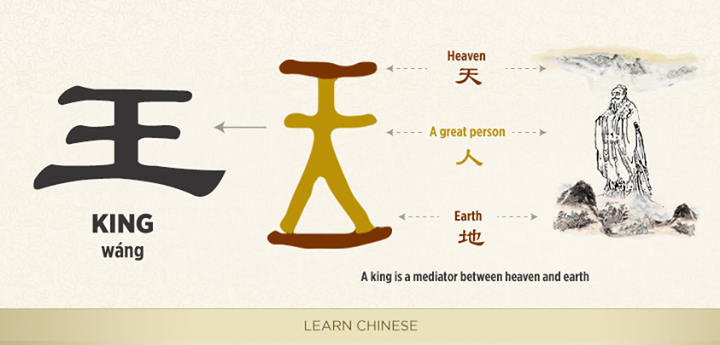
Opening canto - the opening assertion of the Six Ancestors aka dragons flying in the Heavens, the symbolic statement that the Heavens validates their auspicious right to be elevated above men and below the space of universe authority. Reference the meaning of "king" in Chinese character.
meaning of the Chinese character "wang" or "king"
King Taejo, found of the Yi Dynasty, is valorous in war and in the hunt. He is powerful, righteous, blest by the Heavens, and therefore deserves the role of king and ruler/caretaker of the nation.
The last canto, the canto that affirms King Sejong, the fourth king of the dynasty, as the right to continue to rule, as based on the righteous foundation of the Six Ancestors.
Final Comments

Songs of the Dragons was the first book to be printed in the newly developed hangeul writing. Printing was executed with wooden block in October 1447, about two years after its compilation, and 550 copies were presented to various ministers. The editions that are presently extant include those printed in 1612, 1659 and 1735.

The compilation is now recognized as a monument to the cultural independence of Korea from China, a most important source for the study of the Korean language, and the beginning of Korean national consciousness and of vernacular literature.

For more information regarding the translation, reference a 1977 JSTOR preview of the book, by Peter H. Lee. 

Thursday, October 3, 2019

Father of 1,000: Korean War Orphans

Russell Blaisdell, a chaplain colonel in the US Air Force during the Korean War is attributed for saving nearly a thousand children orphaned during the horrific war. Approximately 37,000 US soldiers died in the war, compared with the estimated 2 million civilian deaths in North and South Korea. The children of the streets were casualties of another kind, living while their parents died, but dying because they didn't know how to live.

Russell Blaisdell, assigned as a chaplain to oversee the other chaplains in the US Air Force along with Chaplain "Wally" Wolverton, already in Korea when Russell got there, were the first two US Air Force chaplains with no others imminently scheduled to arrive. Having no specific office, place to sleep and at lose ends about overseeing chaplains that weren't in Korea yet, Russell started dedicating his great energy to helping the children who crawled from make-shift shelters, who chased after American trucks begging and who were tattered and shell-shocked. Along with Wally and sergeant Mike Strang they drove their assigned jeep around, scooping up orphans and transporting them to various care shelters staffed by Korean volunteers. Care of course was easier to provide than food, a war was going on, so Russell would ask servicemen for contributions, and many willingly gave, some giving as much as 50% of their pay! 

Russell's mission to help the orphans didn't really get started until after US and Korean forces were able to retake Seoul after its capture early in the war. The shock of seeing orphans, and so many of them, crying on the streets or crawling in rice bags to die, fueled Russell's energy to help in any way he could. He had already seen orphans throughout the country, but none were as miserable and destitute as those in Seoul. Children were everywhere. Many had parents who had been buried in mass graves -- the bodies of soldiers, priests, government workers were killed when the North Korean stormed Seoul, and all orphans seen by the North Koreans were killed too. And he knew that if/when the North Koreans returned, these orphans would stand no chance. Yet, Russell was surprised at the fight for survival in many so young, and Wally, Russell, and sergeant Mike Strang started organizing places for the orphans to regularly receive help. That is, until for health reasons Wally had to suddenly return to the States. 

Russell and Mike were then alone to organize the removal of the 1,000 orphans they had scattered in various care centers, and the North Koreans were coming back, and this time with Chinese soldiers as allies. Time was important. Evacuation was underway, but how to transport 1,000 orphans and their care-givers?!?! 

Russell frantically contacted various departments, offices, and repeatedly, but there was priority on soldiers and supplies. People were very compassionate, many had helped contribute money, the motor brigade had been most helpful and were always on the lookout for orphans, but there was just no space for 1,000 orphans as troops were ordered out of Seoul in limited transport trucks packed with artillery, soldiers and essentials. Russell was frantic. He could have evacuated with the others, and as a colonel that was totally acceptable and expected, but he chose to remain with the orphans and pray, while running to other departments to ask for assistance.

Kids of the Korean War: Father of a Thousand
Finally he was assigned a boat! A boat that would transport the children to Jeju island. The fortune of a boat as transport would be cold and most miserable for the smallest children, but transport is transport. Yet, when he saw the battered scow that couldn't possibly hold even 100 and even less in the winter sea, he adamantly refused to put a single soul on.

When almost everyone had evacuated, Russell, frantically running around without sleep for five days, went one last time to the Air Force headquarters to make an appeal. Seeing an Air Force Colonel, he ran up to him, unshaven and wild-eyed, and began to blather, "I'm in trouble, I'm in trouble and I need some help." Air Force Colonel T. C. Rogers listened to Russell, pulled out his operations manual and placed a call. Then to Russell he said, "It just so happens that I have a wing of C-54s that have just landed in Japan from the States, and they don't have a mission. If you get those kids to Kimpo Airport by 0800 tomorrow morning, we'll get them to Jeju." 

Russell said he would and rushed back to Incheon where the kids had already been transported over a three-day span of time. He had less than 24 hours to transport the kids 28 miles without trucks over pitted, bombed roads back to Seoul, a task that had taken 3 days just a few days prior. He knew he had to do it! His opportunity came at 0500 when a transport vehicles loaded cement onto a scow. Pulling rank on the drivers, he ordered them to transport the kids to Kimpo. They were not happy, but rank is to be respected. Transport commenced, and suddenly an apoplectic high-ranking colonel drove up screaming, "What are you doing with my trucks?" When he heard that they were being used to transport 1,000 orphans for their chance of hope, the colonel gladly gave Russell permission to commence the evacuation.

The C-54s stayed on the snowy tarmac until 1000 when the children were delivered to the planes for transport. The orphan rescue operation became known as "Operation Kiddy Car", and reading about the children in newspapers and magazines, people in the US began sending donations and supplies. Ms. Hwang Oh-Soon, a woman already with 11 years experience at running an orphanage, became the new director, and a very capable one at that. She organized the kids, cleaned them up, and when Russell returned for a brief visit to Jeju in August 1951 (his tour had completed three months prior), Russell Blaisdell was greeted with a large banner held by the children, thanking him. He was proud to say he saw the beginning of smiles on the resilient faces of many of the orphans.

On January 26, 2001 Russell Blaisdell returned to Korea to reconnect with Ms Hwang Oh-Soon, who was still alive at 102 and still the director at the orphanage [The Orphans Home of Korea, Kyounggi-do] that had been relocated near the capital after the war. She and a cloud of orphans from Operation Kiddy Car met with Russell, age 90. Many orphans gathered also to meet, greet and personally thank Russell for giving them the gift of life, for without being transported to Jeju, the 1,000 orphans and their caretakers as well would have a had a very slim chance to surviving the coming North Korean invasion. It was a touching reunion, and a time or reminiscing and sharing.

--------------------------------------------------

[YouTube] "Arirang Prime-Blaisdell′s Operation Kiddy Car Airlift 브레이즈델 대령의 유모차 수송작전" (15:29)

When Russell first arrived in Seoul after pushing the North Koreans back in 1950, he estimated 6,000 orphans on the street. After the war ended in stalemate in 1953, 54,000 children were officially registered in orphanages, the youngest too young to remember their own names, let alone their parents' names, hometown or birthdays.

Wednesday, September 4, 2019

Esther Park, First Female Medical Doctor in Korea

Kim Jeom-dong (Esther Park), 1879-1910, Paving the Way for Women

Today, it is natural to see a doctor when we are sick, like when we catch a cold. Until 100 years ago, however, when Western medicine was first introduced to Korea, Western doctors were considered scary people who wielded injection needles and knives. 

For women, the situation was even worse. Women patients could hardly let male doctors feel their pulse for diagnosis, and they would never show the ailing parts of their body due to a strict separation of the sexes fixed in Confucian orthodoxy. When women fell sick, they would simply perform shamanic exorcism several times, only to die. 

In those days, there was a medical doctor who was devoted to women patients. Her name was Kim Jeom-dong, the first female practitioner of Western medicine in Korea. 


Ewha Student Kim Jeom-dong Dreams of Becoming a Doctor 


Born in 1879 in Jeong-dong, Seoul, Kim Jeom-dong entered Ewha School, the first modern educational institution for Korean women, in November 1886. 

She was the youngest of four daughters in a poor family. But she became the fourth student at the school, thanks to her father who had been exposed to Western ideas earlier while working for American missionary Henry Gerhard Appenzeller. In school, she quickly mastered various subjects, including the Korean [English?] language, arithmetic, the Bible and Chinese classics. 

Kim was particularly good at English. Her outstanding language skills led to an encounter with Rosetta Sherwood Hall, an American doctor who came to Korea for medical service missions. Mary Fletcher Benton Scranton, then-principal of Ewha School, introduced Kim to Hall as an interpreter so Hall could better communicate with Korean people while engaging in medical activities. That was how Kim was first exposed to Western medicine. At first, she wasn’t interested in medical work very much and only carried out her duties faithfully as an interpreter. But her life completely changed after she witnessed Hall successfully performing an operation on a patient with a harelip, leaving no scars at all. 

At the time, harelip was known as an incurable disease. But the surgery changed the life of a girl who would otherwise live uncomfortably for her entire lifetime. Deeply impressed, Kim made up her mind to learn medicine and help people suffering from diseases. 


From Kim Jeom-dong to Esther Park 


Hall welcomed Kim’s decision. She helped her study medicine and also introduced a man to her. He was Park Yu-san, a Korean man who helped Hall’s husband with his missionary work and medical activities. The missionary couple arranged a marriage between Kim and Park, and they held Korea’s first Western-style wedding ceremony in a church in 1893. 

From then on, Kim began to call herself Esther Park, after her Christian name and her husband’s surname. The following year, Esther and her husband left for the U.S. to study, following Rosetta Sherwood Hall who was returning home after her husband died. Esther stood out in high school in the U.S. and became the youngest student to enter Baltimore Women’s Medical College.

Her husband, who recognized her talent and hoped that she would become a doctor, supported her while working at a farm in New York. Unfortunately, he did not survive to see his wife become a doctor, as he died of tuberculosis in the U.S., six months before Esther graduated from college. 


In Esther Park's time treatments of illnesses were often based on superstition rather than scientific fact.


Fighting God, Fighting Diseases 

Esther earned her M.D. in June 1900, becoming the first Korean woman to receive a degree in Western medicine. Remembering her husband’s last wish that she should become a doctor, she returned to Korea and began to work at Bogu Yeogwan, the forerunner of today’s Ewha Womans University Medical Center, Korea’s first hospital for women, located near Dongdaemun. The hospital was named by King Gojong. For the first ten months, she took care of some 3,000 patients. 

Female doctor Esther Park was the only hope for women patients who couldn’t get proper treatment, as they weren’t allowed to show their bodies to male doctors. She went everywhere in the country, as long as there were women patients waiting for her. She moved to Pyongyang in 1901 when Rosetta Sherwood Hall came back to Korea and established a hospital there. Esther traveled across Hwanghae and Pyongan Provinces to offer free medical services to women who couldn’t benefit from medical care due to their remoteness. In recognition of her service, King Gojong presented a silver medal to her. 

While she was enthusiastic about her medical volunteer work, one thing was missing in her life. She was so busy looking after patients that she didn’t take care of herself very well. She died of tuberculosis, just like her husband, in 1910 at the age of 33. 

Esther Park was like a ray of sunshine in those days when there wasn’t any female medical staff whatsoever. At the time, it was hard for women even to attend school. But Esther went to the U.S. to study and after returning home, she devoted her life to medical services and social work. It would be fair to say she is called the female Schweitzer of Korea. Her spirit and achievements were reevaluated by the later generations, and she was inscribed at the Korea Science and Technology Hall of Fame in 2006.

The Esther Park Award was established in 2008 by the alumnae committee of Ewha School of Medicine to commemorate Park’s achievements and award Ewha alumnae who carry on the legacy of Park as women doctors and scientists. 

_______________________________________________________________

References:
  • PowerPoint slides by Min Seong Jin, student at Korea University 

Tuesday, April 16, 2019

Hanok: Traditional Residence Architecture in Seoul

Among the fine traditional Korean houses which have been transported from elsewhere to form the Namsangol Hanok Village, at the foot of Namsan, stands a house built by master craftsman Lee Seung-eop. The house originally stood in Samgak-dong, next to Gwangyo Bridge over Cheonggyecheon stream, but in the course of development and redevelopment, the house recognized as a fine specimen of middle-class architecture, was dismantled and reconstructed in a collection of other hanok to create the Namsangol Hanok Village. The house was originally known as 'Hongmun (Red Gate) Seot-gol (Standing Town), Ibyeokdong-daek (residence of Ibyeokdong)'.

This remarkably fine house with unusual embellishments was built for his own use by Lee Seung-up, the master builder who worked on rebuilding Gyeongbok Palace in the latter half of the 19th century. Gyeongbok Palace, which had fallen into disrepair over many decades, was ordered to be restored by Heungseon Daewongun (1820-1899), the father who ruled in stead of young King Kojong (1852-1919).

Approximately a decade after master carpenter Lee Seung-eop constructed this house, he encountered financial hardships and was forced to sell, whereupon in 1889 the yangban grandfather (Kyoungju Lee clan) of Lee Sang-oak, our tour guide but of no direct relationship to builder Lee, purchased the house. Three generations of Lee (Yi) lived in the house: Yi Chaeyun (1837-1917), Yi Chong'ik (1889-1966), and Yi Yong'u (1917 - ??? [the book was published in 1998]). 

Lee Sang-oak, our guide, was born in this house, as were his two sisters and elder brother. He lived there until 1964 (he was about 20) when the house was sold to P'unghan Company and remodeled. From 1970 - 1996 Cho Heung Bank used the residence as a small bank museum. During that time, in 1977, Seoul city government designated the residence as City Cultural Asset No. 20. And finally in 1996, the house was sold to the City of Seoul along with four other residences around the city and all five were relocated to the north side of Namsan with the intent of making a park for the preservation of traditional architecture.

Guide Lee Sang-Oak told us stories of his growing up, the foods and cultural events enjoyed by the family, the symbolism and in particular the pungsujiri (geomantic principles) employed in the architecture, and other insights about the construction of the home, its impact on King Kojong (story later!), and details about personal life. Whoever really considers the stories the walls can tell if someone is willing to patiently listen!


Dr. Lee Sang-Oak and Brother Anthony, friends that go way back, explaining the topography of Seoul and why the original location of his house was so propitious. Located in front of the "Red Gate" entrance to his former house/courtyard.

Dr Lee Sang-Oak explaining the functions of the various parts of the house ... and how they were originally, and then after "renovation". Basically, as one historian puts it, "the city butchered his house". To give examples, brick walls are now plastered, whitewashed walls, the ondol passageways are minuscule and nonfunctional now, the traditional three-steps leading to the house were reduced to the convenient one. [Three steps up meant as a person approached house of prestige or standing, the visitor had to look up and be struck by the grandeur created by height.
Evidently the Namsangol Falconer's Organization has an operator here. There was always a stream of kids around the guy with his kestrel and his falcon. He didn't mind if people touched the larger bird either ... and the bird didn't seem to mind either!
For W5,000 a person could have the kestrel fly and land on his or her hand.
Petting was encouraged!


"Commercial" over, now back to Dr. Lee Sang-Oak. Dr. Lee showed up the geomantic symbols. The whole house had symbols hidden on walls, corners. roof beams, and more.


Pungsujiri (geomatric symbols here): the inverted swastika for Buddhistic thought, bats, trigrams like those found on the Korean flag (each trigram represents a humor: earth, air, etc), clouds, patterned windows for well wishes, ...
 

Originally this was the men's residence and was just a single room. Now it's divided into guest residence rooms for privacy.


Even the bird looks at the woman in hanbok gliding around the grounds.

A bit of entertainment for the foreigners and kids who visit the hanok village: "Walk Like a Yangban". Walking like a yangban was to walk confidently (thus, the wide appearing tiles for "authentic" practice),

The Red Moon Gate, the single entrance to the house: Originally the gate stood tall and proud like this one. What's interesting is that when there were no high-rises, King Kojong could look out of Gyeongbokgung and see ... the Red Moon Gate, and supposedly, discomfited he asked, "Whose gate is that?" And once he found out ... the Lee family was asked, which means told, to lower the gate so that King Kojong wouldn't see a gate taller than himself in the near distance. Of course they lowered the house ... and had to bend way down in order to enter, which conveyed indirectly humility to the king.

A spring look at Dr. Lee's former residence.
____________________________________________________________________

About our guide and the author of the book on his first home:
Book: A Traditional Residential Architecture in Seoul: A Study of the Yi Byeokdong Residence of Hongmun-dong (1998), Hollym University Press.

Sang-Oak Lee earned his B.A. and M.A. from Seoul National University, an additional M.A. from the University of Illinois, and a Ph.D. in Linguistics with a doctoral fellowship from Harvard University. He is now an emeritus professor at Seoul National University, where he was for many years a professor in the Department of Korean Language and Literature.
___________________________________________________________

The essentials about the house -- from Dr. Lee Sang-Oak's book (pp 10-13).


Wednesday, September 5, 2018

Staff Sergeant Reckless, Korean War Horse Veteran

The undulating hills with white picket fences setting off groomed green fields where large, small, solid, pintoed and various colored horses graze and trot beckoned me. The Kentucky Horse Park, on the northern outskirts of Lexington, is a park, museum, show rink, horse garden and final resting place for highly commemorated horses. It's one of the most highly esteemed places that lauds derby, triple-crown winners and other horse race challengers, past and present, and I knew I would see statues of some of the most famous horses in American racing history: Man O' War (the most famous Thoroughbred race horse of the 20th century) and some of his offspring including Triple Crown winner War Admiral (who Seabiscuit challenged and triumphed over in the famous 1938 race).

Other famous horses buried at the park are memorialized at the park's Hall of Champions: 
  • Thoroughbreds Forego, Bold Forbes, John Henry, Alysheba and Kona Gold
  • Standardbreds Rambling Willie and Cam Fella
  • Saddlebred show horses CH Imperator, CH Sky Watch and CH Gypsy Supreme
  • Quarter Horse racehorses Sgt. Pepper Feature and Tailor Fit
  • the great European race mare Allez France
  • European Steeplechaser Jay Trump
  • ... and more 

Wandering around the sculpted gardens with horse statuary everywhere, the highlight statue for me wasn't a racehorse winner, but the Korean war horse-veteran: 

Staff Sergeant Reckless (1948-1968)
"The spirit of her loneliness and her loyalty, in spite of the danger, was something else to behold. Hurting. Determined. And alone. That's the image I have imprinted in my head and heart forever." — Sergeant Harold Wadley, USMC

Staff Sergeant Reckless served valiantly with the United States Marine Corps in the Korean War. During the pivotal five-day Battle of Outpost Vegas in late March 1953, she made 51 round-trips in a single day — most of them solo — from the Ammunition Supply Point to the firing sites. She carried 386 rounds of ammunition totaling more than 9,000 pounds, and walked over 35 miles, through open rice paddies and up steep mountains, as enemy fire exploded at the rate of 500 rounds per minute.

Reckless provided a shield for front-line Marines, carried the wounded to safety, and was wounded twice. But she never quit until the mission was complete. She wasn't a horse  —  she was a Marine!

Staff Sergeant Reckless is buried at the Stepp Stables, MCG Camp Pendleton, CA, where she spent her final years before he death in 1968.

Military Decorations:
  • Two Purple Hearts
  • Marine Corps Good Conduct Medal
  • Presidential Unit Citation
  • Navy Unit Commendation
  • National Defense Service Medal
  • United Nations Service Medal — Korea
  • Korean Service Medal with 3 Stars
  • Republic of Korea Presidential Unit Citation
  • PDSA Dickin Medal
For a better understanding of the indomitable and 19-gun-saluted Reckless, watch the YouTube clip Sgt Reckless - Korean War Horse Hero (3:36).

Wednesday, November 1, 2017

Kim Jong Un, NK leader's maternal ancestry traced to Jeju Island, S Korea

[I don't typically repost articles but found this article not only politically but socially interesting--something to reference back to in the future if Kim Jong-un legitimizes nationwide ritual observance at his maternal ancestral tomb in the future.]

Kim Jong-un, North Korea leader’s maternal ancestry line is Jeju island, South Korea


기사승인 2017.10.25 16:01:05, The Jeju Weekly


Why was the grave of Kim Jong-un’s mother hidden under a shroud of secrecy in North Korea?

There is a claim that North Korea is not willing to glorify the grave site of Kim Jong-un’s mother, Ko Young-hui, that is located on the Mt. Taesong area, near to Pyongyang in North Korea. This is allegedly due to the Ko family’s Jeju, South Korea-Japan heritage.

Ko Kyung-taek, Ko Young-hui’s father was born in Jeju and migrated to Japan in search of work. He gave birth to three children including Ko Young-hui, and moved to North Korea in early 1960s.

Curtis Melvin, a researcher at the US-Korea Institute at Johns Hopkins University and a contributor to 38 North said that Kim Jong-un has “quietly” built a grave for his mother, Ko Yong-hui, on Mt. Taesong, Pyongyang but it has never attracted North Korea’s media attention.

It is presumed that the construction of the grave site was completed by October 2012.


Melvin added that “Kim Jong-un may have visited the grave unofficially, but never as a public ritual. The only foreigner I have spoken to who has visited the site saw only one guard on duty. So maybe someday years from now it is intended to be a revolutionary site, but not for now”

Free Radio Asia (FRA) quoted Melvin that Kim Jong-un’s grandfather was labelled as a ‘Japanophile’ as he moved to Osaka, Japan from Jeju island and worked in an Osaka sewing factory run by Japan's ministry of war.

The reason why North Korea built his mother’s grave, but does not try to publicize it, is since it does not complete the idolization of Ko Young-hui because of her Jeju (South Korea)-Japan ancestry heritage.

What happened to Ko Young-hui’s father and his grave on Jeju island?

The Chosun Ilbo reported on Jan. 28. 2014 that Ko Kyeong-taek was born on Jeju in 1913 and passed away in North Korea in 1999. His daughter, Ko Young-hui, was the leader’s mother, producing a child with Kim Jong-il.

Ko Kyeong-taek boarded a ship to Japan calling at one of Jeju’s ports. It was 1929 and he was about eight-years-old. The first half of the 20th century was a time of relative exodus and extreme poverty for Jeju. Throughout Japanese colonization, many Jeju locals fled to Japan for survival.

Ko arrived in the industrial city of Osaka, Japan, the city where most people from Jeju worked in Japanese factories. The estimated 22.2 percent of Japanese-Koreans in Osaka are known to have Jeju heritage. Most Jeju settlers worked in the glass or rubber factories, yet National Intelligence Service records show that Ko worked as a tailor. Kosuke Takahashi of the Asia Times claims he even "made Imperial Japanese Army soldiers’ uniforms in a sewing factory during World War II."

The Chosun Ilbo, however, claimed that Ko worked in a munitions factory and was a human trafficker, for which he was deported from Japan.

Conclusive evidence surfaced on Jan. 28, 2014 that showed Ko Kyeong-taek’s memorial plaque was located in Jeju City. The plaque was at his family’s gravesite along with other 13 other tombs. However, his body was not interned at the site, having been buried in the North.

The plaque is called ‘Gachong (가총)’ or an ‘empty or fake grave.’ The reason for building the plaque is so that ancestors are able to perform the ancestor rites. In particular, after the Korean War, many empty graves or plaques were erected in Korea because many family members were missing.

After the discovery on Jan 28, the Ko’s memorial plaque then swiftly disappeared. Jeju police announced that relatives of the deceased had relocated it for safekeeping. His family is known to be extremely sensitive to the discovery and not willing to reveal their names. It is believed that one of his relatives keeps the plaque at his own home.


Kim Jong-un’s mother to be idolized as Baekdu (North Korea) - Halla (South Korea) mixed bloodline?

Ko Young-hui, Ko Kyeong-taek’s daughter, and mother of current North Korea’s leader moved to North Korea from Japan in May 1961 or in 1962 as part of a repatriation program. In the early 1970s, she began working as a dancer for the Mansudae, Art Troupe in Pyongyang.

It is known that Ko and Kim Jong-il first met in 1972. Ko gave birth to three children including Kim Jong-un.

Many sources report that she died of breast cancer in France in 2004. Her siblings - the offspring of Jeju-born Ko Kyeong-taek - rose to prominence throughout the North’s regime. Her older brother Dong-hun was a diplomat and her younger sister, Yong-suk, managed Kim Jong-il’s secret funds in Geneva, before defecting to the US.

Ko's Jeju, South Korean-Japanese heritage would make her part of the ‘hostile’ class. As she emerged as the most influential woman in a regime beset by dynastic rivalries, her suspicious birth connection to Japan and Jeju heritage remained shrouded.

Darren Southcott, a writer for the Jeju Weekly said in a 2014 article regarding this issue that with Kim Jong-un in place as “The Great Successor,” “it seems that the lid on his maternal line has finally been lifted. Far from a state secret, the regime is exploiting Kim’s Jeju heritage to paint Ko Kyeong-taek as of a revolutionary bloodline.”

Furthermore, the regime is constructing a myth around the Jeju people, glorifying it as an anti-American Communist rebellion in support of Pyongyang, Kiyohito of the Asahi Shimbun reports.

Kosuke Takahashi of the Asia Times also suggests that as of May 2012 Ko Young-hui was brought out of the shadows. She is even hailed as “the Respected Mother" and “the Great Mother" in a state video to “mythologize and legitimize its revolutionary tradition.”

Meanwhile, fear also exists among some; to glorify Kim Jong-un’s maternal line - “Halla (South Korea’s highest mountain in Jeju) and Baekdu (North Korea’s highest mountain) become one”- the North Korea will emphasize Jeju as a rebellious island and the Massacre will be viewed as a collapsed revolution.

Song Jung-hee sjhee@jejuweekly.com

<저작권자 © 제주위클리 무단전재 및 재배포금지>

Wednesday, September 21, 2016

The Peace Corp in S. Korea (1966-1981)

The Museum of Contemporary History is currently holding a special exhibit on the activities of the Peace Corps in South Korea. The temporary exhibition is in commemoration of the 50th Anniversary of the Peace Corps entrance and beginning of contribution here. Suzanne Crowder Han, former Peace Corps volunteer 1977-1981, led the tour and gave wonderful commentary on the history and contribution of the Peace Corps and how, after the Corps withdrew in 1981 from the finally prospering country, she stayed on. Years later many former Peace Corps workers who volunteered in South Korea returned and eventually Friends of Korea was established by the returnees in 2002. At first the Friends were just former Peace Corps workers, but now others who wish to contribute and who love this land can join, especially as Suzanne says, the former volunteers can't be guaranteed to live forever. Suzanne is the Vice President of Friends of Korea as well as being Vice President of the Royal Asiatic Society Korea Branch; she is very well-informed, highly knowledgeable and has the authority of presence in this country lasting 39 years!


The roots of this special exhibition can be traced back to the five homecomings offered by the Korean government for bringing the former Peace Corps volunteers back to the country where they served. After the second homecoming, and a very successful one, people started talking and eventually expressed interest in gathering relics and memorabilia of the former members (the only Peace Corps collection of its kind so far), to share with the public what Korea was like back then and to share their contribution in the social, medical and historical development of the country. Finally, this museum organized the collection of memorabilia and organization of interviews of volunteers, workers, translators, etc for this special 50th commemoration exhibit. Some of the memorabilia will be returned to the former volunteer contributors and others will be kept in the museum archives for future exhibitions. The museum is even open to further contributions by others wishing to expand on the knowledge already packaged in this exhibition.

The exhibition is basically divided into three parts:
I. Situation South Korea was in when the Peace Corps came in 1966
II. Peace Corps volunteers work and life
III. Peace Corps contributions and lives after departing South Korea
Between September 16, 1966 and the last leaving in 1981, a span of 15 years, 51 Peace Corps groups came to South Korea. When the Peace Corps first came to Korea, Korea was the second poorest country in the world, next in poorness only to Ethiopia.

President Kennedy was the president credited with the founding of the Peace Corps; however, others had spoken of starting such an organization but none had actually gone through with the plan. On September 14 in his campaign speech at the University of Michigan, Senator J.F. Kennedy initiated support for establishing the Peace Corps.  The following year on March 1, as president Kennedy signed Executive Order #10924, officially establishing the Peace Corps. In June of the same year, trainings for volunteers were conducted across the US.

And approximately 15,000 volunteers, the highest number, began serving in the Peace Corps. In September the first group (K1) to volunteer in South Korea arrived at Kimpo Airport with Kevin O'Donnell as the director, two days after the signing of the Korea-US agreement of September, 1966. Korea was the fifth country in Asia to host Peace Corps volunteers ... following the Philippines, Thailand, Malaysia, and India. The volunteers received three months of pre-departure training, and after arriving in Korea, went through three days of orientation before being assigned to public secondary schools in various parts of the country. Service was approximately two years.

Two principle groups of volunteers were English teachers to improve education and health care volunteers to treat the many in poverty and poor health. After the first few groups came, the English teaching assignments became organized and teachers would have one year of service in a middle school to get exposure to the language and teaching methods and then the second year would be spent in a college somewhere where they would educate future Korean educators on pronunciation skills and how to teach the English language. Health care workers jobs were more varied. Clinics and hospitals were set up around the country and workers could be divided into specializing clinics like those for eye and ear health, Hansen's disease (leprosy), TB, maternal and child care, malnutrition, to name the larger groups. Cholera and other epidemics had to similarly be dealt with.

Suzanne worked in a health care clinic. During her first few weeks, she mainly stayed in the lab looking at specimen slides and evaluating them to reach a suitable diagnosis. This was because at the end of orientation she broke her leg. After recovering and spending a lot of time in the lab, she convinced the lab she could be useful doing home visitations in outlying villages. Bus rides, walking, and of course Korean language were essential skills. Often she would have to go to several villages in one day to do follow-up of patients who had previously been treated.

One of the stories she noted about this was especially the difficulty in finding the older women patients who had been treated. The older women were illiterate, had been signed into the clinic or hospital by perhaps a son or daughter who had used their name, but unfortunately the name the women were signed in by were not the names the women used. Literally, they had forgotten their names as once they had children, they were called "mother of 'the child'" and then "grandmother of 'a child'" and so their given names simply ceased to be used. Suzanne (group K??) and Jake (K50, the second to last Peace Corps group in South Korea), another health care worker also contributing to the tour, said that they started taking notes about the names of the women's children and grandchildren so that when they went to the village, they could ask for the "grandmother of 'a child'" instead of the women's names. Villagers didn't know the women's names but they recognized the child's names ... and so follow-up could be made on the women.


Peace Corps volunteers after their term of service was up ...


What Peace Corps volunteers did after they left. Well, surprising or maybe not surprising, many of these former Peace Corps volunteers recognized that little was printed or known about Korea and so they started filling the knowledge gap. Having already gained linguistic ability, many former volunteers became recognized as authorities on Korea, and indeed, it was principally the former Peace Corps workers who established the field of Korean studies with their continued scholarship on the country.

For some volunteers, the two years that they spent in Korea became the opportunity for them to become Korea experts. Kathleen Stephens (Korean name Shim Eun-kyung) became a diplomat and returned to Korea as the US Ambassador to Korea. Some developed their interest in Korea into an academic commitment to Korean Studies. Fascinated by Korean Culture, other volunteers have gone on to translate Korean literature, paint Buddhist images, contribute to the globalization of Korean samulnori (Korean traditional percussion performance), and stand up for the preservation of Korean architecture. There have also been those who delved into the democratization scene of Korea, participating in Korea's democratization movement.

Contributors to Korean Studies:
Michael Robinson
Carter Eckert
Laural Kendall
Donald Baker
Daniel Holt
Bruce Cumings
David McCann
Edward Schultz
And writers on Korean Culture:
Bruce Fulton
Suzanna Samstag Oh
Gary Rector
Suzanne Crowder Han
Brian Barry didn't write books but became an expert on Buddhist paintings, a training that took years and years of patience and painstaking painting the same picture over and over and over until the minutiae of it was memorized and the strokes natural as breathing. An example follows — a very LARGE painting!


Tom Coyner, former Vice President of the Royal Asiatic Society Korea Branch, also participated in the Q&A session at the end of the museum walk. He served as an English teacher in group K35, from 1975-1977. At that time, like everyone else in the country he was paid a flat $45/month, and this sum was to pay for all expenses including housing rental, food, etc. Those serving in Seoul had a small increase in their pay as Seoul was a more expensive place to live.

Some interesting facts Tom introduced to the discussion were:
  • South Korea had the highest termination rate among Peace Corps workers. He said one of the biggest reasons for volunteers to withdraw early was that "it wasn't Africa". Tom was sent to 음성 village via a wide four-lane highway. En route he really questioned about being sent to a third-world country but when the bus turned off the highway and he was able to get transportation to 음성, he realized that yes, in fact he had arrived at a third-world location.  
  • South Korea also had the highest rate of extensions for Peace Corps volunteers. 
  • South Korea also had one of the highest marriage rates between Peace Corps workers and locals. All three former volunteers for this museum visit married Koreans.