Showing posts with label intangible cultural asset. Show all posts

Monday, January 1, 2018

Korea & UNESCO Intangible Cultural Heritage

Korea takes great pride in being recognized by UNESCO for its cultural heritage. As for right now, 1 January 2018, the UNESCO World Heritage Center lists South Korea as having 11 world heritage sites, 1 natural heritage site, and 16 more on the tentative list.

As for UNESCO Intangible Cultural Heritage in South Korea, at present there are 19 elements inscribed, one classified as ongoing (2018), and 25 on the backlog nomination list. 

19 Intangible Cultural Heritage elements inscribed:
2016: Culture of Jeju Haenyeo (women divers)
2016: Falconry, a living human heritage
2015: Tugging rituals and games
2014: Nongak, community band music, dance and rituals in the Republic of Korea
2013: Kimjang, making and sharing kimchi in the Republic of Korea
2012: Arirang, lyrical folk song in the Republic of Korea
2011: Jultagi, tightrope walking
2011: Taekkyeon, a traditional Korean martial art
2011: Weaving of Mosi (fine ramie) in the Hansan region
2010: Gagok, lyric song cycles accompanied by an orchestra
2010: Daemokjang, traditional wooden architecture
2009: Namsadang Nori
2009: Yeongsanjae
2009: Jeju Chilmeoridang Yeongdeunggut
2009: Ganggangsullae
2009: Cheoyongmu
2008: Royal ancestral ritual in the Jongmyo shrine and its music
2008: Pansori epic chant
2008: Gangneung Danoje festival
Jongmyo Jerye & Jeryeak ... royal ancestral ritual in the Jonmyo shrine and its music

Pansori epic chant ... with a story-telling singer and a drummer
perhaps this pansori singer is singing the famous Arirang, another intangible heritage

One on-going nomination (not inscribed so no links as yet)
2018: Ssireum, traditional wrestling in the Republic of Korea

25 backlogged nominations (not inscribed so no links as yet)
2013: Yeondeunghoe, lighting lantern festival
2012: Korea's programme for documenting intangible cultural heritage (ART18)
2012: Music of Daegeum and Piri, traditional Korean wind instruments
2012: Music of Gayageum, a traditional Korean string instrument
2012: Craftsmanship of Gat, men's horsehair hats
2010: Hakyeonhwadae-hapseolmu, the crane and lotus flower dance
2010: Hahoe Byeolsingut Tallori, mask dance drama of Hahoe
2010: Gyeonggi-do Dodanggut, tutelary rite of Gyeonggi province
2010: Bawijeol village funeral rehearsal play
2010: Naju Saetgolnai, cotton weaving of Naju
2010: Gasa, narrative songs
2010: Sagijang, ceramics
2010: Seokjang, stonework
2010: Jasujang, embroidery
2010: Chiljang, lacquer craft
2010: Gakjajang, calligraphic engraving
2010: Mokjogakjang, wood sculpture
2010: Yundojang, making geomantic compasses
2010: Wanchojang, sedge work
2010: Yeomsaekjang, dyeing with indigo
2010: Somokjang, wooden furniture construction
2010: Seonjajang
2010: Munbaeju, Munbae liquor
2010: Myeoncheon Dugyeonju, Dugyeonju liquor of Myeoncheon
2010: Gyeongju Gyodong Beopju, Beopju liquor of Gyodong, Gyeongju
a musician wearing a gat (horse-hair hat) playing the gayageum, a zither-like instrument

Sunday, April 9, 2017

Traditional Indigo Silk Dyeing (Naju, SK)

How to make the indigo dyestuff:

  • Sow the indigo plants in early April and transplant the seedlings to a field in mid-June. The harvest is done in October.
  • [While the plants are growing, prepare the oyster shells. The lye is best prepared in the late fall when the straw from rice or dried indigo stems are burned.]
  • In the fall cut down the indigo stalks and put them in a large pot overflowing with water to sit and begin the fermentation process. 12 hours later when the indigo plants have fermented, stir the plants, pushing them down into the water. 
  • By the next day the leaves (not the stems) of the indigo plant will have fermented. Check the color of the water. If it is not deemed colorful enough (as judged by the master), then the plants can ferment an additional day or two. Temperature plays a big factor in the readiness of the fermenting indigo plants. One way to judge if the plant has fermented enough for extracting the rich color is by the stems becoming soft and looking like they have been boiled. When they reach that stage, stir once again, rotating the top and bottom plants, and then wait 3-4 more hours. 
  • Remove the plants from the indigo water, and combine other pots of indigo water to make large full pots. 
  • Gradually mix in a bowl of oyster shell powder (made from carefully burned oyster shells) into the indigo water, then stir the mixture with a long wooden stick for 30 minutes or until white bubbles come to the surface. After stirring, the water color will change from yellow to blue and the bubbles appearing will be as large as jujubes. When the water becomes the color of an eggplant, it is ready for use. At this time the bubbles will diminish and virtually disappear. (If the water only becomes a light eggplant color and still has a few bubbles, then this is called a bland state. It will color cloth but is not particularly ideal for obtaining the most arresting colors.) The dyestuff water is done when the bubbles disappear and the water reflects a person's face.
  • The dyestuff water then is allowed to settle. The clear floating water is then bailed out of the pot, leaving only the denser dyeing sediment. 
  • The sediment is then transferred to a small pot or bucket and allowed to sit for three days or so. During that period the indigo dyestuff enters a tofu-like state, whereupon it is transferred to a big suiri pot. The pot is allowed to sit until the indigo dyestuff becomes jello-like, whereupon the water is again drained off. Then the pot is stored in a cooling area for 3-4 months. (The cooling stage is only for cooling, not freezing. If the dyestuff becomes frozen, then it becomes porous and has inferior dyeing power.)

How to make lime powder:

  • A large 1.5 meters in diameter and 70 cm deep hole is dug into red clay. It is then lined with pine needle kindling and packed with oak or pine firewood. The firewood is stacked from 1 meter to 1.5 meters thick with wood, then the pyre is spread with straw mats, upon which are emptied 3 larges bags of cleaned oyster shells. The shells are then covered with more straw mats, a measure for preventing sparks and retaining the smoke within the pyre while also retaining high heat for long hours. The pyre is like a kiln, and in a bottom vent the fire is lit and allowed to burn for 20 minutes, whereupon the vent is blocked and sealed with earth, preventing air from flaming the fire. The banked fire then burns the wood to a charcoal, smoking the covered oyster shells and eventually charring them. To prevent the flames from burning the straw mats, cups of water are continually thrown on the smoking pyre. Smoke pours out but flames do not. The process takes around 5 hours and the burning-baking oyster shells can be heard crackling.
  • Early in the morning 24 hours after the bake, when the shells have cooled, the pyre is dismantled and the burned oyster shells are carefully separated from the other waste. The shells are then ground into a lime powder (not clear how), and 20 days later the powder is sifted in a sieve. Out of 140 kg of oyster shells, only 4-5 kg of lime powder can be obtained. 

How to make lye:

  • Lye is an important element in the dyeing process. To make it, dried indigo stalks are burned. To obtain merely 40 kb of lye, about 2 tons of indigo plants or rice straw must be burned. The burning process takes about an hour and should be done in a clear field or space in order to collect as much of the lye grounds as possible. The lye is raked or swept up and put into water, whereupon it is strained twice through a hemp cloth. The Master Craftsman checks the lye to ensure it has reached the correct pH of 11; this process is done through expertise, not with modern machinery. 
  • To make the dyestuff, the jello-like indigo paste and the lye are added together at a 10:1 ratio. The two are mixed in a large pot and kept in a warm place to stimulate further fermentation. The well-fermented mixture becomes black. Within 2-4 weeks, the indigo dyestuff changes to yellow, but when a blueness shows within the yellow base, the dyestuff is ready to be used. 
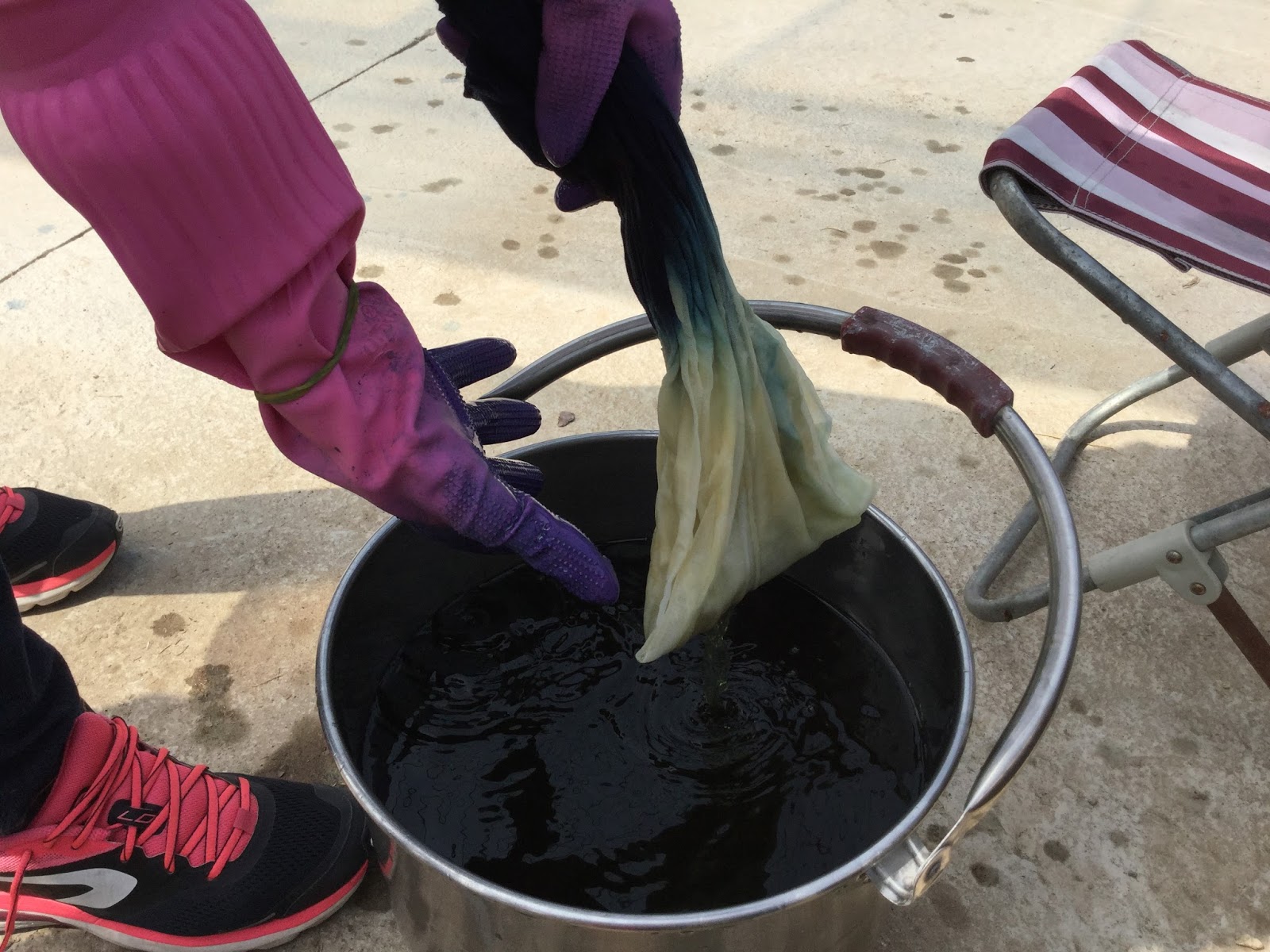
  • To dye material, the material is completely submerged in the dyestuff, not allowing the material to float into the light or be exposed to air. Immediately after submerging for a minute or two, remove the material from the dyestuff and allow to dry while exposing the material, including folds, to as much light and air as possible. Repeat the submerge and expose to air and sunlight method several times for best dyeing results. The color depends on the submerge and sun-exposure process -- from green to blue to navy. 
Organized participation in the silk-dyeing event:

Before we even could begin, we had to receive "education" on the dyeing process, and this entailed going to a large conference hall and being informed of 3 very strict rules:
  1. No talking during the lecture or 20+ minute instructional movie.
  2. If you have a question, clap your hands but do not shout or use your voice in any way.
  3. No leaving for the bathroom because emphatically you cannot return to the work center.
  • We weren't told to not carry our phones, but I was reprimanded for having my iPad ... but I also have a blog and want to retain memories for myself and to share ... so I risked censure, but often asked one of the Master Craftsmen's young kids (they're raising their 6 children to be future Master Craftsmen!) to take pictures of specific steps in the process. 
About 40 of us were participating. Sonja Glaeser, the organizer of Hippies Korea, based in Suwon, organized this phenomenal event. We had a very memorable weekend tour of Buan and Naju, in Jeollanamdo, but this experience was the ultimate and an absolute must-share!

To protect our clothing, we wore rainwear with large plastic aprons
and then gloves to protect our hands from the potent lye.
All of us were divided into teams of 5. We later learned that these teams were made so we could share buckets of indigo dyestuff and then each team was assigned a clothes line for hanging our hand-dyed indigo silks. Very organized system!
Then we accordion folded length-wise our silk scarf, doubled it over, grasped both ends of the folded cloth to make a tight unit. Even-ness is of importance.
Then the folded middle part we tucked into a large plastic bag, wrapped three rubberbands around it, then tied the plastic excess out of the way. The rubberbands tightly around the cloth are to prevent the middle part of the cloth from getting stained while dipping the rest of the cloth.
Each team gathered around their bucket of indigo dyestuff and waiting for the command to gently plunge their cloth up to the rubberband marker into the cloth. Teamwork means we put our clothes in at the same time and likewise removed them at the same time.
The cloths were held submerged in the indigo dyestuff for about 2 minutes each time. During that time we were to gently fan out the loose material to ensure that the cloth would dye evenly. 
After dipping our cloths and removing our cloths to give them air and sunlight exposure and back to dipping (done about 5 times), we removed the rubberbands and plastic bags and unfurled our cloths. The indigo as yet appears very dark but as it interacts with the sunlight, it'll lighten to a brilliant blue. The undyed area looks rather grubby, so next we dye the center. 
Sonja Gleaser of Hippies Korea showing off her talent in dyeing. Awesome setting a
nd in the best season with cherry blossoms just emerging!
To dye the as-yet undyed area, we dipped only the undyed area into a solution (have no idea what it was), squeezed out the excess and then took the cloth to the Master Craftsman.
One of the daughters held each cloth at the ready while the Master Craftsman expertly fed the cloth smoothly into one of the indigo dyestuff buckets. He confidently swished the cloth around, squeezed out the excess and then was whisking the next cloth into the dye almost as quickly as he passed the dipped cloth to its owner. 

This is the first wash-pan in the rinse cycle. Each of the washpans reveal less and less indigo wash-out, which is good.
Once the cloth was dipped, we were cycled through a 15-washpan factory line of rinsing out the indigo dyestuff and alkali from the lye process. The alkali is important to wash out, and this 15-washpan cycle gets most ... but not all. It does stop the dyeing process so that the colors, when exposed to the sun, can obtain their indigo richness.

The colors are already becoming vibrant. The direct sun is definitely having a positive effect on the color outcome. 
Rinse, rinse, rinse.
Team A's silk scarves right after they were hung. It is VERY important that the scarves dry before they are moved. Not sure of the consequences but the wife Master Craftsman kept stressing this. We ate a beautiful traditional buffet-style lunch while we waiting for our scarves to dry ... so we could head back to Seoul with peace of mind.
Hanging the last of the scarves to dry!
Most of us gathered to proudly say, "We created these beautiful pieces!"
One of my team members!
Team B. Sadly, we were the only team that danced with our fashionable scarves!
Beautiful items for sale in the indigo-dye shop. I love that jeogori! 

Care instructions for our beautiful indigo-dyed silk scarves:

Indigo is a permanent dye but direct sunlight does have an effect on it and the color will diminish in direct sunlight. Air also has an effect, so when not in use, fold or roll the scarf and place in a sealed plastic bag, and the silk scarf with its natural colors can last centuries.

Also, because lye was used in the process, even though the scarves were washed in 15 water baths, alkali still remains. To ensure that the scarf can last for uncountable years, the alkali must be removed, so in the following 7 days, every day rinse the scarf in cool water up to 40°C. If the water still shows yellow after 7 days, rinse it out for a couple more days. In follow-up care, only wash with mild detergents, but a water wash without scrubbing is best.

Caution, however, for its use. The natural color blue has a cooling effect on the body and, especially in contact with the skin, particularly at the back of the neck, the indigo can pull body heat and reduce a person's temperature by as much as 2-3°C. [Hence, Lawrence of Arabia always a wearing blue indigo scarf in the desert, and the Blue-men of Mali wearing blue robes while living in and crossing the desert on their camels.] This caution is in particular reference to children and older people, age groups that have a hard time managing body heat.

Traditional Indigo Dyeing Company: Myungha Hatgol

Yoondaam K-blue is Korea's top traditional indigo dyeing brand owned by Myungha Hatgol Co., Ltd., a company committed to carrying out old traditions into modern times and into the future. The 5th-generation family business is a social enterprise established by late Byung-un Yoon (Important Intangible Cultural Asset #115, dye master) and gives back two-thirds of the profit it makes by manufacturing and selling indigo dyeing products and by providing services to society. The plants used for natural dyeing are cultivated by villagers by Myungha Indigo Village, and Myungha Hatgol purchases them all. This is the way of following Byung-un Yoon's wish to make 100 villagers live off of indigo dyeing. Initially, 37 households were supported by the dyeing processes, but currently with numbers of family members moving to the city, only 22 households are available and are supported by the indigo dyeing business.

Email: totocece@naver.com
Web: www.K-BlueYoonDaam.co.kr
Tel: 061-336-5557
Fax: 061-336-5811
13-7 Myeongha-gil, Munpyeong-myeon, Naju-si, Jeollanam-do
절라남도 나주시 문평면 명하길 13-7 
The husband and wife Master Craftsmen of traditional indigo-dyeing.
The indigo of Korea Yoondaam, the dyeing brand created by the later Byung-un (important Intangible Cultural Asset #115, dye master). Byung-un's son and apprentice is now the Master Craftsman, and is the 5th generation representative of the traditional art. He and his wife, also Master Craftsman and leader of the Myung-ha community, are raising their 6 children to be future Master Craftsmen.

Saturday, April 9, 2016

The Jindo Miracle Sea Road Festival

Jindo island located just off the southwest corner of the Korea peninsula is a mystical island of folk art and music, traditional performance and the much celebrated surreal sea road which forms a 2.8 kilometer long pathway to an outer island twice a year. This mysterious walkway roughly 10-40 feet wide has been dubbed the “Korean Moses Miracle” and attracts Koreans and foreigners alike to see the mysterious phenomenon and walk its length.

The four-day Jindo Miracle Sea Road Festival in spring attracts about half of a million visitors every year, making it one of the three top festivals in Korea. The two other most popular festival events are the Mud Festival in July and the king of festivals, the Hwacheon Sancheonea (mountain trout) Ice Festival in January. For all of these, charter tour buses from various cities flow into these otherwise minimally populated areas, filling large pre-designated parking areas. Traveling by private car to any of these places during the festival season is one’s worst nightmare.

This year the Jindo festival opened on a Thursday, April 7, and concluded on Sunday, April 10. And because this year the lowest ebb tide of the Moses Miracle took place on the weekend, tour buses arrived throughout the weekend for people to see this once-a-year celebrated phenomenon. The most popular buses, however, were those that arrived in the early dawn of Saturday, in time for the Fire Torch Walk when thousands of people carry flaming gas-lit torches and walk into the sea on the appearing path that links Jindo to the distant Modo island. For those who missed the iconic Torch Walk, the sea parting occurred again at 18:20 on Saturday and 19:00 on Sunday. A few thousand even got up early Sunday and did the unofficially schedule sea path walk at around 6:40am.


Each of the sea path occurrences lasts about an hour, so if a person does get to Modo island, he or she will probably be stranded there or be forced to hire a local boat to ferry them back to the larger island.

The sea path is steeped in legend and, unlike other legends of long-long ago, the legend of Grandma Ppong and the sea path goes back to a precise date, the year 1480 when a man Son Dong-ji was condemned to exile on Jeju Island. As Son’s ship navigated to Jeju, a furious storm blew and shipwrecked him on the tip of Jindo island at a savage place called Hoedong, literally the “tiger place”, named so because of the numerous striped beasts prowling the area. Son stayed with the villagers and for the next 200 years his descendants lived in Hoedong until the area became so frightening a place to live because of the many tiger attacks that the villagers along with Son’s descendants built rafts and moved to the nearby Modo island.

Unfortunately in the move, a grandmother was left behind. In terror and loneliness Grandmother Ppong prayed to the Dragon King of the sea to be reunited with her family. Finally, in a March night dream the Dragon King appeared and told her the next day a rainbow would appear to guide her to her family. The next day on the rocky shore she prayed again and the rainbow bridge appeared, forming an arching path from Hoedong to Modo island. In her joy she ran along the rainbow path and collapsed into her family’s arms on the other side whereupon she praised the Dragon King for reuniting her and then died from exhaustion.


In filial respect, her family honored her for her tenacious faith in the Dragon King. Many locals still dance, stage shamanic rituals and have other performances to give respects to Grandma Ppong for her strong faith in the Dragon King. Particularly during festival season, the statue of her located at the narrowest expanse between now-Jindo and Modo is draped with ribboned wishes and prayers as she looks earnestly to the distant island. Another statue overlooking the head of the rainbow path is where Grandma Ppong kneels beseechingly while looking toward Modo; a snarling tiger statue is her companion.


Though a legend to some, many Koreans still put faith in the powers of the Dragon King and the faith of Grandma Ppong. Many come to pray for the well-being of family members, for wishes for their children, for prosperity and health. The local Jindo residents have a traditional celebration called Yeongdeungje in which they pray to Grandma Ppong and the Dragon King, their village guardian spirits. Unlike the more publicized Jindo Miracle Sea Road Festival which is only celebrated in spring, Yeongdeungje is held during the spring and fall sea road partings when the road is widest.

The partings are scientifically explained as tidal harmonics. Predictable by the lunar calendar, the phenomenon is controlled by the gravitation pull of the moon along with effects of the rotation and momentum of the earth. From a superstitious point of view, a mystical miracle occurs.

The Jindo sea parting is a family experience. Everyone can participate, and while mom is digging around for lunch, baby is quit dry and content to just be along!
Wearing gumboots and carrying a trowel and a pail or just a bag, Koreans are fully equipped to explore food for lunch: crabs, clams, abalone, stranded octopi, sea tangle and other sea delicacies are all fair game!
photo contribution by Nicola Hayne - adventurers feeling their way along as the tide continues to ebb
The Jindo Miracle Sea Road Festival didn’t stem from the prayers to Grandma Ppong or the Dragon King, but came about by the French ambassador Pierre Landy who was visiting Jindo island in 1975 to learn a bit about, some say the Jindo dogs and others say the local music. Why he actually went there is now unimportant for what he saw, Grandma Ppong’s rainbow bridge, he unintentionally immortalized in a French newspaper when he published his observation as the Korean version of the Moses Miracle and much like the Biblical parting of the Red Sea. After international awareness was raised, other foreigners wanted to witness the parting as well, and so in 1978 the sea parting festival was established.

Western foreign interest increased every year, until in 1996 Tendo Yoshimi, a Japanese pop star, sang the song “A Story of Jindo” describing the enigmatic water parting which ignited Japanese interest in the phenomenon as well, so then hordes of Japanese tourists flocked to Jindo every year.  

The Jindo sea parting miracle is not the only ebb tide sea road in Korea. In fact, about 20 others exist. Somaemuldo, the so-called “lighthouse island” off Geojedo, Gyeongsangnam-do has a rock-strewn path that appears regularly twice a day; then near Incheon a stretch of cement-paved walkway appears to connect Nuesan Island Lighthouse Observatory with the mainland, and nearby on Seonjaedo island a fairy-like meander of golden sand appears to bridge Seonjaedo to the tiny Mokseom island. More exist but none as long or wide as the Jindo phenomenon and none have yet had international exposure on such a grand scale to immortalize them as must-see tourist attractions.

Jindo island in its own right is a tourist attraction. At least five folk heritages have been listed as intangible cultural heritages with UNESCO—the ganggansullae, a circle dance performed by women; the ssitgimgut, a shamanistic ritual soul-cleansing of wandering spirits to resolve their earthly grievances; the Jindo dasiraegi, a performance for consoling people who have lost family members; the deulnorae, a farmer’s song; and samulnori, the play and dance to the beat of four percussion instruments. Two other folk heritages are listed by the provincial government as intangible cultural assets—the Jindo buknori, a traditional drum play with two sticks, and manga, the local funeral dirges. It can be said that much music and performance claims Jindo as their birthplace. And thus the Jindo saying, “When in Jindo, beware of showing your musical abilities” because the musical talents are high and broad.


Jindo, a place where anything is possible if connected to the sea.
These boats were part of a long boat procession that paraded for the Jindo visitors.
The mythical aura of Jindo is more than just legend, and gugak—Korean traditional music and performing arts—has rich history as well for near Jindo island is where brilliant Admiral Yi Sun-shin (1545-1598) fought with his famed turtle ships to defeat the Japanese fleet. It is also the island that the unfortunate ship MV Sewol sank near in its unfortunate maritime accident just two years ago. On a lighter note, the famed Jindo dog is of course taking its name from Jindo island; the animal is no highly regarded that it is esteemed as a national treasure. Accordingly, Jindo dog shows and performances during the Jindo Sea Road Festival are scheduled to highlight the dog’s superior intelligence and loyalty to its master.

And finally, if someone adventures to Jindo island, whether during festival season or not, a visit is said not to be complete unless one enjoys the local Jindo hongju, a 40% alcoholic drink made from whole grains, rice and jicho, a local medicinal herb extract. The bright red liquor, hence its name “hong” for red, is the only distilled red-colored liquor in the world, and it is said not to give someone a hangover the next morning. With that in mind, the visitor can enjoy the mystical flavor of the island while walking the sea path, listening to gugak or simply drinking the medicinal-herb liquor.

Korean traditional wrestling with professionals

After the professionals exhibited their skills, foreigners could participate. My friend and one other were the only foreigners of about eight who could "triumph" over the professionals. They brought with them Western wrestling tricks unknown to the Korean pros.


Published in Korean Quarterly, Vol 19, No 40, Summer 2016, p 49, 64-65.

Monday, February 15, 2016

What Is Hanji?

Hanji literally means “the paper of Korea”. It has been a part of Korean life and tradition for over a thousand years. Hanji is an extremely durable and high-quality paper, made from the fibrous inner bark of the mulberry tree, which grows well in Korea. 

Hanji is used in very many ways : 
  • covering for doors and windows of traditional Korean houses
  • printing paper for important documents and books 
  • household objects: fans, tobacco pouches, notebooks, shrouds, rope and string, baskets, shoes, clothes, umbrellas, lamps, kites … 
  • furniture making
  • calligraphy paper
  • wall papering 
  • arts and crafts 
The durability of hanji allows it to be used in a multitude of ways. Before Korea opened its ports, Koreans even used hanji as a suit of armor after varnishing it with lacquer. There is an old saying that paper lasts a thousand years and textiles (such as silk or hemp) last 500. In the West, products made of paper more than 300∼400 years old are rare, but Korea has preserved quite a few books and drawings which are almost 1000 years old. In fact, the oldest printed material in the world, created in 751, was printed on hanji. 

The strength and durability of the traditional paper comes from its natural materials. Mulberry bark is strong and can even be immersed in water for a year without decomposing. The mulberry fibers are wide and the fibers stay aerated with air and light passing through. The high-quality Korean paper can be produced with young trees—trees that are one year old—while cheaper modern paper requires pulp made from trees 20-30 years old. 

Manufacturing hanji is complicated, slow and labor-intensive. Dry mulberry branches are cut after the frost and steamed. The branches are then immersed in water for one day, dried under sunlight, then the bark is peeled off and once again the plant fibers are steamed, this time immersed inside an iron pot with caustic soda. The steamed bark is then smashed with a mortar to squeeze the water out, and then placed in a wrapper and rinsed in flowing water. The fine mulberry fibers are then mixed with water and a natural adhesive in a large cauldron from which the fibers are lightly dipped out with a bamboo screen and rhythmically swished back and forth to create a crisscross pattern of fibers. The pulp remaining on the screen is then dried in a stack of wooden panels with good aeration and exposure to the sun, and once dried, peeled off the screen in a sheet of paper. The Korean Paper Museum in Jeonju gives visitors a more detailed perspective of hanji making (www.hanjimuseum.co.kr). 

Because of its laboriousness in production, traditional masters of hanji want less difficult jobs for their sons. As one master says, “I will not let my son be a container man (the person who strains the fiber through a bamboo screen) even if I am driven to the worst”. The small quantities, a long production process and distribution limited to specialty markets make traditional hanji production difficult to compete with the mass distribution of cheap easily produced modern paper. Therefore, he Korean government has appointed the masters of Korean paper making as intangible cultural assets and makes efforts to protect the industry. 

With global changes, hanji is finding new markets, and currently the hottest market trend for hanji is in the art industry. 

Artists for calligraphy and dyeing find hanji more suitable for applying ink than with less expensive, modern papers because of their impurities. For example, black Chinese ink spreads evenly because the hanji is strong and lacks impurities despite being thin. Also as it is very fibrous, it soaks up ink rather than letting it pool and puddle, which results in streaks and smears. Fashion shows featuring hanji clothing have been held on the Champs Elysee in Paris. Hanji has been developed as a substitute for styrofoam as internal pack material. And currently underway is a joint study by Korea and the US to study the potential protective properties of hanji paper for space shuttles. 

Source
What makes hanji so special? How can it be so durable?

The answer is in the bark of the mulberry tree. This bark is so strong that it can be immersed in water for an entire year without decomposing! Also, as the fibers of the bark are wide, it allows both air and light to go through. The mulberry pulp is naturally pH neutral and has an incomparable longevity; the fibers of the mulberry pulp are longer, more flexible and more resistant than other plants' fibers. Its extraordinary resilience makes it a prime choice for archival use; that's why the most important documents in the history of Korea have been written or printed on hanji.

Traditional Korean hanji is made with mulberry pulp and clean water, without any fillers or additives.

"Since 1945, Korean lifestyle underwent a dramatic overhaul. Traditional thatch top houses, which used a lot of handmade paper for walls, doors, windows, and flooring, were replaced by western architecture. Hanji was no longer an integral part of daily life and its main consumers were reduced to artists who practiced traditional ink painting or calligraphy. However, in recent years, a renewed awareness and appreciation is growing and the excellence of paper-making tradition is being rediscovered. More people are accepting the responsibility to carry on this invaluable legacy for next generations, opening a new era of hanji." (History of Hanji, Fides International).

Sources:


Thursday, December 31, 2015

UNESCO Sites in South Korea (2015)

UNESCO World Heritage refers to both cultural and natural heritage sites registered on the World Heritage List. In November 1972, UNESCO adopted the "Convention Concerning the Protection of the World Cultural and Natural Heritage" in the General Conference during its seventeenth session. Under the Convention, the World Heritage committee established a World Heritage List that includes cultural and natural heritage with outstanding value whose conservation is recognized to be in the interest of all humanity. 

As of July 2015, Korea has eleven cultural heritage sites and one natural heritage site.

Apart from this, UNESCO also has a separate program called 'Memory of the World' and 'Intangible Heritage of Humanity'. In Korea, there are seven and eight of them respectively.


World Cultural Heritage Sites

Korea's Cultural Heritage conveys a genuine sentiment of simplicity and peacefulness. The historical background of the heritage is diverse, encompassing the history of Korea from ancient times (Dolmen sites) to the Joseon Dynasty. The sites embody a wide variety of values from tidy and neat artistic spirit to scientific rationality as witnessed in such traditional constructions as a royal palaces or temples. A total of eleven Korean cultural sites are registered on the list of World Cultural Heritage Sites including:
  1. Jongmyo Shrine (1995)
  2. Haeinsa Temple Janggyeong Panjeon, the Depositories for the Tripitaka Koreana Woodblocks (1995)
  3. Seokguram Grotto and Bulguksa Temple (1995)
  4. Hwaseong Fortress (1997)
  5. Changdeokgung Palace Complex (1997)
  6. Gyeongju Historic Areas (2000)
  7. Gochang, Hwasun and Ganghwa Dolmen Sites (2000)
  8. Royal Tombs of the Joseon Dynasty (2009)
  9. Historic Villages of Korea: Hahoe and Yangdong (2010)
  10. Namhansanseong Fortress (2014)
  11. Baekje Historic Areas (2015)

World Natural Heritage Sites

UNESCO chooses to-be World Natural Heritage Sites based on an objective evaluation of historic and academic worth, and then assists in ensuring their preservation. 
  1. The volcanic island of Jeju-do has an outstandingly beautiful natural environment that is significant for its geological features and ecological value. In 2007, Jeju-do Island was listed as a UNESCO Natural Heritage Site under the name of "Jeju Volcanic Island and Lava Tubes". This includes Mount Hallasan Natural Reserve, the Geomunoreum Lava Tube System and Seongsan Ilchulbong Peak. 

Intangible Cultural Heritage

An international assessment committee appointed by the UNESCO Secretary General reviews the list of World Intangible Heritage of Humanity every two years with the mission of safeguarding and protecting such intangible heritage as language, culture, music, dance, games, myths, rituals, customs and handicrafts. A total of eighteen examples of Korean intangible heritage are on the list, including: 
  1. The Royal Ancestral Ritual in the Jongmyo Shrine and its Music (2001)
  2. The Pansori Epic Chant (2003)
  3. The Gangneung Danoje Festival (2005)
  4. Ganggangsullae Dance (2009)
  5. Namsadang-nori Performance (2009)
  6. Yeongsanjae Buddhist Ritual (2009)
  7. Jeju Chilmeoridang-yeongdeung-gut Shaman Ritual (2009)
  8. The Cheoyongmu Dance (2009)
  9. Gagok, lyric song cycles accompanied by an orchestra (2010)
  10. Falconry, a living human heritage (2010)
  11. Daemokjang, traditional wooden architecture (2010)
  12. Weaving of Mosi (fine ramie) in the Hansan region (2011)
  13. Taekkyeon, a traditional Korean martial art (2011)
  14. Jultagi, tightrope walking (2011)
  15. Arirang, lyrical folk song in the Republic of Korea (2012)
  16. Kimjang, making and sharing kimchi (2013)
  17. Nongak, Community band music, dance and rituals in the Republic of Korea (2014)
  18. Juldarigi, traditional ritual wishing for a good harvest, a tug-of-war game (2015)

Memory of the World Register


The Korean documents declared UNESCO Memory of the World include:
  1. The Hunminjeongeum Manuscript(1997)
  2. Joseonwangjosillok, the Annals of the Joseon Dynasty (1997)
  3. Seungjeongwon Ilgi, the Diaries of the Royal Secretariat (2001)
  4. Jikji Simche Yojeol, the Second Volume of "Anthology of Great Buddhist Priests' Zen Teachings" (2001)
  5. Printing Woodblocks of the Tripitaka Koreana and Miscellaneous Buddhist Scriptures (2007)
  6. Uigwe, the Royal Protocols of the Joseon Dynasty (2007)
  7. Donguibogam, the Principles and Practice of Eastern Medicine (2009)
  8. Ilseongnok, Records of Daily Reflections (2011)
  9. Arresting the demonstrating students, archives of the May 18 Democratic Uprising against the Military Regime (2011)
  10. Nanjung Ilgi: War Diary of Admiral Yi Sun-sin (2013)
  11. Archives of Saemaul Undong (New Community Movement) (2013)
  12. Confucian Printing Woodblocks in Korea (2015)
  13. The Archives of the KBS Special Live Broadcast “Finding Dispersed Families” (2015)

Above information adapted from the Visit Korea "UNESCO World Heritage" posting.

Thursday, December 17, 2015

Kumbak: Gold Leaf Embossing

In ancient times gold was a symbol of eternity, beauty and authority, and gilding clothes was symbolic of showing one's elegance and "planting hope on every pattern and character" [sic - from the KumBakYeon brochure]. 

Generally in China, Japan and Europe, the gilding technique was used for architecture, for the exterior and interior decor or even furniture decor. In contrast, Korean had little (if none) gilding of buildings, limited gilding of ritual wares, but its gilding of clothing was highly advanced and employed a detailed and technical woodblock imprinting technique on silk. Developed in ancient times, this technique or gilding of clothing remained unique to Korea through the centuries.

Clothing having gold was limited to royalty, or perhaps the highest royal officials, and wearing it "revealed the authority of the royal family and the ruler's desire for national prosperity through various patterns of gold leaf." [sic] Therefore, every pattern of gold leaf had to be followed by strict rules. The clothes with gold leaf were used as ceremonial robes, usually used only once, but they could be re-used on wedding days, 60th birthdays or other such highly important events. 

Passing down gold leaf embossed robes gave prestige and status to one's family. One family known to pass down gold leaf embossed clothing can trace five generations as having inherited it. 
1st generation: Kim Wan-hyeong, who worked under the control of King Cheoljong (1849-1863), Joseon era
2nd generation: Kim Won-sun, who worked for the last imperial family of the Korean Empire 
3rd generation: Kim Gyeong-yong, who was first appointed as human cultural asset 
4th generation: Kim Deok-hwan, who is currently appointed as national important intangible cultural asset No. 119 
5th generation: Kim Gi-ho & Park Soo-young, who are currently working in succession to Kim's father, Kim Deok-hwan
Four of us gathered at the KumBakYeon gold leaf experiential house in Bukcheon to make a gold-embossed greeting card and a gold-embossed bookmark.

Materials: paintbrush for the sticky glue, special glue, gold foil leaf papers, (wood) stamps, silk or material to stamp, and not pictured but a place to warm the glue for a few seconds just prior to stamping (trade secret!) 
The stamps all mean something different: peony for yangban, the Chinese character of "luck/propitiousness" ...
The design of the stamps used dictate the message being conveyed to the wearer or recipient.
My card on the left symbolizes luck/good fortune as I've stamped with Chinese luck character, the flower for fortune or good returns, and the butterfly which brings luck or fortune. The bookmark on the right is a wish for scholarliness and wisdom.
Among all the beautifully embossed pieces of clothing and accessories on display in the modern hanok KumBakYeon, this silken purse of a scholar with exquisite embossing caught my eye. Symbols of 싶장생 (the 10 symbols of longevity) are on it wishing the bearer a long and happy life. 
The ceremonial robe of [someone important (king?) and donated to the KumBakYeon]. This robe is for royalty as can be assured by the intricate high-quality of gold embossing and the type of symbols employed.
Clusters of grapes are symbols of fertility beside a character of buddha-like figure with a staff which exemplifies wisdom.
This belt is for the one-year-old baby. The butterflies are symbols of fertility, the red and blue colors are the balancing of yin and yang, the five balls are for five happinesses, and each ball having five grains inside which make wishes for blessings. [This is much like the propitious grain offering at Sajikdan at which offerings for prosperity of the nation and fruitfulness of the earth are prayed in hopes of the bestowal of heavenly blessings in the upcoming year.]
the five balls wishing for five happinesses
This is the seal of the emperor of the Daehan Empire, before royalty ceased to rule in the Korean peninsula.

금박의 순서 - Working Process
  • 도안 - design (first, a design is imagined)
  • 금박판 조각하기 - carving (the woodblocks for the design are carved)
  • 금박풀 만둘기 - making fish-based (mina) glue to adhere gold leaf (preparing dried mina cartilage, boiling it and squeezing out the cartilage to make a very sticky glue - used also in traditional bow construction)
금박믄양 올리기 - Sticking on the Gold Leaf Pattern 
  • 금박풀 칠하기 및 찍기 - brushing glue on the woodblock and imprinting (The mina glue is brushed but not gummed on the woodblock in smooth strokes, not clogging the carved fissures; the woodblock is stamped and pressed firmly onto the cloth.)
  • 금박 올리기 - sticking on the gold leaf pattern (The gold leaf is dabbed on the glue imprint and quickly and repeatedly tapped with the fingers - through repetition the gold leaf adheres to the cloth and the excess is flaked up through the repetition.)
  • 건조 - drying (the cloth with mina glue is hung to dry)
  • 뒷손질 - later adjustments (taking a tissue or soft smooth cloth and lightly wiping back and forth picks up the non-glued areas of gold leaf; a fine needle or point can lift excess leafing or clean up rough edges.)