Showing posts with label family. Show all posts

Wednesday, December 25, 2019

Songs of the Dragons

Songs of the Dragons Flying to Heaven, translated by James Hoyt (1979), was a compilation of 125 cantos compiled to establish the legitimacy of King Sejong's lineage. King Sejong (1397-1450), 4th king of the Joseon Dynasty (1392-1910) ordered the compilation to extol the merits of the Yi (Lee) lineage in the new dynasty, and printed the compilation with the newly-made hangeul script made for all people of the nation to easily read. Songs of the Dragons was the first book to be printed in Sejong's new "alphabet".  


Three Reasons for the Compilation

(1) Extolling the great accomplishments of the six generation of founders of the new Yi, or Chosun/Joseon Dynasty. The heroic actions of the Six Ancestors are compared to the flights of dragons symbolic of the throne, hence the title of the work. Of the Six Ancestors, only two actually sat on the throne of Korea. The other four generations of the House, preceding the establishment of the dynasty, are designated as chamnyong, or "submerged dragons," and their residences as chamjo, or "submerged palaces," after Chinese usage. [When Yi Seong-gye took the throne, he had to justify through ancestry that he was eligible for the throne. Ancestry was of need traceable back by at least four generations; thus, when Yi Seong-gye established his Dynasty, he brought with him the bones of his four primary ancestors.]
  • The ancestors of the Yi family lived in Jeonju, Jeolla-do, and their prominence dates from Mokcho (Yi An-sa, d. 1274), the First Ancestor, who served the Goryeo Dynasty (918-1392) in various capacities in a number of provinces. Mokcho's descendant in the fourth generation, Yi Seong-gye, became King Taejo, the founder of the Yi Dynasty after overthrowing the Goryeo Dynasty.
  • The Second Ancestor, Ikcho (Yi Haeng-ni), was noted for his difficulties with the Jurchen tribesmen in the North.
  • The Third Ancestor, Tojo (Yi Ch'un, e. 1342), a skillful bowman.
  • The Fourth Ancestor, Hwanjo (Yi Cha-ch'un, 1315-1361), based the growing power of his family on the imminent collapse of the Mongol empire in China (1368) and the concomitant weakening of the Mongolized dynasty of Korea.
  • The Fifth Ancestor, Taejo (Yi Seong-gye, 1335-1408), wielding military power as a result of his expeditions against both the Jurchen tribesmen and Japanese freebooters and for espousing a program of land reform and alliance with the Ming, he established himself as king and ruled until his abdication in 1398.
  • Chongjo, an ineffectual son of Taejo and who was a caretaker-king during a period of rivalry over succession (1399-1400), does not merit qualification to be listed as one of the Ancestors of the dynasty.
  • The Sixth Ancestor, Taejong (1401-1418), completed the work of establishing a firm dynasty, which would last until 1910.
First four kings of the Yi/Lee Dynasty / Joseon Dynasty:
  1.   Fifth Ancestor: Taejo (r. 1392-1398)
  2.   Jeongjong (1398-1400)
  3.   Sixth Ancestor: Taejong (1400-1418)
  4.   The Great King Sejong (1418-1450)

(2) Providing inspiration for King Sejong and subsequent kings on the Yi line by recalling the vicissitudes and tenacity of the Six Ancestors. No less than 15 of the 125 cantos end with the hortatory refrain, "Let Your Majesty not forget this!"

(3) Proclaiming to the world that the accession of the Yi family to power was in accordance with the Chinese concept of the Mandate of Heaven. This concept of the Mandate of Heaven is an ancient one, formulated by Tun Chung-shu (2nd century BC), who declared that when a ruler commits unjust acts, Heaven shows its displeasure by such calamities as earthquakes, famines, and floods. If these warnings are not heeded, Heaven seeks to admonish rulers by means of such portents as eclipses and comets. If these are not needed, the ruler loses the Mandate, and Heaven selects another to mount the throne. The attainment of the Mandate of Heaven's divine plan is the much repeated theme of Songs of the Dragons Flying to Heaven, and the word "Heaven" in the title refers to Heavenly favors bestowed upon the six heroes. The writing of the work is, in short, a written legitimization of the Yi rule.

CONTENTS

All of the cantos are focused on the assertion that the Six Ancestors have the favor of Heaven. The earlier cantos speak of the exploits of the first four Ancestors, aiming to support the Fifth Ancestor Taejo, who took the throne. The cantos XXVII to XCV (68 or 54% of the cantos!) were of the exploits of King Taejo, how mighty he was and how he repeatedly saved the country through his valorous deeds in battle or in the hunt. No cantos were given to Jeongjong (1398-1400), the ineffectual son of Taejo who ruled briefly during a period of political instability and fighting for the throne. Cantos XCVII to CIX (13 cantos) were dedicated to the Sixth Ancestor, Taejong (1400-1418). Those 13 cantos primarily reflected the time of instability and mostly sang of assassination plots and recognition of loyalty. Cantos CX to the end of the songs, Canto CXXV, sang of the merits and righteousness of the Great King Sejong, the Sixth Ancestor. These cantos were a series of admonishments. Admonishments:
  • to not forget the hardships of his Ancestors and to be steadfast in purpose
  • to not forget the contrast between the magnificence of his palace and the crudeness of his Ancestor's shelter
  • to not forget the contrast of his embroidered belt of office with the crude armor of his Ancestors
  • to not forget his Ancestor's hunger as he dines of the finest of food and richest of drinks
  • to not forget his Ancestor's fierce battles as he presides over a brilliant and peaceful court
  • to rule with clemency, an important quality of kingship
  • to have compassion
  • to be humble lest he become a tool of conniving ministers
  • to act in a manner befitting a king
  • to overcome with benevolence the plot of evil ones
  • to maintain a strong economic basis for the state
  • to be forgiving to his advisors as was Taejong
  • to respect scholarship and beware of trouble-makers
  • to evade slander mongers and those who embroider the truth
  • to despise Buddhism and revere Confucianism
  • to emulate the Flying Dragons
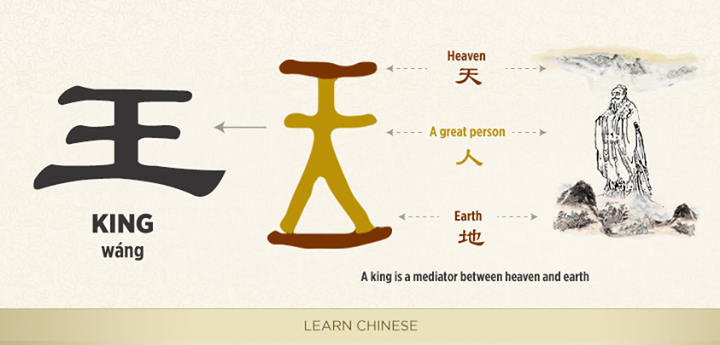
Opening canto - the opening assertion of the Six Ancestors aka dragons flying in the Heavens, the symbolic statement that the Heavens validates their auspicious right to be elevated above men and below the space of universe authority. Reference the meaning of "king" in Chinese character.
meaning of the Chinese character "wang" or "king"
King Taejo, found of the Yi Dynasty, is valorous in war and in the hunt. He is powerful, righteous, blest by the Heavens, and therefore deserves the role of king and ruler/caretaker of the nation.
The last canto, the canto that affirms King Sejong, the fourth king of the dynasty, as the right to continue to rule, as based on the righteous foundation of the Six Ancestors.
Final Comments

Songs of the Dragons was the first book to be printed in the newly developed hangeul writing. Printing was executed with wooden block in October 1447, about two years after its compilation, and 550 copies were presented to various ministers. The editions that are presently extant include those printed in 1612, 1659 and 1735.

The compilation is now recognized as a monument to the cultural independence of Korea from China, a most important source for the study of the Korean language, and the beginning of Korean national consciousness and of vernacular literature.

For more information regarding the translation, reference a 1977 JSTOR preview of the book, by Peter H. Lee. 

Tuesday, April 16, 2019

Hanok: Traditional Residence Architecture in Seoul

Among the fine traditional Korean houses which have been transported from elsewhere to form the Namsangol Hanok Village, at the foot of Namsan, stands a house built by master craftsman Lee Seung-eop. The house originally stood in Samgak-dong, next to Gwangyo Bridge over Cheonggyecheon stream, but in the course of development and redevelopment, the house recognized as a fine specimen of middle-class architecture, was dismantled and reconstructed in a collection of other hanok to create the Namsangol Hanok Village. The house was originally known as 'Hongmun (Red Gate) Seot-gol (Standing Town), Ibyeokdong-daek (residence of Ibyeokdong)'.

This remarkably fine house with unusual embellishments was built for his own use by Lee Seung-up, the master builder who worked on rebuilding Gyeongbok Palace in the latter half of the 19th century. Gyeongbok Palace, which had fallen into disrepair over many decades, was ordered to be restored by Heungseon Daewongun (1820-1899), the father who ruled in stead of young King Kojong (1852-1919).

Approximately a decade after master carpenter Lee Seung-eop constructed this house, he encountered financial hardships and was forced to sell, whereupon in 1889 the yangban grandfather (Kyoungju Lee clan) of Lee Sang-oak, our tour guide but of no direct relationship to builder Lee, purchased the house. Three generations of Lee (Yi) lived in the house: Yi Chaeyun (1837-1917), Yi Chong'ik (1889-1966), and Yi Yong'u (1917 - ??? [the book was published in 1998]). 

Lee Sang-oak, our guide, was born in this house, as were his two sisters and elder brother. He lived there until 1964 (he was about 20) when the house was sold to P'unghan Company and remodeled. From 1970 - 1996 Cho Heung Bank used the residence as a small bank museum. During that time, in 1977, Seoul city government designated the residence as City Cultural Asset No. 20. And finally in 1996, the house was sold to the City of Seoul along with four other residences around the city and all five were relocated to the north side of Namsan with the intent of making a park for the preservation of traditional architecture.

Guide Lee Sang-Oak told us stories of his growing up, the foods and cultural events enjoyed by the family, the symbolism and in particular the pungsujiri (geomantic principles) employed in the architecture, and other insights about the construction of the home, its impact on King Kojong (story later!), and details about personal life. Whoever really considers the stories the walls can tell if someone is willing to patiently listen!


Dr. Lee Sang-Oak and Brother Anthony, friends that go way back, explaining the topography of Seoul and why the original location of his house was so propitious. Located in front of the "Red Gate" entrance to his former house/courtyard.

Dr Lee Sang-Oak explaining the functions of the various parts of the house ... and how they were originally, and then after "renovation". Basically, as one historian puts it, "the city butchered his house". To give examples, brick walls are now plastered, whitewashed walls, the ondol passageways are minuscule and nonfunctional now, the traditional three-steps leading to the house were reduced to the convenient one. [Three steps up meant as a person approached house of prestige or standing, the visitor had to look up and be struck by the grandeur created by height.
Evidently the Namsangol Falconer's Organization has an operator here. There was always a stream of kids around the guy with his kestrel and his falcon. He didn't mind if people touched the larger bird either ... and the bird didn't seem to mind either!
For W5,000 a person could have the kestrel fly and land on his or her hand.
Petting was encouraged!


"Commercial" over, now back to Dr. Lee Sang-Oak. Dr. Lee showed up the geomantic symbols. The whole house had symbols hidden on walls, corners. roof beams, and more.


Pungsujiri (geomatric symbols here): the inverted swastika for Buddhistic thought, bats, trigrams like those found on the Korean flag (each trigram represents a humor: earth, air, etc), clouds, patterned windows for well wishes, ...
 

Originally this was the men's residence and was just a single room. Now it's divided into guest residence rooms for privacy.


Even the bird looks at the woman in hanbok gliding around the grounds.

A bit of entertainment for the foreigners and kids who visit the hanok village: "Walk Like a Yangban". Walking like a yangban was to walk confidently (thus, the wide appearing tiles for "authentic" practice),

The Red Moon Gate, the single entrance to the house: Originally the gate stood tall and proud like this one. What's interesting is that when there were no high-rises, King Kojong could look out of Gyeongbokgung and see ... the Red Moon Gate, and supposedly, discomfited he asked, "Whose gate is that?" And once he found out ... the Lee family was asked, which means told, to lower the gate so that King Kojong wouldn't see a gate taller than himself in the near distance. Of course they lowered the house ... and had to bend way down in order to enter, which conveyed indirectly humility to the king.

A spring look at Dr. Lee's former residence.
____________________________________________________________________

About our guide and the author of the book on his first home:
Book: A Traditional Residential Architecture in Seoul: A Study of the Yi Byeokdong Residence of Hongmun-dong (1998), Hollym University Press.

Sang-Oak Lee earned his B.A. and M.A. from Seoul National University, an additional M.A. from the University of Illinois, and a Ph.D. in Linguistics with a doctoral fellowship from Harvard University. He is now an emeritus professor at Seoul National University, where he was for many years a professor in the Department of Korean Language and Literature.
___________________________________________________________

The essentials about the house -- from Dr. Lee Sang-Oak's book (pp 10-13).


Sunday, November 26, 2017

Korean Story-telling: Ancestral Memorial Rite for General Kim Bang Gyeong

Story-teller Seung Ah Kim and her extended family hosted a very unique trip to the Andong Kim family ancestor memorial rite ceremony for the Andong-Kim branch founder, General Kim Bang Gyeong. Ancestor General Kim dates back to the Goryeo Dynasty in the 13th century. The Andong Kim family gathers annually for the sije rite and this year opened the rite to the public.

Sije is the seasonal rites held for ancestors up to five generations past and is typically performed annually on the tenth lunar month, the best month of the year's harvest. To run smoothly, it needs financial support so the family prepares for three things: wito (money for the food and setting the table), seonsan (mountain for ancestral tombs), and jaesil (place for food preparation and rest). These three components do vary from family to family.
Sije for General Kim Bang Gyeong is held every October 9 (lunar calendar) in front of the tomb in Andong. If its rains it is held at Eumsujae, the main building, in Neungdongjaesa established only for General Kim. The day before sije the ritual team gets together to discuss the important agendas and select three eldest males for offering rice wine three times one after another with rituals assistants. 
Kangshinrye - greeting rituals to call the spirit down. Choheongwan (the first host) burns incense and pours rice wine over the burial mound three times and then bows twice.
Chamshinrye - all the participants bow twice 
Choheon - Choheongwan (the first host) offers the first rice wine and bows twice
Dokchuk - Chukgwan (reciter) recites an eulogy 
Aheon - Aheongwan (the second host) offers the second rice wine and bows twice 
Jongheon - Jeongheongwan (the final host) offers the final rice wine and bows twice 
Yusik - food offering rituals to the spirit. An assistant sticks a spoon into the center of the rice bowl facing eastward and puts a pair of chopsticks on top of the bowl also facing eastward 
Sashin - farewell ritual, bowing twice 
Eumbok (drink blessings) - participants share the ritual food and drinks as it symbolizes the receiving of the blessings bestowed upon the family 
Bunchuk - burn out all chukmun (eulogy)
I was very curious why such a private family ceremony would be opened to the public, and the answer is that "History needs to be shared!" Great answer! 

In particular, three of the elderly men of the clan have done extensive research on the family and published articles and books on the family history, specifically that of General Kim Bang Gyeong and his descendants. I commented that almost the entire clan that had gathered was over the age of 50 and was probably 80% male. Yes, I had identified a problem! But the elderly male who guided the tour in conjunction with Seung Ah Kim, the lead story-teller, said that when he was young he hadn't been interested in the family history but now he is, and so he believes that the younger generation will get interested later. He also added that his generation of people doing research have made it easy for subsequent generations. They just have to read the books published. The young generation now doesn't have much knowledge of complicated Chinese characters, the format used to write in older generations, so the published books not only compile the ancient family history, but translate it to modern Korean.

Sachon Village

Located in Sachon, Jeomgok-myeong, Uiseong-gun, Gyeongsannamdo, Sachon is the ancestral village of General Kim Bang Gyeong, and is named after the Sachon village near China, "Sajinchon". The village is surrounded by beautiful nature and the people have inherited the spirit of seonbi (virtuous scholars) of the Joseon Dynasty and led uibyeong (army raised in the cause of justice) against Japan. One of the most famous scholar-officials of the Joseon Dynasty, Ryu Seong-ryong, was born in Sachon in 1542; his mother was an Andong Kim.

Historic Sites in Andong
Manchuidang (Treasure No. 1825) is one of the oldest wooden buildings of a Joseon Dynasty private house. It is used as a living space for the head family and a gathering space for the Andong Kim family members. Manchidang was a pen name of Kim Sa-won, the old student of the prominent Korean Confucian scholar, Han Seok-bong, who composed calligraphy for the royal court. 
Seorim (West Forest) was planted by the Kim clan to fill an empty space to the west of the village. Originally 10 different species of trees were planted, and now it is a dense flourishing forest with 300-600 year-old trees. Seorim is the oldest forest of its kind in Korea. 
Jidang Pond is an artificial pond in the middle of the village. In olden days people believed in geomancy / feng shui, and according to it, with the character of "fire" in written Sachon, it was believed that by building a pond, the "fire" of Sachon would be neutralized.
The Andong Kim family clan village is located in Sachon, Andong, Gyeongsangnamdo.

the white spirit papers with ancestors names propitiously waving in the wind
the main gate to the ancestor's home, Manchuidang
story-teller Seung Ah Kim in her representative Goryeo Dynasty attire
representatives of the Andong Kim clan (note that most are men and over 50)
the main building strung with the ancestor's papers to the right;
the walkway up to the gi-filled tombsites seen between the buildings
climbing to the tomb site(s)
last-minute preparations for the ritual: arranging the spirit food correctly
during the ceremony everyone was to bow (but because it was so crowded, only the representative members in ritual white were obligated to bow; everyone else could from necessity remain standing)
as soon as the ceremony was over everyone descended on the ritually arranged food to eat (Eumbok)
Removing the food from the ancestor's altar.
It's now possible to see the multi-grave arrangements that extend up the hill.
NOTE: the picture in the lower left corner was actually off to the right of the tomb and is the food set out for the Sanshin (the mountain god), a practice that is rarely seen anymore!
A few representative families with the foreigners (15-20) who had accepted the invitation to attend the ceremony.
The tomb arrangement after the place cleared of people and ritual materials.
It's hard to believe that one hour earlier this place was crammed with people, 
ground sheets, photographers, tons of food, and a large speaker system!

a view from this highest tomb ... very propitious gi-filled site!

Other famous places related to the Andong Kim family heritage:


3 of the Most Famous Historical Descendants of Kim Bang Gyeong

Kim Sa-hyeong (1341-1407)
One of the founders of the Joseon Dynasty. In 1336, Korean official Kim Sa-hyeong led a campaign into Tsushima.

Sim Si-min (1554-1592)
Most famous for having defended Jinju Castle with untrained fighters against the Japanese invaders during the Seven Years' War. Since he was one of the greatest generals of Joseon Dynasty, he received the title "Chungmygong", Duke of Loyalty and Warfare like Naval Commander Yi Sun-shin.

Kim Gu (1876-1949)
Better known by his pen name "Baekbom", Kim Gu's autobiography "Baekbeomilji" has inspired many Korean people. He was a Korean nationalist politician, the sixth and later the last Premier of the Provisional Government of the Republic of Korea, a leader of the Korean independence movement against the Japanese Empire, and a reunification activist after 1945.
"My Desire" 
At the end of his autobiography, Kim expressed his desire which he carried throughout his lifetime: 
"If God asked me what was my wish, I would reply unhesitatingly, "Korean independence." If He asked me what my second wish was, I would again answer, "My country's independence." If He asked me what was my third wish, I would reply in an even louder voice, "My wish is the complete independence of my country, Korea". 
"... I want our nation to be the most beautiful in the world. By this I do not mean the most powerful nation. Because I have felt the pain of being invaded by another nation, I do not want my nation to invade others. It is sufficient that our wealth makes our lives abundant; it is sufficient that our strength is able to prevent foreign invasions. The only thing that I desire in infinite quantity is the power of a noble culture. This is because the power of culture both makes us all happy and gives happiness to others."

Wednesday, November 1, 2017

Kim Jong Un, NK leader's maternal ancestry traced to Jeju Island, S Korea

[I don't typically repost articles but found this article not only politically but socially interesting--something to reference back to in the future if Kim Jong-un legitimizes nationwide ritual observance at his maternal ancestral tomb in the future.]

Kim Jong-un, North Korea leader’s maternal ancestry line is Jeju island, South Korea


기사승인 2017.10.25 16:01:05, The Jeju Weekly


Why was the grave of Kim Jong-un’s mother hidden under a shroud of secrecy in North Korea?

There is a claim that North Korea is not willing to glorify the grave site of Kim Jong-un’s mother, Ko Young-hui, that is located on the Mt. Taesong area, near to Pyongyang in North Korea. This is allegedly due to the Ko family’s Jeju, South Korea-Japan heritage.

Ko Kyung-taek, Ko Young-hui’s father was born in Jeju and migrated to Japan in search of work. He gave birth to three children including Ko Young-hui, and moved to North Korea in early 1960s.

Curtis Melvin, a researcher at the US-Korea Institute at Johns Hopkins University and a contributor to 38 North said that Kim Jong-un has “quietly” built a grave for his mother, Ko Yong-hui, on Mt. Taesong, Pyongyang but it has never attracted North Korea’s media attention.

It is presumed that the construction of the grave site was completed by October 2012.


Melvin added that “Kim Jong-un may have visited the grave unofficially, but never as a public ritual. The only foreigner I have spoken to who has visited the site saw only one guard on duty. So maybe someday years from now it is intended to be a revolutionary site, but not for now”

Free Radio Asia (FRA) quoted Melvin that Kim Jong-un’s grandfather was labelled as a ‘Japanophile’ as he moved to Osaka, Japan from Jeju island and worked in an Osaka sewing factory run by Japan's ministry of war.

The reason why North Korea built his mother’s grave, but does not try to publicize it, is since it does not complete the idolization of Ko Young-hui because of her Jeju (South Korea)-Japan ancestry heritage.

What happened to Ko Young-hui’s father and his grave on Jeju island?

The Chosun Ilbo reported on Jan. 28. 2014 that Ko Kyeong-taek was born on Jeju in 1913 and passed away in North Korea in 1999. His daughter, Ko Young-hui, was the leader’s mother, producing a child with Kim Jong-il.

Ko Kyeong-taek boarded a ship to Japan calling at one of Jeju’s ports. It was 1929 and he was about eight-years-old. The first half of the 20th century was a time of relative exodus and extreme poverty for Jeju. Throughout Japanese colonization, many Jeju locals fled to Japan for survival.

Ko arrived in the industrial city of Osaka, Japan, the city where most people from Jeju worked in Japanese factories. The estimated 22.2 percent of Japanese-Koreans in Osaka are known to have Jeju heritage. Most Jeju settlers worked in the glass or rubber factories, yet National Intelligence Service records show that Ko worked as a tailor. Kosuke Takahashi of the Asia Times claims he even "made Imperial Japanese Army soldiers’ uniforms in a sewing factory during World War II."

The Chosun Ilbo, however, claimed that Ko worked in a munitions factory and was a human trafficker, for which he was deported from Japan.

Conclusive evidence surfaced on Jan. 28, 2014 that showed Ko Kyeong-taek’s memorial plaque was located in Jeju City. The plaque was at his family’s gravesite along with other 13 other tombs. However, his body was not interned at the site, having been buried in the North.

The plaque is called ‘Gachong (가총)’ or an ‘empty or fake grave.’ The reason for building the plaque is so that ancestors are able to perform the ancestor rites. In particular, after the Korean War, many empty graves or plaques were erected in Korea because many family members were missing.

After the discovery on Jan 28, the Ko’s memorial plaque then swiftly disappeared. Jeju police announced that relatives of the deceased had relocated it for safekeeping. His family is known to be extremely sensitive to the discovery and not willing to reveal their names. It is believed that one of his relatives keeps the plaque at his own home.


Kim Jong-un’s mother to be idolized as Baekdu (North Korea) - Halla (South Korea) mixed bloodline?

Ko Young-hui, Ko Kyeong-taek’s daughter, and mother of current North Korea’s leader moved to North Korea from Japan in May 1961 or in 1962 as part of a repatriation program. In the early 1970s, she began working as a dancer for the Mansudae, Art Troupe in Pyongyang.

It is known that Ko and Kim Jong-il first met in 1972. Ko gave birth to three children including Kim Jong-un.

Many sources report that she died of breast cancer in France in 2004. Her siblings - the offspring of Jeju-born Ko Kyeong-taek - rose to prominence throughout the North’s regime. Her older brother Dong-hun was a diplomat and her younger sister, Yong-suk, managed Kim Jong-il’s secret funds in Geneva, before defecting to the US.

Ko's Jeju, South Korean-Japanese heritage would make her part of the ‘hostile’ class. As she emerged as the most influential woman in a regime beset by dynastic rivalries, her suspicious birth connection to Japan and Jeju heritage remained shrouded.

Darren Southcott, a writer for the Jeju Weekly said in a 2014 article regarding this issue that with Kim Jong-un in place as “The Great Successor,” “it seems that the lid on his maternal line has finally been lifted. Far from a state secret, the regime is exploiting Kim’s Jeju heritage to paint Ko Kyeong-taek as of a revolutionary bloodline.”

Furthermore, the regime is constructing a myth around the Jeju people, glorifying it as an anti-American Communist rebellion in support of Pyongyang, Kiyohito of the Asahi Shimbun reports.

Kosuke Takahashi of the Asia Times also suggests that as of May 2012 Ko Young-hui was brought out of the shadows. She is even hailed as “the Respected Mother" and “the Great Mother" in a state video to “mythologize and legitimize its revolutionary tradition.”

Meanwhile, fear also exists among some; to glorify Kim Jong-un’s maternal line - “Halla (South Korea’s highest mountain in Jeju) and Baekdu (North Korea’s highest mountain) become one”- the North Korea will emphasize Jeju as a rebellious island and the Massacre will be viewed as a collapsed revolution.

Song Jung-hee sjhee@jejuweekly.com

<저작권자 © 제주위클리 무단전재 및 재배포금지>

Wednesday, April 19, 2017

Bring Them Home: Remains of Korean War Heroes

The National Museum of Korean Contemporary History put on a special exhibition of the soldiers who died giving their lives for their families and countries but unfortunately because of the war were buried in the nameless place. The special exhibition is a tribute to these soldiers and to the efforts made to repatriate them to their families … “until the very last [soldier] is found”. (The following commentary is taken from the museum placards and displays.)


Section 1: In memory of those who could not return from the battlefields

Countless young Koreans participated in fighting against North Korea in the Korean War. The Korean War broke out when North Korea launched a surprise attack in the wee hours of June 1950. Around 163,000 Koreans lost their lives. During the war, 29,000 remains were recovered and returned to their families. However, there are 133,000 remains yet to be recovered. The pain of war is not limited to the front lines; it ricochets all the way back home to the family members. Discovering that their loved one had been killed in combat via a single casualty notification letter, the families were forced to live with their loss. The MND Agency for KIA Recovery & Identification (MAKRI, activated in 2007) launched a project to recover and identify the remains of the fallen heroes who are still waiting on the battlefields to be returned to their families. As of 2017, MAKRI has recovered 9,500 remains and has confirmed the identity of 121 remains. MAKRI spares no effort in fulfilling the noble promise and the duty to bring all the heroes back home.

Lives sacrificed for the country

When the Korean War broke out, the ROK Armed Forces had 103,827 soldiers and there were 48,283 police forces. Overwhelmed by the North Korean Army juggernaut, the ROK Armed Forces lost Seoul in three days and was cornered into the defense line at the Nakdong River. The United Nations came to the aid of Korea. Together with the UN Forces, the ROK Armed Forces assault continued north to the Aprok (Yalu or Amnok) River until the intervention of the People’s Republic of China in the war. A series of fierce battles took place all over the peninsula. More than 700,000 people answered the call to serve the country and student soldiers as well as the Civil Defense Corps soldiers were mobilized. Countless young soldiers lost their lives during the course of the war and 130,000 remains are still left behind on the battlefields.


Called to serve the country

At the beginning of the Korean War, there were already 21,478 casualties. The battle of Nakdong River itself caused 14,125 casualties. The number of casualties continued to rise and there was a great need for new soldiers. During the early stages of the war, not only was the ROK Armed Forces unprepared, but it was also ill-trained and ill-equipped to face a surprise attack. It was impossible to properly train new soldiers, including student soldiers, due to the rapidly evolving battlefield situations. In some cases, new soldiers were placed in battlefields only after a few hours of basic shooting training. It was not until August 1950 that the first recruit training center was established in Daegu. The newly recruited soldiers were posted to respective divisions after receiving basic military training for 4-16 weeks. Upon the completion of the basic military training, the soldiers were allowed to spend some time with their families before heading to the battlefields, leaving all the memories behind.

Number of deaths of civilians by province
Damage status to schools
On the front line

As the battles were fought all across the Korean peninsula, the last footprints of the soldiers are spread all over the country [sic]. Fierce battles took the lives of countless young soldiers. One of the war veterans said he lost two comrades in the Battle of Angang in September 1950, burying one comrade across Hyeongsan River and the other one at the 300 height [sic] towards Gyeongju. Another war veteran said he had to continue to fight against the enemy forces right after burying eight squad members in the Inje and Gimhwa in Gangwon-do in the summer of 1953. The ROK Armed Forces fought against the North Korean Army and the Chinese forces. More than half of a century has passed since the last soldier was buried on the battlefields.

Casualty notice

While there were already countless casualties during the early stages of the war and in the defensive battle around Nakdong river, there were more casualties from deadlocked battles on the front after 1951 as well. There were 50,000 casualties during the deadlock period. Both parties kept snatching back hilltops. In October 1952, there was the Battle of White Horse in Cheolwon, Gyeonggi-do. In the battle, the 9th Infantry Division of Korea fought against two divisions from the Chinese forces. The Korean Army had to give up the dominant hilltop position six times, but eventually managed to take and keep the hill after the seventh attempt. While the ownership of the hill continuously changed, it was impossible to collect dead bodies from the battlefield. In the summer of 1953, when the long war had finally ended, families awaited their sons but to no avail. All they received in the end was a casualty notice letter and an MIA (missing in action) confirmation letter.

Section 2: Unforgettable people

How can you forget a comrade left alone in a bullet-riddled trench? When can you fulfill the promised that you would at least take his remains to his family? From right after the war until the 1960s, there were efforts to find the remains of those who had lost their lives in the war. In fact, some of them were found and collected in the Pohang region in 1967. After that, there was no KIA (killed in action) recovery and identification project for a long time. However, the hope and the desire to find those who must not be forgotten has always been there and it led to a new KIA recovery and identification project in 2000. Thinking of the comrades they fought alongside during the war, we have been determined to deliver the promise that is long overdue.

Warfare is ugly ... Remains of cartridges recovered along with remains of some soldiers.
In pursuit of finding those who lost their lives in war

A project on compiling the history of the Korea War was carried out until the 1990s, and information of the battlefields was gathered. It was also suggested that a proactive approach on KIA recovery be introduced as the war generations who were able to provide information on the possible locations of the remains of the fallen soldiers were getting older. Against this backdrop, the Armed Forces commenced a KIA recovery project in Dabu-dong, Chilgok-gun, Gyeongsangbuk-do, and the MND Agency for KIA Recovery & Identification was established in 2007. The agency analyzed the memorial tablets and gravestones at the National Cemetery in Seoul and put together a list of main battlefields based on information and advice provided by war veterans and war history documents. At the same time, the agency collected DNA information from the families of the missing soldiers to help in the identification of bodies recovered.

Nameless remains

The KIA recovery process is done as follows. The first thing is the preparation for the KIA recovery. The battle records are analyzed based on the testimonies from war veterans and information offered by local residents, and then the possible recovery sites are surveyed. After looking at traces of battles, such as foxholes, trenches and battle ruins, the specific locations are selected where the recovery mission will take place. After that, recovery and collection begins. An opening ceremony is held before excavating the site to recover the remains of the fallen soldiers. The recovery remains are temporarily placed and kept in paulownia caskets. Now it is all down to identifying the nameless soldiers.

Talking about the day

Along with the remains of around 10,000 soldiers, a few hundred thousand personal artifacts were recovered. There were helmets, rifles, ammunition, casings, bayonet, bayonet cases, belt buckles, raincoats, combat soles, shovels, and whistles. They were worn and eroded as many years have passed. In some cases only the buttons have survived the years as military uniforms with names tags have disappeared. There were traces of everyday items as well. Water bottles. Spoons, plastic combs, toothbrushes, soap cases, bowls, lighters, shoe cream cases, hand mirrors and wrist watches were recovered. Some artifacts conveyed the pain of going separate ways from loved ones. Fountain pens used to write letters to family members, harmonicas that would have made those in the battlefields feel sad and emotional, and necklaces that must have been carried by the owners at all times while they were alive. These bring us back to that day, more than 60 years ago.


Pictured in upper left: small glass bottles with antidotes for illnesses and the ubiquitous mosquitoes. Combat soles, bullets, and plastic spoons were some of the commonly recovered items ... they could withstand the weathering toils of 60+ years in acid soil which has high moisture content.
Section 3: Coming back to long-lost homes and families

The person who has been yearning to be returned to his family is finally returning. There is a welcoming placard in the neighborhood and a soldier knocks on the door of the departed one’s family house. Hearing the trembling voice of the messenger mentioning the name of the fallen hero who has returned to his family in a small box, the family cannot help but cry and caress the box. This is one of the very lucky cases. Around 10,000 remains recovered from all over the country are yet to be identified, by the following process. First, we determine whether the remains belong to the ROK or enemy forces. Thorough identification procedures, which involve equipment such as 3D scanners, take place; then DNA sample is compared with the families’ DNA information saved in our database.

Identifying the names of the fallen

At the discovery sites, friends from foes cannot be distinguished. Remains of the ROK, the UN, the North Korean and Chinese soldiers are often found together at the sites where fierce battles took place. It is likely that all of them have families somewhere far away from the battlefields. It is challenging to tell the difference between the North and South Korean soldiers by simply looking at the remains. The rifles and ammunition found together with the remains are carefully examined. The battle history is thoroughly studied to understand the attack and defense tactics used at the time. For some of the remains reaching the final conclusion, to determine whether it belongs to friends or foe, is sometimes postponed despite careful steps. It is a long journey to find the names of each and every soldier.

Recovered munitions of North Korean and Chinese forces.
Recovered munitions of South Korean forces.
With the power of advanced technology

Once the remains initially are identified to belong to a ROK soldier, they are transferred to the Central Identification Laboratory of the MND Agency for KIA Recovery & Identification for further analysis. Artifacts recovered with the remains are also transferred to the laboratory. When there is an artifact with an identification marker, photo or name, the DNA of the appropriate family is compared to confirm the identity. If there is no artifact found with the recovered remains, the DNA remains is compared with that of all families in the database. As DNA identification technology is highly advanced these days, the technology is used to a great extent. When performing DNA procedures, mt-DNA for material family members is used first and then hn-DNA of paternal family members is used. The mt-DNA method is used to compare the DNA information of the recovered remains with that of a living family member. The success or failure of this identification process depends on collecting DNA samples from family members.

Family members getting back together

Nobody foresaw that their father, older brother or baby brother would return to them. Waiting for 60 years has done that. Was it the lucky dream? Was it the food they served for the ancestors without skipping a year? Now they have the artifacts returned with the remains in front of them. Families share their stories. They show the photos the departed family member had given them before the final battle. They talk about the times passed holding on to the letters and postcards from them. They remember the farewell song their father had sung. They say they finally feel relieved from the lifelong grief of living without their father’s presence. Some remains found in the North were returned to the families after traveling halfway around the world. Each of these stories is heart-wrenching.

The notice of one's family member who was known to have died or gone missing in the war. This box of information was delivered to a family ... the only remains that most would ever get of their family member perhaps forever buried in an unknown nameless site.
Heading to a far-away country

As the armistice agreement was signed in 1953, the remains of the KIAs were recovered and exchanged between both parties. Around 4,000 remains from the UN forces and around 130,000 remains from the Red Army were exchanged during that time. However, there was no full-scale recovery project for the remains of the UN forces, the Chinese forces and the North Korean forces until 2000. Since the MND Agency for KIA Recovery & Identification commenced recovery work, they have found over 10,000 remains, some of which were found to belong to the UN, the Chinese and the North Korean forces. The agency held a mutual repatriation ceremony in 2016 and returned 10 American soldiers to their motherland. They have been repatriating the remains of Chinese soldiers every year since 2014. With the remains belonging to the North Korean forces, they have not been able to return them to North Korea, but they have set up a single cemetery for them in Paju, Gyeonggi-do.

Waiting for decades

The pain of waiting for family members who never returned after the war has been a shared grievance in the country. The ache of waiting, the sadness and the consolation are found in Korean literature, popular songs and films. Many literary works describe the memories of the war through stories and emotions about parting with loved ones, horror and conflicts. Sang Gu’s poem ‘The Poem of Burnt Land’ is one of them. Recording artist In Hyeon’s song ‘Farewell to My Comrade’ had a strong appeal for the affected families. The war has been covered by many films as well. Bongchun Yoon made a film called ‘On the Western Front’, which was about the Allied Forces’ Seoul recovery operation and advance towards the North.

Until the very last person is found

The main building MAKRI is located on the east side of the National Cemetery in Seoul. Elderly people relying on walking sticks who have not been able to find any remains of their family members visit the building. They visit with the shred of hope that the newly recovered remains belong to their lost family members. They do not have many more years left, but they are still hoping to hear the good news before it is too late. To the right of the building is Kuksunjae, a storage place for unidentified remains. The carefully kept 10,000 containers that are stacked together up to the ceiling have numbers instead of names on them. In continuous pursuit of recovering 124,000 soldiers who lost their lives in the war, members of MAKRI walk the valleys and ridges even today.