Showing posts with label hangeul. Show all posts

Wednesday, December 25, 2019

Songs of the Dragons

Songs of the Dragons Flying to Heaven, translated by James Hoyt (1979), was a compilation of 125 cantos compiled to establish the legitimacy of King Sejong's lineage. King Sejong (1397-1450), 4th king of the Joseon Dynasty (1392-1910) ordered the compilation to extol the merits of the Yi (Lee) lineage in the new dynasty, and printed the compilation with the newly-made hangeul script made for all people of the nation to easily read. Songs of the Dragons was the first book to be printed in Sejong's new "alphabet".  


Three Reasons for the Compilation

(1) Extolling the great accomplishments of the six generation of founders of the new Yi, or Chosun/Joseon Dynasty. The heroic actions of the Six Ancestors are compared to the flights of dragons symbolic of the throne, hence the title of the work. Of the Six Ancestors, only two actually sat on the throne of Korea. The other four generations of the House, preceding the establishment of the dynasty, are designated as chamnyong, or "submerged dragons," and their residences as chamjo, or "submerged palaces," after Chinese usage. [When Yi Seong-gye took the throne, he had to justify through ancestry that he was eligible for the throne. Ancestry was of need traceable back by at least four generations; thus, when Yi Seong-gye established his Dynasty, he brought with him the bones of his four primary ancestors.]
  • The ancestors of the Yi family lived in Jeonju, Jeolla-do, and their prominence dates from Mokcho (Yi An-sa, d. 1274), the First Ancestor, who served the Goryeo Dynasty (918-1392) in various capacities in a number of provinces. Mokcho's descendant in the fourth generation, Yi Seong-gye, became King Taejo, the founder of the Yi Dynasty after overthrowing the Goryeo Dynasty.
  • The Second Ancestor, Ikcho (Yi Haeng-ni), was noted for his difficulties with the Jurchen tribesmen in the North.
  • The Third Ancestor, Tojo (Yi Ch'un, e. 1342), a skillful bowman.
  • The Fourth Ancestor, Hwanjo (Yi Cha-ch'un, 1315-1361), based the growing power of his family on the imminent collapse of the Mongol empire in China (1368) and the concomitant weakening of the Mongolized dynasty of Korea.
  • The Fifth Ancestor, Taejo (Yi Seong-gye, 1335-1408), wielding military power as a result of his expeditions against both the Jurchen tribesmen and Japanese freebooters and for espousing a program of land reform and alliance with the Ming, he established himself as king and ruled until his abdication in 1398.
  • Chongjo, an ineffectual son of Taejo and who was a caretaker-king during a period of rivalry over succession (1399-1400), does not merit qualification to be listed as one of the Ancestors of the dynasty.
  • The Sixth Ancestor, Taejong (1401-1418), completed the work of establishing a firm dynasty, which would last until 1910.
First four kings of the Yi/Lee Dynasty / Joseon Dynasty:
  1.   Fifth Ancestor: Taejo (r. 1392-1398)
  2.   Jeongjong (1398-1400)
  3.   Sixth Ancestor: Taejong (1400-1418)
  4.   The Great King Sejong (1418-1450)

(2) Providing inspiration for King Sejong and subsequent kings on the Yi line by recalling the vicissitudes and tenacity of the Six Ancestors. No less than 15 of the 125 cantos end with the hortatory refrain, "Let Your Majesty not forget this!"

(3) Proclaiming to the world that the accession of the Yi family to power was in accordance with the Chinese concept of the Mandate of Heaven. This concept of the Mandate of Heaven is an ancient one, formulated by Tun Chung-shu (2nd century BC), who declared that when a ruler commits unjust acts, Heaven shows its displeasure by such calamities as earthquakes, famines, and floods. If these warnings are not heeded, Heaven seeks to admonish rulers by means of such portents as eclipses and comets. If these are not needed, the ruler loses the Mandate, and Heaven selects another to mount the throne. The attainment of the Mandate of Heaven's divine plan is the much repeated theme of Songs of the Dragons Flying to Heaven, and the word "Heaven" in the title refers to Heavenly favors bestowed upon the six heroes. The writing of the work is, in short, a written legitimization of the Yi rule.

CONTENTS

All of the cantos are focused on the assertion that the Six Ancestors have the favor of Heaven. The earlier cantos speak of the exploits of the first four Ancestors, aiming to support the Fifth Ancestor Taejo, who took the throne. The cantos XXVII to XCV (68 or 54% of the cantos!) were of the exploits of King Taejo, how mighty he was and how he repeatedly saved the country through his valorous deeds in battle or in the hunt. No cantos were given to Jeongjong (1398-1400), the ineffectual son of Taejo who ruled briefly during a period of political instability and fighting for the throne. Cantos XCVII to CIX (13 cantos) were dedicated to the Sixth Ancestor, Taejong (1400-1418). Those 13 cantos primarily reflected the time of instability and mostly sang of assassination plots and recognition of loyalty. Cantos CX to the end of the songs, Canto CXXV, sang of the merits and righteousness of the Great King Sejong, the Sixth Ancestor. These cantos were a series of admonishments. Admonishments:
  • to not forget the hardships of his Ancestors and to be steadfast in purpose
  • to not forget the contrast between the magnificence of his palace and the crudeness of his Ancestor's shelter
  • to not forget the contrast of his embroidered belt of office with the crude armor of his Ancestors
  • to not forget his Ancestor's hunger as he dines of the finest of food and richest of drinks
  • to not forget his Ancestor's fierce battles as he presides over a brilliant and peaceful court
  • to rule with clemency, an important quality of kingship
  • to have compassion
  • to be humble lest he become a tool of conniving ministers
  • to act in a manner befitting a king
  • to overcome with benevolence the plot of evil ones
  • to maintain a strong economic basis for the state
  • to be forgiving to his advisors as was Taejong
  • to respect scholarship and beware of trouble-makers
  • to evade slander mongers and those who embroider the truth
  • to despise Buddhism and revere Confucianism
  • to emulate the Flying Dragons
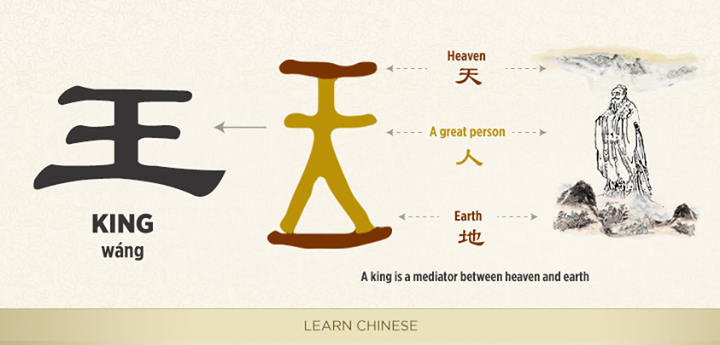
Opening canto - the opening assertion of the Six Ancestors aka dragons flying in the Heavens, the symbolic statement that the Heavens validates their auspicious right to be elevated above men and below the space of universe authority. Reference the meaning of "king" in Chinese character.
meaning of the Chinese character "wang" or "king"
King Taejo, found of the Yi Dynasty, is valorous in war and in the hunt. He is powerful, righteous, blest by the Heavens, and therefore deserves the role of king and ruler/caretaker of the nation.
The last canto, the canto that affirms King Sejong, the fourth king of the dynasty, as the right to continue to rule, as based on the righteous foundation of the Six Ancestors.
Final Comments

Songs of the Dragons was the first book to be printed in the newly developed hangeul writing. Printing was executed with wooden block in October 1447, about two years after its compilation, and 550 copies were presented to various ministers. The editions that are presently extant include those printed in 1612, 1659 and 1735.

The compilation is now recognized as a monument to the cultural independence of Korea from China, a most important source for the study of the Korean language, and the beginning of Korean national consciousness and of vernacular literature.

For more information regarding the translation, reference a 1977 JSTOR preview of the book, by Peter H. Lee. 

Thursday, October 31, 2019

Bank of Korea Money Museum

Bank of Korea Money Museum is in the heart of downtown Seoul and was a phenomenal find! I never even heard of the place, but when I was passing by and saw people walking out of elegantly old, stately building that smacked of government money, I took a closer look at the large "marble" sign in front. A banking museum?! I decided I had time to go in!

Anti-counterfeiting Efforts

Central banks and minting offices around the world make great effort to develop anti-counterfeiting devices in order to combat increasingly sophisticated counterfeiting techniques.

Before the 1990s - characteristic banknote paper or special printing methods were used, e.g. watermarks and micro lettering.


From the 1990s - 2000 -- Additional features like windowed thread, intaglio latent images, optically variable ink, and special presses and soldering were developed and employed.

From 2006 to the present -- With forged banknotes increasing due to technological advances in digital devices, color printers and scanners, new security features like moving images in a striped band and band-type holograms have been adopted.


Examples of counterfeit banknotes: top (counterfeit), bottom (authentic)


High-tech process for making the modern authentic banknote

Security thread, comber noil (the short fibers remaining when cotton is spun into yarn), and florescent thread are woven into acid-free cotton pulp paper undergoing durability-building processes.


The paper then undergoes a systemic series of printings to layer prints on top of intaglios on top of varying colors ...


And the same series of printings with colors, iridescent dyes, itaglios, etc is also on the back side.

Design Symbolism on the Korean Banknotes

Each of the four banknotes in Korea (W1,000 ... W5,000 ... W10,000 ... W50,000) are imbued with cultural symbolism. Who is the great respected person on each banknotes and what are the primary symbolisms employed? All banknotes have highly recognized pieces of great art or scientific learning -- art, architecture, astronomy -- and each select piece contains deep symbolic value, e.g. books for scholarship, pine tree for the uprightness of the scholar and an eternal symbol, certain plants for longevity, wisdom, blessings, wealth, and the continuation of a family dynasty through a son, clocks and ancient maps lauding scientific learning and great advancement, to name a few.

W50,000


FRONT (OBVERSE) VIEW

Shin Saimdang, one of the most brilliant members of the literati and a calligrapher and painter of the Joseon Dynasty, excelled at poetry, handwriting and painting. She is well-known for her "Insects and Plants", which reveal many traditional Korean themes imbued with cultural value.

"Insects and Plants" (Treasure No 595)
"Mukpododo"


BACK (REVERSE) VIEW

Lee Jeong's Poongjukdo and Eo Mongryong's Wolmaedo are among the most typical paintings of the mid-Joseon Dynasty, depicting bamboo and ume flowers, respectively.


 W10,000


FRONT (OBVERSE) VIEW

King Sejong the Great was the fourth king of the Joseon Dynasty among whose great achievements was the creation of Hangeul (the Korean alphabet). 

"Inworobongdo" (The sun, moon, and five peaks) symbolizes the king in the Joseon Dynasty, and Yongbieochaeonga (Songs of the Flying Dragon) was the first literary work written in Hangeul.


BACK (REVERSE) VIEW

Cheonsangyeolchabunyajido (National Treasure No. 228) is an astronomical map produced during the reign of King Taejo, founder of the Joseon Dynasty, showing the original astronomical view of our ancestors.

Hongcheonui is the celestial globe element of Honcheonsigye (National Treasure No. 230), an astronomical timepiece invented in the reign of Joseon's King Hyeonjong.

The Optical Astronomical Telescope in Bohyunsan Optical Astronomy Observatory is the largest reflecting telescope in Korea.


 W5,000


FRONT (OBVERSE) VIEW

Yi I (Yulgok) was a Confucian scholar and politician during the middle Joseon Dynasty. Ojukheon (Treasure No. 165) was Yi I's childhood home, the place of his upbringing. It was so named because it was surrounded by ojuk (black bamboos).


BACK (REVERSE) VIEW

"Insects and Plants" as appearing on the W50,000 bill is part of a eight-panel folding screen, painted by Shin Saimdang. Two more of the panels appear on the W5,000 bill: "A Cockscomb and a Frog" and "A Watermelon and a Katydid". 


W1,000


FRONT (OBVERSE) VIEW

Yi Hwang (Toeggye) was a Confucian scholar during the mid-Joseon Dynasty.

Myeongnyundang (Treasure No. 141) is the building in the Seonggyungwan where students were taught.


BACK (REVERSE) VIEW

Gyesangjeonggeodo (Treasure No. 585) is a painting of the seodang, where Toeggye stayed, and its surround scenery. It is one of the masterpieces drawn by Jeong Seon (Gyeomjae).


______________________________________________________________

Anyone can walk through the museum, but do pay attention that the second floor closes a bit earlier than the other floors (at 4pm). Reservations for a specific language guided tour are possible:


a high recommend!

Tuesday, October 9, 2018

Hangeul Day, 2018 - Calligraphy at City Hall

According to the Sejong Sillok, King Sejong proclaimed publication of Hunmin Jeongeum, the document introducing the newly created alphabet which was also originally called by the same name in 1446. In 1926, the Korean Language Society, whose goal was to preserve the Korean language during a time of rapid forced Japanization, celebrated the octo-sexagesimal (480th) anniversary of the declaration of hangeul on the last day of the ninth month of the lunar calendar, which is on November 4 of the Gregorian calendar. Members of the Society declared it the first observance of "Gagyanal" (가갸날). The name came from "Gagyageul" (가갸글), an early colloquial name for hangeul, based on a mnemonic recitation beginning "gagya geogyeo" (가갸거겨). The name of the commemorative day was changed to "Hangullal" in 1928, soon after the term "hangul", coined originally in 1913 by Ju Si-gyeong, became widely accepted as the new name for the alphabet, and celebrated according to the lunar calendar.  
In 1931, the celebration of the day was switched to October 29 of the Gregorian Calendar, the calendar which is in contemporary use. Three years later, the date was moved to October 28, to coordinate the date with that of the Julian Calendar, which had been in use during the 15th century, when King Sejong had made his proclamation. 
The discovery in 1940 of an original copy of the Hunmin Jeongeum Haerye, revealed that the Hunmin Jeongeum was announced during the first ten days of the ninth month. The tenth day of the ninth month of the 1446 lunar calendar was equivalent to October 9 of that same year's Julian calendar. The South Korean government, established in 1945, declared October 9 to be Hangeul Day, a yearly legal holiday which excused government employees from work. 
Major employers pressured the South Korean government to increase the country's annual number of work days. In 1991, to balance out the adoption of the United Nations Day, it vacated Hangeul Day's status as a holiday. By law, Hangeul Day remained a national commemoration day, and the Hangeul Society campaigned for the holiday's restoration. On November 1, 2012, the Society won that campaign, when the National Assembly voted 189 to 4 (with 4 abstaining) in favor of a resolution that called for the return of Hangeul Day as a national holiday. This put pressure on the Lee Myung Bak administration, which applied the change in 2013.
But in reality, this is a bit of a "free" day for Koreans, meaning there are no social or family obligations entwined at all with this day. This holiday has no specific food traditions, no ceremonial traditions, and no duties or functions to perform or even think about. So people can just enjoy a whole day without communal obligations or need to gather over specifically prepared foods. They are totally free to plan their hours without any social constraints. and so I was really pleased to see a large gathering at City Hall where people could indulge in street food and experience Hangeul Day themed art. 

An extensive line-up of display boards lined the Cheongyecheon and the boards were loaded with Hangeul Day postcards, many done in watercolors and calligraphy inks. I'm under the impression that middle and high school students made a large contribution to this display, but the public was certainly encouraged to make their own Hangeul Day postcard at booths on both sides of the display. Wherever this huge display of handmade postcards came from, I have to say that the art level of some of the postcards was quite stunning!


Thursday, February 22, 2018

James Garth - "I Thank Korea for Her Books"


“I thank Korea for her books” James Scarth Gale, Korean Literature in Hanmun, and Allo-metropolitan Missionary Orientalism

Lecturer: Professor Ross King
Date: Tuesday, October 17, 2017 - 7:30pm to 9:00pm
Venue: Second floor Residents’ Lounge, Somerset Palace, Gwanghwamun
             (near Anguk Station, across street from Japanese Embassy)

A Royal Asiatic Society Korea Branch bi-monthly lecture (www.raskb.com for more lectures)


In this lecture, I give an overview of my forthcoming book by the same title. Based largely on the James Scarth Gale papers held by the Fisher Rare Book Library (University of Toronto), this project examines and contextualizes James Scarth Gale’s forty-year career as a missionary scholar in Korea (1888-1927) and argues that Gale is a foundational but largely forgotten and underappreciated figure in the history of modern Korean Studies, particularly as concerns traditional Korean literary culture and literary history—topics that remain underexplored in English-language scholarship to this day. The Gale Papers force a reevaluation of our image of Gale and his legacy: from that of missionary, lexicographer, historian, and occasional translator of premodern fiction, to dedicated bibliophile, and champion, prolific translator and interpreter of Korean literature and literary culture in Literary Sinitic.

The project approaches Gale’s scholarly legacy by focusing on his Korean bibliomania, and is divided into two parts. Part One analyzes Gale’s collecting of old Korean books, his study and translation of them in collaboration with his Korean ‘pundits’, and the relationship of his literary and scholarly work to broader questions of ‘Orientalism’ in general and missionary Orientalism, in particular. 
One key argument is that for Gale, ‘Korean literature’ existed almost exclusively in the cosmopolitan code of Literary Sinitic (‘Classical Chinese’); modern Korean literature was barely getting off the ground in the 1920s when Gale retired, and he was dismissive of vernacular literary production, both premodern and modern.  
A second key argument is that Gale strove through all of his activities to demonstrate that Korea was a ‘civilized nation’ and a ‘nation of scholars and books’, whose deep historical engagement with Chinese civilization and thought had prepared it for Christianity and its one Great Book.  
A third key argument is that Gale’s literary and bibliophilic project amounted to a major intervention into defining—in a contested and transnational intellectual field in colonial Korea in the 19teens and 1920s—the premodern Korean literary tradition and canon; a full accounting of his book collecting and translation projects sheds new light on the process by which the modern notion of the ‘Korean Classics’ was constructed.  
A final question the book poses concerns the relative oblivion into which Gale’s work fell: why is he largely forgotten today, even in Korea, and why was the bulk of his work never published?
Ross King earned his BA in Linguistics and Political Science from Yale College and his MA and PhD from Harvard in Linguistics. Currently he serves as Professor of Korean and Head of Department in the Department of Asian Studies at the University of British Columbia in Vancouver, Canada. His main research interests are Korean historical linguistics, Korean dialectology (esp. the dialect(s) preserved by the ethnic Korean minority in Russia and the former USSR), the history of Korean linguistics (including the history of Korean linguistic thought in Korea and Korean linguistic and script nationalism), and the history of language, writing and literary culture in the ‘Sinographic Cosmopolis’ (漢字文化圈).

Ross King is also the author of a Korean language series: Elementary Korean: Second Edition, (Audio CD Included), Advanced Korean: Includes Sino-Korean Companion Workbook on CD-ROM, and Continuing Korean: Second Edition (Includes Audio CD) - all three published 2014 and 2015.

This lecture can be viewed on the Royal Asiatic Society Korea Branch YouTube channel - 

Wednesday, November 2, 2016

Nat'l Museum of Korea: Moveable Type (special exhibition)

The National Museum of Korea has a special exhibition displaying huge trays of moveable type with placards around giving more specific information on what is being seen. The museum has two English-speaking docents who are new to guiding guests, but they were phenomenal in organization of slides and content. The docent who primarily led this tour, Sun, put together the following slides to facilitate guests in gaining easy access to a lot of information in the single-hour tour. Thank you, Sun! 


National Museum of Korea: Home to world's largest collection of moveable type 

The National Museum of Korea is holding the first-ever exhibition presenting a complete picture of the Joseon Dynasty moveable type housed in its collection. Most of the more than 820,000 pieces of moveable type were used by the royal court and in government offices from the 17th to early 20th centuries. It is a rare case for such a large volume of moveable type originating within a single dynasty to have survived. In terms of both quantity and quality, over 500,000 of the pieces of metal moveable type in the collection have no parallel anywhere in the world.

Moveable type represents the ambitions of the rulers of the Joseon Dynasty as they sought to govern the nation through Confucian principles. Chests for storing moveable type pieces allow a glimpse into Joseon typesetters' unique system for classifying and storing moveable type pieces.


Chests for storing and organizing moveable type

Metal moveable type produced by the state represented royal authority and therefore demanded meticulous maintenance and management. A set of moveable type was generally stored in a collection of seven chests, and the amount stored in each chest was recorded in a moveable type catalog knows as a jabo. These catalogs classified moveable type in Chinese characters in a manner distinct from the system found in classic dictionaries of Chinese characters. For more convenient use and storage of moveable type, certain radicals of the Chinese characters were integrated with other radicals, and characters were classified by shape rather than by the number of strokes.

In Joseon why was moveable type produced?

In contrast to woodblock printing that was by nature restricted to only the inscribed content, moveable type, once produced, could rapidly print a range of documents by simply recombining type pieces as needed.

How many times was moveable type produced?

During the Joseon dynasty, both metal and wooden moveable type sets were respectively produced at least 30 times. Production of metal moveable type was mostly a project of the state, and wooden moveable type was also produced by the state on a number of occasions. The quantity of wooden moveable type produced by the citizenry is difficult to determine.

How many pieces of moveable type were produced each time?

Due to the quantity of type pieces required to print several kinds of books in logographic Chinese characters with a given set, at least tens of thousands of pieces were produced for each set of moveable type. Additionally, pieces of type that might appear multiple times on a single page were often produced in the hundreds.


A Timeline of Moveable Type