Saturday, April 16, 2016

Sinheung-sa Temple and Jang Bogo

Sinheungsa meaning "newly emerging temple" was founded and originally named Bulnosa or "not aging temple" by Venerable Kim Seongyeol in 1932. Though having such a short history, its foundation spirit dates back to one of the greatest admirals in Korean history, the commoner Jang Bogo (787-846) from Unified Silla (676-935).

Not only a strong believer in Buddhism, Jang was a powerful maritime figure who for several decades effectively controlled the West Sea and Korean coast between southwestern Korea and China's Shandong peninsula. His impressive fleet of ships was centralized on the island of Wando off Korea's southernmost tip. So influential a figure did Jang become in late Silla politics that he was granted official office as Maritime Commissioner of the Cheonghaejin Garrison. With increasing power, he became rather contentious with the Silla king and its related political powers, and in a bold step to marry his daughter to the king of the Silla kingdom, he overstepped his power and was assassinated in 846. In death, he was worshipped as a god, especially on the small island of Jangdo. The shamanistic temple on the island worships "Great General Song", who is, according to islanders, the title for Jang Bogo.

He was the founder of the now defunct Beophwasa, "Dharma prospering temple", on Wando and he helped Buddhism grow in the region. In fact, many places on the island were named after Buddhist terminology. Though Beophwasa was later destroyed, its historical legacy was passed down to Sinheungsa, which is an important temple to the islanders.

Jang used Buddhism as a tool to educate and unify people. His influence is evident in the Beophwawon temple in China, which he built, and several other temples having the same name and which he also built—in Kyoto Japan, in Zhejang China, on Jeju island Korea.

Jang sponsored the Korean monks who were studying Buddhism in China. After returning to Korea, they became forefathers in a new Buddhist movement that started to shift the method of mind enlightenment from sutra study to Seon/Zen practice. In the southwestern part of the Korean peninsula, he gave large support to three key temples of the nine newly opened Seon temples. This Seon Buddhism grew to become a mainstream for teaching Korean Buddhism throughout history. 

Of particular interest in Sinheung-sa is the Wooden Seated Medicine Buddha in the main Buddha hall. It is thought that the medicine Buddha is one of a Triad of Medicine Buddhas in Simjeok-am Hermitage if Daeheung-sa, and which was later moved to Sinheung-sa by Monk Eungsong. According to record being kept inside the Buddha, this medicine Buddha was carved out of wood in 1628 and coated with gold in 1865. It was created in peace time after the end of the period of Japanese invasions, the aftermath of war when Buddha statues began to be produced nationwide in large quantities.

Walking distance from Sinheung-sa

The temple is located high on a sharp hill overlooking Dadohae Haesang National Park, which is heavily dotted with islands amid expansive sweeps of water. What a view! About 30 minutes hike down the mountain-hill is a fish market teaming with fresh fish pulled that day from the ocean, and a bit further is the tall Wando Tower that climbs into the sky to give a powerfully impressive view of a waterscape of the national park.


Korean Buddhists don't eat fish or seafood because it's taking life. I do wonder, however, when this practice started because historically Korea has had a lot of dependence on the duality of agricultural and maritime food fare.
Temple-stay at Sinheung-sa

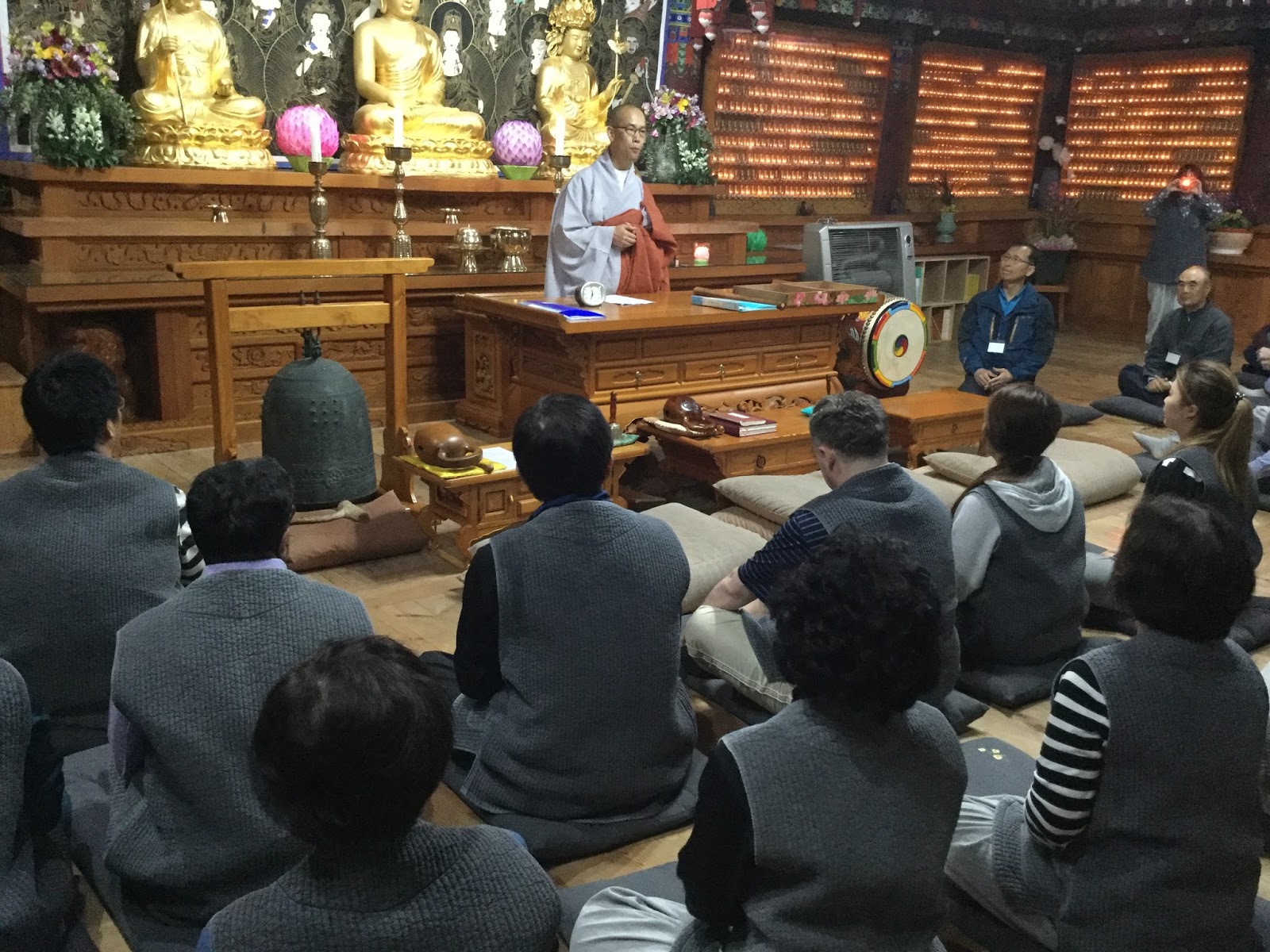
About 35 people participated in the temple-stay offered by Dongguk University Seon Center. As a guess, about half of the people were Buddhist and 11 of us were foreigners (USA, Poland, Brazil, Spain, China, Japan, India).


Amazingly huge! Dragons are the protectors of Korean Buddhism,
but I'd never seen a dragon sitting on the ground before. They're always been portrayed as celestial creatures
of the air as they represent the space between earth and heaven. 
The celestial phoenix also plays a central role in Korean Buddhism.
The blue and the yellow dragons over the Buddha. One day I'll understand the significance of these two colors which invariably play a central part in the Korean temples.
The Buddha of the main hall. I'm not sure if this is the famed medicine Buddha or not.
108 Prostrations

The number of 108 is a number important in Hinduism and Buddhism. The number represents the number of defilements in the mind, or as some look at it, the number of compartments in the mind. Each prostration opens a compartment and clears consciousness, and by bowing the full 108 times, the mind and the body become one. Consciousness is slowly restored this way. As one source says, "Our bowing takes away our karma mind, our thinking mind, and helps us to find our true nature and save all things from suffering". The last part is very disconnected, but ultimately the bowing is supposed to help the individual and the earth keep from suffering. I'll have to think about this. At the moment it makes no sense. Here's another quote related to bowing 108 times:
"The practicer of Buddhism is the never-ending humbling of the ego. Humbling yourself before the world, by lowering your body you realize that you are one with everything. Performing 108 prostrations is yet another path towards the realization of the True Self."

And then a look at the 108 bows as expressed as a mathematical equation:
We have 6 doors of perception: sight, sound, smell, touch, taste and thought.
There are 3 aspects of time: past, present and future.
There are 2 conditions of the heart/mind: pure or impure.
There are 3 possible attitudes: like, dislike and indifference.
Korean Buddhists use this formula 6 x 3 x 2 x 3 = 108 bows to cut through our Karma.
Supposedly temple-stay is about helping people find or restore their True Self. During temple-stay there are three meals (some temples offer only two, but Korean monks really like to eat so the two-meal temples are rare) and three meditations, one of which usually involves prostrating one's self 108 times.

The ceremony begins with the ringing of a large bell inside the main Buddha hall.
The repetitious ringing of the bell is to, as I understand, relieve the sufferers in hell.
Each strike is supposed to offer some relief. The ringing is performed while chanting. 
The head monk then moves in front of the Buddha statue and, while chanting (the lotus sutra?) begins the 108 bows.
At first the rhythm is slow and then it picks up.
Bow to the floor, left foot overlapping right foot slightly, lift hands palm upwards past the ears to lift up prayers or thoughts? Your forehead, elbows and knees (the five points of the body) are to touch the floor simultaneously.


And following the 108 bows when supposedly the mind and body are pure and unified, a Dharma talk is given.

Tuesday, April 12, 2016

Korean Garden Cultures—Longing for the Immortal

Professor Sim Woo-kyung affirms that "it is essential to maintain and celebrate cultural diversity in a landscape to acknowledge the contributions to garden art being made by ethnic groups world over. Historically, gardens have attempted to recreate paradise, becoming ever more elaborate versions of the rational mind's vision of heaven. Garden makers in history have been intent on creating earthly paradises. All the people have wishes to live in the paradise, but the concept of the paradise has been differently imagined by the Eastern and the Western cultures, especially according to their religions. The Western cultures have been deeply influenced by the Judeo-Christian and the Islam which believe in the only God [monotheism], but the Easterner has been influenced by their beliefs in many gods [polytheism], that is, by Taoism, Buddhism, Confucianism, Animism, Totemism and Shamanism.

In the Western world which has developed from the desert, a prototype of garden was where human beings were protected by high wall from hot sandy wind and fearful animals, and where cool water and fruit trees were well supplied to live safely [sic]. On the contrary, in the Eastern world which has developed from beautiful natural environment, the prototype was where people could realize the longevity in the immortal world through living harmoniously with nature.

Korean traditional garden culture has developed uniquely under the beautiful natural environment and various religious influences. Thus the final goal of Korean garden cultures has been the immortal world."

Evidence of the Immortal World in Korea Gardens

Garden cultures have been developed in natural environment and influenced by religious fervor; thus, it can be said that the purpose of the garden cultures is to recreate an Earthly Paradise according to the dreaming ideal world of each country. Even the English word "garden" is influenced by monotheistic religious beliefs because "garden" stems from gar [protect] + eden [pleasure], namely a place of pleasure to protect or that protects.

Korea has been known as the Immortal Country in Chinese literature and this is evidenced by"examples" of the Immortal worlds in Korean garden cultures as shown through drawings, historic records and remains. Even during the Joseon Dynasty where stern Confucianism was a state religion, many scholars longed for the Immortal worlds in their gardens.

The mountains and sea islands described in the thoughts of the immortal worlds were not only landscapes as objets for meditation and appreciation but ideal landscapes, in other words, Oriental Utopia, which human beings try to achieve.


Background of Korean Garden Culture:

Korean Natural Environments

  • clearly different in each of the 4 seasons (금순강산 - the four seasons meaning "scenic areas")
  • mountainous country (65%)
  • peninsular country
  • approximately 7,500 genera of flora
  • 104 species of indigenous fauna

Envisioning the immortal as depicted in the Goguryeo tomb murals.
For more specifics look up pictures of paintings found inGoguryeo tombs dating back to the 4th C in Jiban, China
Korea Religions—peaceful coexistence of diverse religions

  • since 5,000 years ago - present: indigenous faiths such as manaism, animism, totemism, shamanism, mountain spirits
  • since 1,700 years ago - present: Buddhism, Confucianism 
  • since 1,300 years ago - present: Daoism 
  • since 600 years ago - present: Neo-confucianism
  • since 300 years ago - present: Catholicism
  • since 120 years ago - present: Christianity
  • since 100 years ago - present: Cheondogyo, Wonbulgyo, Jeungsando, Islam, etc
  • [source: David Mason (2000) Mountain Spirits]


11 immortal figures are carved on the golden incense burner, which supports the connection with mortals and their projected thoughts to the immortal world, a world of longevity (or as Christians would say, eternal life). By incorporating the symbols of the 싶장생 (the 10 eternal symbols), Koreans showed their longing and search for the immortal world.


Even in the Joseon Dynasty, the longing for an immortal world and for long-life, health and happiness are reflected in the dynasty's garden architecture. Particularly iconic examples of this longing for immortality is also apparent in many buildings especially palaces, gates, art, etc that still are in existence today. And an important note, garden architecture is intimately tied with mountain reflections and the qi (energy) within.


Between Gyeongsan County (2014) and Lee Hyok-jong (2009), there are 120 documented sites of remains which reflect the immortal worlds.
Even Goh boards have been carved on the rocks of several mountains. The game of Goh was known as the game of the gods, basically as a game played by the immortals, and therefore was a game to embrace with great thought.
Pictured is a modern-day goh board; the game of goh is intensely popular with older men, in fact, so interesting that aging men gather in specific areas of parks to compete; they also pay for memberships at goh rooms. Even TV stations broadcast the players playing the thoughtful (and very slow) game of goh, and the programs are widely popular ... seems to be considered a male game as I've never seen a woman enjoying goh in public.  The four names listed under the goh board are mountains where a goh board was carved long ago high on its rocks.
Similarly, rock holes are carved near peaks of certain mountains. The sites were chosen for the natural energies erupting form those rocks or mountains and so inside of these holes, magical elixirs were brewed. It is very likely that hot burning charcoal chunks were dropped into the elixir in the holes and brewed that way.


There are 101 Nine Valleys (Gosan Gugok), 1577AD,  in Korea, while in China there are only 12. The Nine Valleys are a bit hard to explain but seem to be nine precious areas which contain 101 (in the case of Korea) treasures of longevity (?). This is very unclear to me, the blogger, so this needs more personal research. Each of these nine valleys, however, are associated with a Great Confucian Scholar.


Confucian scholars who followed stern disciplines tended to disregard the Immortal world, but they wished to be immortal through many gardens and writings. Making the Immortal world in the garden means a kind of auspicious activity for having the same thought connected with same results.

Thoughts on the Immortal have been deeply rooted in Korean minds and their history began from the Korean founder Dangun Wanggeom (born 2333BC) via Hwarangdo in the Silla Dynasty and Kim Ga-gi's "soaring to the sky" (February 25, 859) and then Choi Chi-won's (857-?) Punryu treatment. Punryu is a unique philosophic religion, and "soaring to the sky" comes from 신선, which derives from spirit + flying into the sky. To be immortal, it is for one's spirit to go to the mountains.

There are two ways to be immortal. One is to take a magical elixir, which is in fact dangerous as Chinese history tells us: many emperors died through this method. The other is to practice qi exercises, particularly in propitious places.


Thus, traditional gardens are not just built to be in an aesthetic setting but built to be practical, functional, educational, symbolic and even ecological.

Professor Sim Woo-kyung will continue giving information on the immortal considerations of the traditional Korean garden and its attempt to embrace immortality. He will be leading tours May 20-29 of his beloved Rose Garden which he designed as an architectural engineer. The Rose Garden is located in his hometown in Gokseonggun County, Seonnam.

__________________________________________________________

Dr. Sim Woo-kyung 五峯 沈愚京, Emeritus Professor of Landscape Planting and Garden History (Korea University, Seoul), President, Research Institute for Spiritual Environments [R.I.S.E.], Director, OBONG Academy for Research Institute for Spiritual Environments, and Chair for the Promotion Committee for Founding University of Global Environment Conservation, presented on Korea's garden culture and its ephemeral representation of an immortal and perhaps celestial world.

Saturday, April 9, 2016

The Jindo Miracle Sea Road Festival

Jindo island located just off the southwest corner of the Korea peninsula is a mystical island of folk art and music, traditional performance and the much celebrated surreal sea road which forms a 2.8 kilometer long pathway to an outer island twice a year. This mysterious walkway roughly 10-40 feet wide has been dubbed the “Korean Moses Miracle” and attracts Koreans and foreigners alike to see the mysterious phenomenon and walk its length.

The four-day Jindo Miracle Sea Road Festival in spring attracts about half of a million visitors every year, making it one of the three top festivals in Korea. The two other most popular festival events are the Mud Festival in July and the king of festivals, the Hwacheon Sancheonea (mountain trout) Ice Festival in January. For all of these, charter tour buses from various cities flow into these otherwise minimally populated areas, filling large pre-designated parking areas. Traveling by private car to any of these places during the festival season is one’s worst nightmare.

This year the Jindo festival opened on a Thursday, April 7, and concluded on Sunday, April 10. And because this year the lowest ebb tide of the Moses Miracle took place on the weekend, tour buses arrived throughout the weekend for people to see this once-a-year celebrated phenomenon. The most popular buses, however, were those that arrived in the early dawn of Saturday, in time for the Fire Torch Walk when thousands of people carry flaming gas-lit torches and walk into the sea on the appearing path that links Jindo to the distant Modo island. For those who missed the iconic Torch Walk, the sea parting occurred again at 18:20 on Saturday and 19:00 on Sunday. A few thousand even got up early Sunday and did the unofficially schedule sea path walk at around 6:40am.


Each of the sea path occurrences lasts about an hour, so if a person does get to Modo island, he or she will probably be stranded there or be forced to hire a local boat to ferry them back to the larger island.

The sea path is steeped in legend and, unlike other legends of long-long ago, the legend of Grandma Ppong and the sea path goes back to a precise date, the year 1480 when a man Son Dong-ji was condemned to exile on Jeju Island. As Son’s ship navigated to Jeju, a furious storm blew and shipwrecked him on the tip of Jindo island at a savage place called Hoedong, literally the “tiger place”, named so because of the numerous striped beasts prowling the area. Son stayed with the villagers and for the next 200 years his descendants lived in Hoedong until the area became so frightening a place to live because of the many tiger attacks that the villagers along with Son’s descendants built rafts and moved to the nearby Modo island.

Unfortunately in the move, a grandmother was left behind. In terror and loneliness Grandmother Ppong prayed to the Dragon King of the sea to be reunited with her family. Finally, in a March night dream the Dragon King appeared and told her the next day a rainbow would appear to guide her to her family. The next day on the rocky shore she prayed again and the rainbow bridge appeared, forming an arching path from Hoedong to Modo island. In her joy she ran along the rainbow path and collapsed into her family’s arms on the other side whereupon she praised the Dragon King for reuniting her and then died from exhaustion.


In filial respect, her family honored her for her tenacious faith in the Dragon King. Many locals still dance, stage shamanic rituals and have other performances to give respects to Grandma Ppong for her strong faith in the Dragon King. Particularly during festival season, the statue of her located at the narrowest expanse between now-Jindo and Modo is draped with ribboned wishes and prayers as she looks earnestly to the distant island. Another statue overlooking the head of the rainbow path is where Grandma Ppong kneels beseechingly while looking toward Modo; a snarling tiger statue is her companion.


Though a legend to some, many Koreans still put faith in the powers of the Dragon King and the faith of Grandma Ppong. Many come to pray for the well-being of family members, for wishes for their children, for prosperity and health. The local Jindo residents have a traditional celebration called Yeongdeungje in which they pray to Grandma Ppong and the Dragon King, their village guardian spirits. Unlike the more publicized Jindo Miracle Sea Road Festival which is only celebrated in spring, Yeongdeungje is held during the spring and fall sea road partings when the road is widest.

The partings are scientifically explained as tidal harmonics. Predictable by the lunar calendar, the phenomenon is controlled by the gravitation pull of the moon along with effects of the rotation and momentum of the earth. From a superstitious point of view, a mystical miracle occurs.

The Jindo sea parting is a family experience. Everyone can participate, and while mom is digging around for lunch, baby is quit dry and content to just be along!
Wearing gumboots and carrying a trowel and a pail or just a bag, Koreans are fully equipped to explore food for lunch: crabs, clams, abalone, stranded octopi, sea tangle and other sea delicacies are all fair game!
photo contribution by Nicola Hayne - adventurers feeling their way along as the tide continues to ebb
The Jindo Miracle Sea Road Festival didn’t stem from the prayers to Grandma Ppong or the Dragon King, but came about by the French ambassador Pierre Landy who was visiting Jindo island in 1975 to learn a bit about, some say the Jindo dogs and others say the local music. Why he actually went there is now unimportant for what he saw, Grandma Ppong’s rainbow bridge, he unintentionally immortalized in a French newspaper when he published his observation as the Korean version of the Moses Miracle and much like the Biblical parting of the Red Sea. After international awareness was raised, other foreigners wanted to witness the parting as well, and so in 1978 the sea parting festival was established.

Western foreign interest increased every year, until in 1996 Tendo Yoshimi, a Japanese pop star, sang the song “A Story of Jindo” describing the enigmatic water parting which ignited Japanese interest in the phenomenon as well, so then hordes of Japanese tourists flocked to Jindo every year.  

The Jindo sea parting miracle is not the only ebb tide sea road in Korea. In fact, about 20 others exist. Somaemuldo, the so-called “lighthouse island” off Geojedo, Gyeongsangnam-do has a rock-strewn path that appears regularly twice a day; then near Incheon a stretch of cement-paved walkway appears to connect Nuesan Island Lighthouse Observatory with the mainland, and nearby on Seonjaedo island a fairy-like meander of golden sand appears to bridge Seonjaedo to the tiny Mokseom island. More exist but none as long or wide as the Jindo phenomenon and none have yet had international exposure on such a grand scale to immortalize them as must-see tourist attractions.

Jindo island in its own right is a tourist attraction. At least five folk heritages have been listed as intangible cultural heritages with UNESCO—the ganggansullae, a circle dance performed by women; the ssitgimgut, a shamanistic ritual soul-cleansing of wandering spirits to resolve their earthly grievances; the Jindo dasiraegi, a performance for consoling people who have lost family members; the deulnorae, a farmer’s song; and samulnori, the play and dance to the beat of four percussion instruments. Two other folk heritages are listed by the provincial government as intangible cultural assets—the Jindo buknori, a traditional drum play with two sticks, and manga, the local funeral dirges. It can be said that much music and performance claims Jindo as their birthplace. And thus the Jindo saying, “When in Jindo, beware of showing your musical abilities” because the musical talents are high and broad.


Jindo, a place where anything is possible if connected to the sea.
These boats were part of a long boat procession that paraded for the Jindo visitors.
The mythical aura of Jindo is more than just legend, and gugak—Korean traditional music and performing arts—has rich history as well for near Jindo island is where brilliant Admiral Yi Sun-shin (1545-1598) fought with his famed turtle ships to defeat the Japanese fleet. It is also the island that the unfortunate ship MV Sewol sank near in its unfortunate maritime accident just two years ago. On a lighter note, the famed Jindo dog is of course taking its name from Jindo island; the animal is no highly regarded that it is esteemed as a national treasure. Accordingly, Jindo dog shows and performances during the Jindo Sea Road Festival are scheduled to highlight the dog’s superior intelligence and loyalty to its master.

And finally, if someone adventures to Jindo island, whether during festival season or not, a visit is said not to be complete unless one enjoys the local Jindo hongju, a 40% alcoholic drink made from whole grains, rice and jicho, a local medicinal herb extract. The bright red liquor, hence its name “hong” for red, is the only distilled red-colored liquor in the world, and it is said not to give someone a hangover the next morning. With that in mind, the visitor can enjoy the mystical flavor of the island while walking the sea path, listening to gugak or simply drinking the medicinal-herb liquor.

Korean traditional wrestling with professionals

After the professionals exhibited their skills, foreigners could participate. My friend and one other were the only foreigners of about eight who could "triumph" over the professionals. They brought with them Western wrestling tricks unknown to the Korean pros.


Published in Korean Quarterly, Vol 19, No 40, Summer 2016, p 49, 64-65.

Sunday, April 3, 2016

Holy Hai Festival in Busan

Holi Hai Festival in Pusan is a big attraction to the young foreign crowd in Korea, and Seoul Hiking Group, Adventure Korea, WINK Travels, Goh Travel Korea, CIK (Climbing in Korea), and I am sure there are others, cashed in on the demand for entertainment and scheduled multiple overnight buses leaving Friday night from Seoul to arrive in Pusan in the early a.m. for a weekend of fun. The colorful Holi Hai Indian celebration wasn't to be held until Sunday, so the various foreigner-only travel groups planned attractive itineraries to lure in the foreigners and entertain them.

The group I've started participating in is Seoul Hiking Group. Compared with the others, Seoul Hiking gets more involved in the natural landscape of Korea. While there is of course the focus to entertain, the organizer Warren is passionate about hiking and drinking magkeolli but he emphasizes that hiking is the purpose for the fun so not to drink too much. A very homey, down-to-earth approach which I like, and a quick way to get to far away places without trying to catch a series of public transportation which take forever, esp when going to distant secluded areas.

I wasn't particularly keen to go to the Holi Hai event but was lured in by the posted schedule of waking up on Saturday morning for an early sunrise experience at Yonggungsa Temple, the only temple in Korea that's built at the edge of the sea. The temple name translated means "Dragon Palace Temple" and the temple is said to embody the harmony between the sea in its foreground, the black dragon that ordered the temple built, and the Great Goddess Buddha, the protecting temple deity. I'd never been there but heard it was beautiful, especially at sunrise, so I joined the go-to-Holi-Hai event. Hmmm, we did get to Yonggungsa but not at sunrise. I got some pictures but not the mystical pictures I was hoping for with an early sunrise experience. Bit disappointed, but the Holi Hai festivities were pretty good fun and a new cultural experience so it was a good weekend.

The Meaning of Holi Hai


Holi has become perhaps India's biggest festival and probably its least religious. Holi is a Hindu annual festival that is based on Hindu mythology and used to be an agricultural festival. However, now it is just a celebration of spring and its coming colors and return of vibrancy. During the typically two day festival (used to be five) social norms between the castes, classes and genders are relaxed and everyone indulges themselves in merrymaking and the throwing of water and colored powders, hence the festival name "festival of colors". In the relaxed atmosphere which is typically controlled by rigid rules of decorum, language becomes ribald and behavior even wild and licentious, but what is commonly heard during Holi is "Bura na mano. Holi hai" (Don't feel offended. It's Holi."

I don't really know why Korea has started embracing the Holi Hai festivities, but there are a lot of middle-easterners and maybe their community at one time had a big festival for themselves and others watched and wanted to participate. Anyway, Holi Hai has been celebrated since 2010 in Korea. Last year (2015), 1,500 people participated in the event!


Pusan Sight-seeing Options

Our bus arrived in Busan around 5 a.m. Saturday morning, and after our 10 a.m. stop at Yonggungsa Temple and check-in at our pension, we were free to join the beautiful coastal walk at Igidae or do our own thing elsewhere in Busan.

Warren, the tour leader, gave us a lot of options and tentative time schedule for planning our away-from-the-group activities. Warren's travel tip: "The easiest way to get somewhere is to walk and get exercise and see more!" Haha, that's Warren!
A. Tour bus option: IGIDAE ORYUKDO ISLAND COASTAL WALK (3 hrs) 
After hike, Sunset Mountain Skyroad Driving for night scenery which was chosen as one of the best night sceneries in the world (1hour), and Vivid Night Fish Market (1hour) 
B. JANGSAN MOUNTAIN: 장산, best view of Haeundae (2 hrs) 
You don't have to go all the way to the tower or pay money to take the elevator up! The mountain is right behind the subway station and is similar to the mountains in Seoul, commanding great views of the city, especially the whole area of Haeundae. And if you don't want to hike all the way up, just walk for 30 minutes up through the village and pass a temple. The mountain paths are scenic in their own right! 
C. HAEUNDAE TRADITIONAL MARKET: taste local food! (1~2 hrs) 
The Haeundae area is famous for the market alleys. You can find several 소머리국밥 "someori gugbap" (beef stew with rice) places. You can pretty much walk into any crowded restaurant and everyone will be eating this same style of stew! On the restaurant walls there is usually a bunch of autographed photos of celebrities who have visited. There are of course other choices, but this is the only stew with rice in it or rice on the side. Or, if you're feeling more adventurous and want something more unusual, try 선지 해장국 "seonji haejangguk," a stew made with beef blood jelly. Sounds gross but is actually really good! 
D. CENTUM CITY & BUSAN FILM FESTIVAL (2~4 hrs; subway from Haeundae 15 min) 
Busan has the monstrously huge Centum City Department store, which won the Guinness Book of World Record for biggest department store in the world in 2009! You can see the award monument in front of Shinsaegae. It has one of the biggest saunas in Korea, Spa Land (스파 랜드), and if you're a fan of saunas, this is a must-do! Very near Centum City (a block on foot) is the facility where the well known Busan Film Festival is held; it  has great architecture. Film exhibitions and some performances will be at Centum, for those interested. 
E. JALGALCHI FISH MARKET & TAEJONGDAE - 자갈치 & 태종대: (4~6 hrs; subway from Haeundae, 1hr) 
Jagalchi fish market is a great place to feel the vivid energy of coastal life. A person can explore not only the market but the nearby 광복동 "Gwangbokdong" fashion street, and 남포동 "Nampodong" which is kind of the old downtown Busan. For enjoying a view, just walk up towards 용두산 "Yongdusan" Park to also see a statue of admiral Lee Sun Shin . As the lord high admiral of the Korean fleet in the Choseon Dynasty, Lee Sun Shin led the fight against the Japanese during their invasion of Korea in 1592. Busan was hit the hardest by the Japanese invasion and occupation being the closet port to Japan.

From Jagalchi, take the city bus to 태종대 "Taejongdae" Marine Park (about 40 min) to enjoy a pebble beach, and eat live octopus. Adventure on hiking paths, stroll to a lighthouse.

F. BEOMEOSA TEMPLE & GEUMJEONGSAN FORTRESS - 범어사 & 금정산: (4~5 hrs; 1 hr by subway) 
Hiking starts from Beomeosa station where there is a trail to the temple. At the top, hike a loop which will take about 3 hours (very light hiking) to explore the mountain area around the fortress. 
Geumjeongsan is kind of like the "Bukhansan" of Seoul -- very popular, many trails, and any of the trails take you back to some part of the city, so even if you get lost, you can explore and end up finding more interesting places. Walk along the ridges of Geumjeongsan for 1~2 hours. There is also a trail which leads you to 금강공원 "Geumgang gongwon" (park) and a cable car to the top. The bottom of the park where the cable car starts is the 온천동 "Oncheondong" (spa town), well-known for 동래온천 "Dongrae oncheon". All the roads are lined with spa motels, including one of the oldest and biggest in Busan. The closest subway station to this area is Dongrae (동래) station. 
G. OBSERVATORY & EULSUKDO ISLAND - 을숙도: Eulsukdo Island (2 hrs; 1 hr 10 min travel time) 
Where the end of Nakdong river merges into the ocean is an excellent spot for bird watching. Here, many birds rest during their long migration, and can be seen in the observatory. There is also the new Nakdong estuary eco center 낙동하구체험센터 for feeling, seeing and tasting some of local culture. The closest subway station is Sinpyeong station (신평역). 
H. GAMCHEON CULTURE VILLAGE - 감천문화마을: (2 hrs; subway ride 1 hr) 
This untouched (for 30-40 years) town is located within a steep hill and is far from downtown. It is similar to 개미마을 village in Seoul. Winding roads in a valley crevice full of colorfully painted houses and murals. A super interesting contrast of old and new. The whole village has a view of the ocean, so all the houses are densely crammed into a small space! Start explorations here from Jagalchi station (자갈치역) or Toseong (토성) station.