Thursday, May 5, 2016

Myohyeollye at Jongmyo Shrine

As part of the 2nd Royal Culture Festival 2016: Today We Meet the Palace, which highlights court proceedings in the Joseon Dynasty, the ancestral rites of Myohyeollye were conducted at Jongmyo Shrine.

Myohyeollye refers to the ceremony for the reporting of the marriage of Joseon's Crown Princess to the spirits of the deceased royal ancestors at Jongmyo. Among the national rites of the Joseon Dynasty performed at Jongmyo, this was the only event in which royal females were allowed to participate.

Myoheyollye Ceremony in Joseon Wangjo Sillok (Annals of the Joseon Dynasty)

1st articles of the Imjin dated October 9 in the 22nd year of King Sukjong's reign in the Chronicles of the King Sukjong, Book 30.
"If we allow female royal officials to participate in the Myohyeon rite, the dignity and reverence of the royal ancestral shrine will surely be harmed."
However, King Sukjong sternly reprimanded his retainers:
"Adopting and implementing the Chinese system is truly appropriate. Furthermore, who else should assist the Myohyeon rite performed by the queen and crown princesses, other than female royal officials? If we abolished or ceased performing the Myohyeon rite for this reason, it would be similar to not eating feed because we feel choked. Review this carefully, notify me, and strictly implement it."
After the king had sternly rebuked his retainers, he ordered them to go to Jongmyo Shrine with the queen and crown princesses. This incident shows the strength of King Sukjong's leadership. On October 16th in the 22nd year of King Sukjong's reign, the queen and crown princesses went to Jongmyo to pay their respects to their royal ancestors. For King Sukjong, allowing the queen and crown princesses to perform the Myohyeollye signified recognition of his daughter-in-laws' succession to the royal tradition and confirmed the status of his queen.

As such, the Myohyeollye, which was performed on October 16th in the 22nd year of King Sukjong's reign, was the first national event to include female participants, and was also the first time that both the queen and the crown princesses performed the Myohyeollye rite together. On that day, the king and crown prince wore myeonbok (the most prestigious formal robe -- on the king's outer robe were 9 cranes and 7 cranes on the princes, more than on the typical court robes robe at other ceremonies), while the queen and crown princesses wore the most splendid, colorful jeogui (the more formal dresses).  

Procedure of Myohyeollye

(1) Preparation of Bongsim by the King and Crown Prince
The king, crown prince, and civil and military officials make four reverent bows to the dynasty's previous kings.


(2) Visit to the Shrine by the King and Crown Prince
The king and crown prince pay a visit to the shrine rooms of the spirits of the deceased royal ancestors.


(3) The King and Crown Prince Enter Socha
After the civil and military officials have left the shrine, the king and crown prince enter socha.

(4) Almyo by the Queen and Crown Princess
The queen and crown princess pay an official visit to the dynasty's previous kings.


(5) The Queen and Crown Princess Depart

(6) Closing Ceremonial Photo Shoot


The Formality of the Attire: King and Crown Prince's myeongbok and the Queen and Crown Princess's jeogui


Sunday, May 1, 2016

Embellishments of Buddha Halls

A temporary exhibit last spring on the "Embellishments of Buddha Halls in the World of Magnificently Decorated Buddha" at the Central Buddhist Museum at the Jogyesa described some of the material accompaniments to augment religious practices. This helps me make some sense of the material culture of Buddhism which was suppressed but existed simultaneously with the aestheticism of Confucianism.


The Hall of Enshrined Buddha

Buljeon refers to a hall or building where Buddha is enshrined, and this building is the center of the temple. In a narrow sense, it simply refers to the main building of a temple, but broadly it means all buildings enshrined with Buddha or bodhisattva statues. A temple embodies the pure land of the utmost bliss. Therefore, a person's journey to a temple likewise leads to the pure land of utmost bliss. When a layperson like enters the Single Pillar gate, that person leaves the mundane world he/she lives in behind.

Since a Buddha hall is considered the pure land of utmost bliss, its architects magnificently decorate the building with sincerity in their hearts. When someone says Jangeom, it means to embellish or decorate with fine and beautiful things. Jangeom implies the pure land where all is beautiful and solemn, and also indicates the state of the bodies of Buddha and bodhisattvas, beautifully shining because of their good deeds. In this sense, it also includes the devotees decorating Buddha halls, as well as the statues. It is only natural that its embellishments are majestic and beautiful, since it is the pure land where the eminent Buddha resides.


Decorating the Land of Buddha

As a Buddha hall is a form of Buddha's land realized on Earth, it is the ultimate refuge for the sangha and the laity. Its symbols have been manifested in various forms of Buddhist art in every era. Accordingly, all the elements of the embellishments in Buddha halls are decorated in an elaborate and magnificent manner so that all devotees may cultivate their minds in the ideal pure land of Buddha, and thus they should be able to receive the divine response of the Buddha for their great devotion. Among all the elements of the embellishments in Buddha halls, the desire for magnificence is expressed most strongly in the form of craft works. These are excellent examples of the tradition of the most impressive Buddhist arts. During the Joseon Dynasty, various Buddhist ceremonies flourished despite religious oppression. At the time, Buddha halls were utilized for a variety of purposes. Consequently, the embellishments in Buddha halls were used in numbers of ways, leading to a greater variety in types of Buddhist decorations. Even now, many of these artworks survive, reflecting the aesthetic sense and faith of that time.


The Expansion of Buddha Halls, Outdoor Dharma Talks, and Embellishments

Various ceremonies were carried out inside of the main dharma hall to pay homage to the Buddha. However, when many people came for a ceremony, it was done outdoors. Well-known outdoor dharma ceremonies included Suryukjac, which is a ceremony to comfort lonely spirits and hungry ghosts both in water and on land, and help them attain rebirth in the Pure Land or in heaven by redeeming their bad karma.

For these outdoor ceremonies, the whole temple ground was set. However, the main yard of the main Buddha hall was the center stage of the ceremony. Also, just like a Buddha hall has three mandalas or altars, the system of three mandalas or altars was applied to outdoor ceremonies. The upper altar, with Buddha and bodhisattvas, became the dharma hall, and was decorated with gwaebul, an outdoor version of the long hanging Buddhist scroll painting of the Buddha and bodhisattvas. These outdoor gwaebuls were an important symbol not only for the ceremony, but also because they could transform the temple grounds into a Buddha hall, a ceremonial space.


Saturday, April 30, 2016

Garye for King Gojong and Queen Myeongseong

Garye refers to the wedding ceremony of kings, crown princes, eldest sons of crown princes, and the appointment of crown princes and eldest sons of crown princes. As it was a major event for the country, it usually took several months and mobilized several thousands of people. The event proceeds in the order of Nabchae, Nabjing, Gogi, Chaikbi, Chinyeong, and Dongroe. 


Garye for King Gojong and Queen Meyongseong at Unhyeongung Palace

Garye for King Gojong and Queen Myeongseong took place in March 1866 (the third year of the reign of King Kojong) in the following order:
  • Marriage was prohibited for all young ladies nationwide who were between 12 and 17 years on January 1 of the year in which Garye was going to take place.
  • Afterwards, Chogantaek (first screening) selected five ladies, and Jaegantaek (second screening) on February 29 whittled the number to three ladies, while Samgantaek (third screening) on March 6 Min Ja-yeong, the daughter of Min Chi-rok, was selected as the wife and queen of King Kojong.
Garye followed thereafter:
  • March 9 - Nabchaeeui proceeded at Changdeokgung Palace and Sunabchaeeui at Unhyeongung Palace,  a byeolgung (a separate palace)
  • March 17 - Nabjingeui and Sunabjingeui were conducted 
  • March 20 - Chaekbieui and Bisuchaekeui were conducted
  • March 21, during jinsi (7am - 9am) Chinyeongeui were conducted to receive the queen into Unhyeongung Palace, and during jeongsi (12:30pm - 1:30pm) Changdeokgung Palace served as a venue for Dongroeyeon, a ceremony in which the king and queen bowed to one another and shared drinks and tea before they had their first night.
  • Thus Garye as a ceremony for receiving the queen came to an end.
Note: Garye should have been conducted at the queen's father's house, but it was carried out at Unhyeongung, a byeolgung, because the big national ceremony presented too many difficulties to be handled at a private house. At Unhyeongung, Garye for King Kojong and Queen Myeongseong is reenacted according to Yukrye (six matrimonial procedures) twice a year. 

The Procedure for the Reenactment 

(1) Pre-ceremony Entertainment Performance

A traditional dance that heralds the splendid beginning of Garye for King Kojong and Queen Myeongseong


(2) Ceremony of Bisuchaek (the official designation of the queen)
  • Welcoming the king's envoy: The master of Unhyeongung welcomes the envoy who is dispatched from the royal palace with the official notice to designate the queen.

  • Queen-to-be's appearance: The queen-to-be enters the stage built at the north to be officially designated.

  • Announcement of the king's decree: After four ceremonial bows, the queen-to-be is officially proclaimed by a court lady as the queen. The queen performs four more ceremonial bows before she takes the designated seat.

  • The queen exits: Guided by the maid of honor of the chamber and the nurse, the queen retires.
(3) The Royal Procession Carrying King Kojong in a Sedan

The parade in which a number of officials and soldiers guarded King Gojong riding eoyeon (royal litter) to Unhyeongung for Garye (Unhyeongung - Insa-dong street - Nagwon Instrument Arcade - Unhyeongung).


(4) Gungjung Jeongjae (palace dancers)

Various palace dancers perform as they do on happy occasions in the palace.

(5) The Ceremony in Which the King Receives the Queen
  • Welcoming the king: The master of Uhyeongung welcomes the king and his attendants at the gate.
  • The king enters the byeolgung of the queen: Guided by the master and Jwatongrye (master of ceremonies), the king enters Unhyeongung and goes into socha (tent for the king), and the royal family and government officials enter the palace and line up.
  • The king takes the eastern podium: The king comes out of socha and takes the eastern podium on which he stands facing westward.
  • The queen take the western podium: She stands facing southward.
  • The king and queen take the northern podium: After taking the northern podium together, the master of the palace stands behind the king while the mistress stands behind the queen.
  • Jeonanrye (ceremony of serving the wild goose): The king receives a carved wooden goose and places it on Jeonanseok (the stone table for the ceremonial goose) at the northern podium.
  • Completing the ceremony: The king steps down from the norther podium and goes into socha. After the goose is removed from the Jeonanseok, the master and the mistress of the palace give well-wishing remarks to the queen.
  • A bow to the king and queen: After they acceded to the throne, all courtiers take a deep bow to the royal couple.

(6) Commemorative Photography

Photo time with the king and queen ... got to have those modern touches and get the spectators "actively" involved.

(above information from the program brochure)

Friday, April 22, 2016

On the Road: Two Migrant Workers in South Korea

On The Road
A Film by Changhee Chun
Fulbright Senior Researcher, Ithaca College

Fulbright Forums Presents: "During the last decade, one of the greatest social changes in South Korea has been the development of a multicultural society with increasing numbers of migrant workers. However, the population of unskilled laborers from South Asia is very much an invisible minority in Korea. The only time this population is mentioned is when a crime is committed by someone in this community, or to say that areas where large numbers of South Asians live are dangerous and should be avoided. Little is known about the “Korean Dream” of better opportunities that these people pursue after leaving their motherland. On the Road follows Moazzem and Maruf, two migrant workers from Bangladesh, who did not have any other alternative than to leave their country in search of better opportunities in Korea. Moazzem and Maruf labor as small factory migrant workers in rural Korea, sacrificing their lives in Bangladesh in hope of helping their families and themselves survive.

On the Road profiles these two as they journey in a foreign-land in quest of their individual “Korean Dream.” The film chronicles their personal journeys of difficulties and witnesses some of the sacrifices they have to make in their daily lives as migrants, such as working and living in undesirable conditions, struggle with language barriers, and separation from their families. The unskilled laborers migrant community in Korea is doing their best to find happiness and success in a society different from their own, away from home, filled with the ups and downs of life. While hope of acceptance, harmony, and co-prosperity persists for Moazzem and Maruf in Korea, one cannot deny that for now their paths toward their dreams are not without turbulence.

The film serves as an ethnographic observation of the daily lives of migrant laborers in Korea—allowing the audience to not only relate to the struggles towards success migrants endure, but also reflect on their own pursuit of success. No different from the audience, migrant laborers too are just ordinary people, traveling down the road toward their dreams. Whether one is a migrant laborer or not, our lives are journeys on an unpaved road filled with obstacles and challenges that we must overcome to reach a destination of success. On the Road gives the audience a view into an alternative road that may not be all too different from their own."
Research:
  • Migrant Workers Center in Korea (Pastor Hae-sung Kim)
  • Korea Support Center for Foreign Workers
  • National Human Rights Commission of Korea (NHRCK)
  • Hanyang University
  • Sungkyul University

"On the Road" follows the same theme of migrant workers in South Korea as his previous documentary "Lost Baggage" (2009).  "Lost Baggage" deals with the lives and struggles of migrant workers in South Korea, their efforts to create change and the complex legal situations many have faced since the early 1990s, when South Korea saw the first influx of migrant workers to the country. 

Thursday, April 21, 2016

Seal (인장) Carving Tutorial

National Museum of Korea hosted a seal-carving class for foreigners to experience Korean culture. In two hours a group of us were to be instructed briefly on the history of seal carving, design our own name (simply of course) on a roughly 2 cm square seal, and carve the name. Rather ambitious but carving on soapstone really is quite simple. I had a seal carved a few months ago out of a regular stone and the professional took a full hour - a very interesting hour for me as I watched and talked intermittently with him on the process. See "Carving an Artist Mood Seal".


Korean Traditional Seal Making : 한국을 새기다

What is a seal (인장)?
  • a stamp with letters or patterns, and in modern times, pictures or symbols
  • has been used since 4,000 BC
  • helps to identify a person's social class and their grade or level of social achievement
  • symbol for denoting possession
In the Korean Times article "Injang: A square inch of art" the definition of a seal is more clearly explained:
"Injang" refers to personal and official seals in Korea. The origin of the seals goes back to "jeongak" in the Neolithic age, referring to a carving a person makes on trees and stone walls to leave a trace or to communicate with others. 
During the Joseon Kingdom, seals were widely used by artists to leave their signatures on their paintings and calligraphy. 
Wood, stones, metals and ivory are great materials for making a seal. During the Joseon Kingdom, Confucian scholars made their own seals from wood or stone, retaining the material's natural and unique style. From the 1800s, however, traditional Korean seals were influenced by Chinese styles, which were flamboyant in technique and decoration.
In East Asian countries such as China, Korea and Japan, seals instead of signatures are widely used for identifying a person or for government documents, such as in financial and business transactions, and communication.
There has also been a preference for a seal that can simultaneously function as an amulet to be carved from the lightning-struck wood of a jujube tree. Such wood is filled with the energetic power of fire, one of the five elements, and therefore believed to repel evil spirits.
"The temperature of lightning is around 30,000 degrees C or six times as hot as the surface of the Sun. It is believed that sap is one reason trees are common targets for lightening because sap is a better conductor of electricity than air. When lightning strikes a tree, the energy is discharged through the tree turning the sap into steam, which causes the bark to split apart. 
In Chinese folklore, a special divination system called lingqijing uses lightning struck wood as the material from which to make the divinatory objects. The word lingqijing consists of three characters – ling means 'magic' or 'spirit' or 'supernatural', while jing is simply 'book' or 'classic'. Traditionally, the disks were made from wood taken from a tree that has been struck by lightning, and prepared over a 60-day cycle in a rather involved ritualistic process, with the characters being inscribed with a cutting tool and then filled with red pigment. Lightning-struck wood is ideal for seals, since lightning is powerfully yang and wood is powerfully yin, and in Chinese mysticism lightning-struck wood is regarded as good for expelling ghosts and malevolent spirits. 
To consult the lingqijing you need 12 flat wooden disks. Four are inscribed with the Chinese character shang, meaning nothing more complicated than 'above', four with zhong, 'middle', and four with xia, 'below'. The backs are left plain. You throw the 12 disks to the ground all at once and arrange the fallen disks into a trigraph of three rows, according to their inscribed positions, of which there are 125 possible combinations. (The term 'trigraph' was brought into usage by Ralph D Sawyer, to avoid confusion with the three-line figures associated with the yijing, the 'trigrams'.)" (SOURCE)


Chinese (and Korean) seals were initially a symbol of political power, and were used to authenticate a signature on a document for the appointment or removal of governmental officials in the past. All the official documents should be affixed with an official seal. Later on the literati and officials also used seals as identification to show their social status, ownership, and authorship. Over time seals broadened to include predominantly three groupings: name-carving, zodiac and mood/object seal.

There are three ways to make a seal: carving, casting and clay-baking. The materials used range from gold, copper, iron, jade, ivory, stone, wood, porcelain to crystal and glass. Characters carved on seals could be in relief (yang) or in intaglio (yin). The script on the seals developed with the evolution of Chinese characters over the past 3,000 years and displayed different features in different times. For a clearer history on the Chinese seal, see "Buy Chinese Seal". 

  • The imperial seals - a symbol of power and authority; having the mandate of heaven 
  • The official seals - a token of office and authority
  • The private seals - (two kinds) seals with names and pen names and used as a signature; leisure seals having a quote from a famous writing or saying

The materials from which the seal were carved often depended on social status, rank and wealth. Many variables came into play when deciding material but typically:
  • royal family - gold, silver, jade
  • commoners - wood, stone
  • lowest class (the illiterates) - traced around their hand 

Structure of Eastern seals

Seals are comprised of four key parts: the 뉴, 인신, 인면 and the 인문.

  • 뉴 - the top or head shape of the seal; different shapes originally based on one's class or status (a king or high official would have a dragon, tiger, turtle on the top; only a king could have a dragon)
  • 인신 - who and when the seal was made (in old-style, specific dates were not used but rather the season in which the sentiment was flowing and therefore the seal carved. [In Eastern thinking, each of the typical four seasons was further divided into three sub-seasons, e.g. early-spring, mid-spring, and late spring.)
  • 인면 - the "face" of the seal; generally square-shaped, but circles or irregular-shaped stones often used
  • 인문 - the carved space, whether relief or intaglio

The actual seal carving

Materials needed: carving clamp, carving knives, soap stone or other carving material, clear tracing paper (optional), glove to protect non-carving hand (optional).

Insert the stone in the clamp. Tip: If afraid of scratching the stone or the stone is irregular and therefore slippery, wrap the area to clamp in tissue paper and then clamp.

Next, decide how you want your seal -  relief (yang - easiest to carve) or itaglio (yin - time-consuming as detail work can be intricate).

Draw your name or pen-name differently than how you write; this is a stylized version. Or you can plan to carve out a zodiac symbol or a mood seal with sentiment or even a object that inspires you. Once that is drawn how you like, draw it on the clear tracing paper and turn the paper over. The reverse side is what you will draw in pencil on the 인면 or "face" of the seal. Go over the pencil marks with a felt-tipped pen when done, and if mistakes are made, an alcohol solution can probably remove the ink and you can start over. Then carve. Carving an Artist Mood Seal is a pretty clear step-by-step carving process.

의인 means "someone's name"

Obviously I made little "scratches" where the blade slipped a bit. This is not a problem at all.
It lends character to the final seal and it makes the seal harder to counterfeit.

And my finished product! Lecture, planning and carving done in the two hours allotted!

Sunday, April 17, 2016

Daeheungsa, a Seon Center for Buddhistic Philosophy

Daeheungsa on Duryun Mountain in Jeollanamdo is a major Seon center for teaching Buddhistic philosophy for the Chogye order. Daeheunsa means "Great Flourishing Temple" and is said to have a history spanning more than a millenium. There's a bit of head-scratch on who the founder is as three monks have been named as the temple's possible founders: Venerable Jeonggwan in 426, Monk Ado in 514 and National Preceptor Doseon during the Baekje Dynasty (18 BCE - 660 CE). According to Joseon Dynasty records, the temple flourished then at its highest peak, which is ironic as common oral history discounts the acceptance and adherence to Buddhism during the Joseon period. That said, this temple is in the southern-most regions of Jeollanamdo, one of the most remote regions at the time during the dynasty (and even afterwards).

Great Master Seosan (1520 - 1604)

The temple preserves robes and bowls of the Great Master Seosan, his name meaning "West Mountain" because he resided at Mt. Myohang for a long time. (He is also known by his Dharma name, Hyujeong, not his secular name Choi Yeo-sin.) In fact, to commemorate Seosan's patriotism and heroic battles during the Japanese invasion of 1592 King Jeongjo bestowed the honorable signboard of "Pyochungsa" upon the temple in 1789, making it one of the homes of "Korea's patriotic Buddhism". The temple also nurtured 13 patriarchs and 13 teaching masters following the Dharma lineage of the Great Master Seosan, bringing together both Seon (meditation) and Gyo (scriptural) schools. Since, the temple lays claim to being called "the Buddhist scholastic center of the whole country".

Great Master Seosan

A Great Master carried a staff used for transferring Dharma. The staff is his symbol of power and when he speaks, he first raises the staff over his head, briefly holds it horizontal to the ground, then lowers it to the ground in a vertical position before laying it on the ground in front of him. Only then will he speak Dharma wisdom.

The whisk was used much like that in Jainism, to respect the animal world and sweep the bugs and insects and spirits in front of him out of the way so as not to step on them or give harm to their life.
Seosan was orphaned early but was able to go to the capital to study thanks to the patronage of a local administrative chief. At 15 he applied for the state examination but failed to pass, so took to the road. In his wanderings he met Sungin Jangro in Jiri Mountain and became his apprentice. Following that he became fully ordained by Ilseon and was taught by Seon Master Buyong Yeonggwan (1485 - 1571). At 33 he passed the state examination for Buddhist monks and by 36 was a Great Master in Seon practice, eventually rising to the highest monastic position of Great Master of Doctrinal Studies and Seon Practice. He later renounced all titles and dedicated himself to teaching disciples in Geumgang, Duryun and Myohang Mountains.

Accused in 1589, the 22nd year of King Seonjo's reign, of being involved in Jeong Yeo-lip's uprising, Seosan was imprisoned but upon being proven innocent was released by King Seonjo's decree. The Japanese forces of Toyotomi Hideyoshi invaded Korea three years later, and when the capital was sacked and the court fled to Euiji, Master Seosan, at the age of 73, answered King Seonjo's desperate plea and accepted the position of National Monastic Chief and rallied the whole Buddhist community to the challenge of defending the besieged country. His disciples became a catalyst in forming monk militias all across the country, eventually numbering 5,000. 

Monk soldiers under his command distinguished themselves at the siege of Pyeongyang and retook the capital. Master then Seosan stepped down from his position, passed the responsibilities to his disciples Samyeong and Cheonyoung and returned to Mt. Myohang.

In 1604, at the age of 85 he entered pari-nirvana at Wonjeok-am Hermitage. After greeting his 85th new year's day, he bathed, garbed himself in full monastic regalia, and summoned the Sangha of Tt. Myohang to hold a Dharma Assembly. When the Assembly was over, he picked up his funerary portrait and wrote on the back "This is me 80 years ago. I am this 80 years afterward." Then he settled himself into a lotus position and quietly closed his eyes, and according to text, the room was filled with fragrance which did not dissipate for 21 days. His cremated remains were enshrined in funerary stupas and erected in Bohyeon-sa, Ansim-sa and Daeheung-sa Temples. His golden ceremonial robe and bowl were sent to Daeheungsa Temple according to his will and are still extant today at the temple along with the funerary stupa. His writings include: Seonga geuigam, Seongyoseok, Seongyogyeol, Unsudan and Cheongheo dangjip. Seosan is particularly venerated as he left a great book for practitioners to read and know how to lead a great life.

Cultural Properties

The temple is a wealth of cultural properties. The temple compound consists of the North Court, South Court, and Annexed Court. In the North Court are found the Daeung-bojeon Hall and the 3-story Stone Pagoda of Eungjin-dang (Treasure No. 320). One thousand smiling Buddha statues (Local Tangible Cultural Property No. 52) are enshrined in the Cheonbul-jeon Hall (Local Tangible Cultural Property No. 48) of the South Court where the Yonghwa-dang Hall (Local Tangible Cultural Property No. 93) is also situated. In the Annexed Court are the Pyochungsa Shrine (Local Monument No. 19; the shrine built in 1669 by King Hyeonjong to honor Master Seosan's patriotism and achievement as a reviver of Seon Buddhism at Daeheung-sa Temple), the Daegwangmyeong-jeon Hall (Local Tangible Cultural Property No. 94) and the Buddhist Treasure Museum. Also housed are he Buddhist cultural treasures: the Seated Buddha Image inscribed on the cliff at Bukmireuk-am hermitage (National Treasure No. 308) about 1.5 hours walk deeper into the mountains, the 3-storey Stone Pagoda of Bukmireuk-am hermitage (Treasure No. 301) and the Stupa of Great Master Seosan (Treasure No. 1347).

The temple is very proud of the image of the seated Buddha near Bukmileuk-am hermitage (National Treasure No. 308). The hermitage is about a 1.5 hour hike deeper into the mountains behind Daeheungsa, but the museum at Daeheungsa has a replica (pictured below) scaled down to 50% the size of the original which was about 4.85 meters in height and 3.5 meters wide on a 8 by 12 meter cliff face. Four heavenly beings also in relief make offerings to him. This image is one of the oldest remaining works of this kind from the Goryeo Dynasty and is considered one of the largest and most artistically accomplished pieces from this period. 


History of Tea Culture at Daeheung-sa Temple

Haenam, the area in which Daejeung-sa Temple is located, is listed as one of Korea’s tea producing districts both in Sinjeung dongguk yeoji seunglam, revised and published in 1530, and Gosacholyo by Eo Suk-gwon, a scholar from the mid-Joseon Dynasty. Yeojidoseo and Gosainseo also describe Haenam’s tea cultivation. The first person who wrote about the tea of Daeheung-sa Temple not as a part of topographical surveys was Cheongheo Hyujeong in his book Cheongheodangjip. Either Cheongheo or Master Seosan must have been exposed to the tea drinking at the temples in Jiri Mountain and Daejeung-sa Temple. By the time Master Seosan was teaching at Daeheung-sa, tea grown in Duryun Mountain in Haenam must have been an integral part of the monastic life. Poems on tea written by great masters and teachers of Daeheung-sa following Master Seosan confirm tea drinking as part of meditation practice.

Out of 13 Great Masters of Daeheung-sa, seven Masters left tea poems while two out of the 13 Great Teachers of Daeheung-sa left tea poems. The 13th Great Master, Choeui Euisun, was the most prolific on composing about tea. He wrote 25 poems in 29 verses, two essays as well as the two books Dongdasong and Dasinjeon.

The philosophy of Korea's tea drinking culture started to develop during the Silla Dynasty, but its influence can be traced back to the Korean Buddhism traditions promoted by Wonhyo, the many poems and books on tea by Lee Gyu-bo and Jeong Mong-ji of Goryeo, and by Master Seosan. 

 The Four Arts: Poetry, Calligraphy, Painting and Tea

In Joseon Korea, those who were experts in the arts of poetry, calligraphy and painting were referred to as the virtuoso of three arts. Seon Master Choeui was exceptionally gifted at all three as well as being an esteemed master of tea art as a means of meditative reflection and artistic expression.

Almost all of the extant Buddhist paintings at Daeheung-sa Temple and nearby temples in the Haenam area are attributed to Seon Master Choeui, attesting to his artistic mastery.

Seon Master Choeui (1786 - 1866)

Seon Master Choeui's painting of Avalokitesvara of 42 Arms at Daeheung-sa is a great masterpiece, designated Tangible Cultural Property. He also administered dancheong for the Vairocana Hall, the Dharma Hall and the Thousand Buddha Hall at Daeheung-sa (then Daedun-sa). He painted the landscape of Dasan’s hut, scenes from tea offering ceremonies, and the images of arhats and the Avalokitesvara at Mihwang-sa in Dalma Mountain. Seon Master Choeui’s calligraphy is not limited to a particular style, but his works exude vigor, creativity and unpretentious beauty. In his lifetime, as a poet he composed over 180 poems, but his literary genius spanned many different genres and he was a prolific writer—funeral orations, messages for ridge-beam-raising ceremonies, and prefaces and eulogies to books of other Buddhist authors. Diversely talented, he excelled in many subjects and fields—Buddhist painting, dancheong, music for Buddhist rituals and preparation of temple cuisine. Seon Master Choeui left his encyclopedic knowledge in his book Subangbo, the content of which ranges from robe making, temple food recipes, orchid cultivation, landscaping, medicine, fortune telling to carpentry and pottery.

Born in Jeollanamdo to the Jang family of the Heungsun clan, he later took the Dharma name Euisun and wrote under the nom de plume of Choeui. At the age of 5, he almost drowned in a rapids but was rescued by a passing monk who recommended to him a monastic career. At 15 entered monk apprenticeship at Unheung-sa Temple in Naju city and received full monastic precepts at 19 from Wonho at Daeheung-sa (then Daedun-sa). Particularly gifted as a painter and calligrapher, his calligraphy was praised as "flowing as naturally and graciously as the seamless garment of heavenly maidens", an expression used to describe pure beauty with no trace of artifice. Sochi Heoryeon, the most famous Korean painter of the modern era, was his student.

Regardless of people's religious backgrounds, he was a good friend to many of the greatest scholars of his time including Wondang Kim Jeong-hee. At 39 he restored Ilgi-am Hermitage behind Daeheung-sa and wrote many books such as Choeui seongua, Dongsasong, and Dasinjeon there. in 1866 at 81 he sat in a full lotus position facing the west and entered pari-nirvana, 66 years after entering the monkhood.


The Story of Jang-gun Saem

It seems that temple grounds are so busy listing their tangible properties and giving them names and dimensions that the smaller stories that flesh-out a place get lost. Daeheung-sa has a story based on old traditions and cultural folk beliefs that makes the temple grounds more reflective of the people who visited. Jang-gun saem is a small spring of water bubbling from an underground pool a few meters from Choeui's statue.

Jang-gun saem is said to have been cool in summer and warm in winter, and once a year the spring flowed so abundantly that it created a pond in front of a temple. The water rose and dripped from protruding corners of the temple. At approximately midnight a temple monk drank the water and was cured of all of his diseases. Since, as long as people can remember, this spring has been regarded as the best for boiling down herbs and brewing tea. The name of this spring was derived from Yun Sundo (who was a Korea poet, scholar, high-ranking bureaucrat and politician during the Joseon kingdom. When he saw the wisdom and spirit of the monks in this temple, he thought that the water of this spring made them like that, so he drank the spring water every day without skipping a day, naming the spring "Jang-gun" meaning "general". [Perhaps the name implies the power of mental acuity of great leadership, but the actual reason for naming isn't clear. Too bad, but great folk story.]


The Summary

After the invasion of Korea by the Japanese in 1592 Seon Master Seosan stated that Daeheung-sa was never to suffer from by samjae, the three disasters of wind, flood and fire, and it should never be destroyed so as to remain the center of Buddhist spirit and ideals. He asked that his own ceremonial robes and monk bowls and his relics should be kept there, which has been carried out, and Daeheung-sa has prospered since. Although the Joseon government attempted to suppress Buddhism, Daeheung-sa managed to produce thirteen Seon Monks as well as thirteen high monks of education (Great Teachers) to become the leading Seon Buddhist center. It was also the place where Seon Master Choeui, regarded as the person who re-introduced Korean tea culture, met the great thinkers of the time who exchanged their views on the ideas of the doctrines of Confucianism, Buddhism,and realism, and discussed their poetry, paintings and tea flavors.

Saturday, April 16, 2016

Sinheung-sa Temple and Jang Bogo

Sinheungsa meaning "newly emerging temple" was founded and originally named Bulnosa or "not aging temple" by Venerable Kim Seongyeol in 1932. Though having such a short history, its foundation spirit dates back to one of the greatest admirals in Korean history, the commoner Jang Bogo (787-846) from Unified Silla (676-935).

Not only a strong believer in Buddhism, Jang was a powerful maritime figure who for several decades effectively controlled the West Sea and Korean coast between southwestern Korea and China's Shandong peninsula. His impressive fleet of ships was centralized on the island of Wando off Korea's southernmost tip. So influential a figure did Jang become in late Silla politics that he was granted official office as Maritime Commissioner of the Cheonghaejin Garrison. With increasing power, he became rather contentious with the Silla king and its related political powers, and in a bold step to marry his daughter to the king of the Silla kingdom, he overstepped his power and was assassinated in 846. In death, he was worshipped as a god, especially on the small island of Jangdo. The shamanistic temple on the island worships "Great General Song", who is, according to islanders, the title for Jang Bogo.

He was the founder of the now defunct Beophwasa, "Dharma prospering temple", on Wando and he helped Buddhism grow in the region. In fact, many places on the island were named after Buddhist terminology. Though Beophwasa was later destroyed, its historical legacy was passed down to Sinheungsa, which is an important temple to the islanders.

Jang used Buddhism as a tool to educate and unify people. His influence is evident in the Beophwawon temple in China, which he built, and several other temples having the same name and which he also built—in Kyoto Japan, in Zhejang China, on Jeju island Korea.

Jang sponsored the Korean monks who were studying Buddhism in China. After returning to Korea, they became forefathers in a new Buddhist movement that started to shift the method of mind enlightenment from sutra study to Seon/Zen practice. In the southwestern part of the Korean peninsula, he gave large support to three key temples of the nine newly opened Seon temples. This Seon Buddhism grew to become a mainstream for teaching Korean Buddhism throughout history. 

Of particular interest in Sinheung-sa is the Wooden Seated Medicine Buddha in the main Buddha hall. It is thought that the medicine Buddha is one of a Triad of Medicine Buddhas in Simjeok-am Hermitage if Daeheung-sa, and which was later moved to Sinheung-sa by Monk Eungsong. According to record being kept inside the Buddha, this medicine Buddha was carved out of wood in 1628 and coated with gold in 1865. It was created in peace time after the end of the period of Japanese invasions, the aftermath of war when Buddha statues began to be produced nationwide in large quantities.

Walking distance from Sinheung-sa

The temple is located high on a sharp hill overlooking Dadohae Haesang National Park, which is heavily dotted with islands amid expansive sweeps of water. What a view! About 30 minutes hike down the mountain-hill is a fish market teaming with fresh fish pulled that day from the ocean, and a bit further is the tall Wando Tower that climbs into the sky to give a powerfully impressive view of a waterscape of the national park.


Korean Buddhists don't eat fish or seafood because it's taking life. I do wonder, however, when this practice started because historically Korea has had a lot of dependence on the duality of agricultural and maritime food fare.
Temple-stay at Sinheung-sa

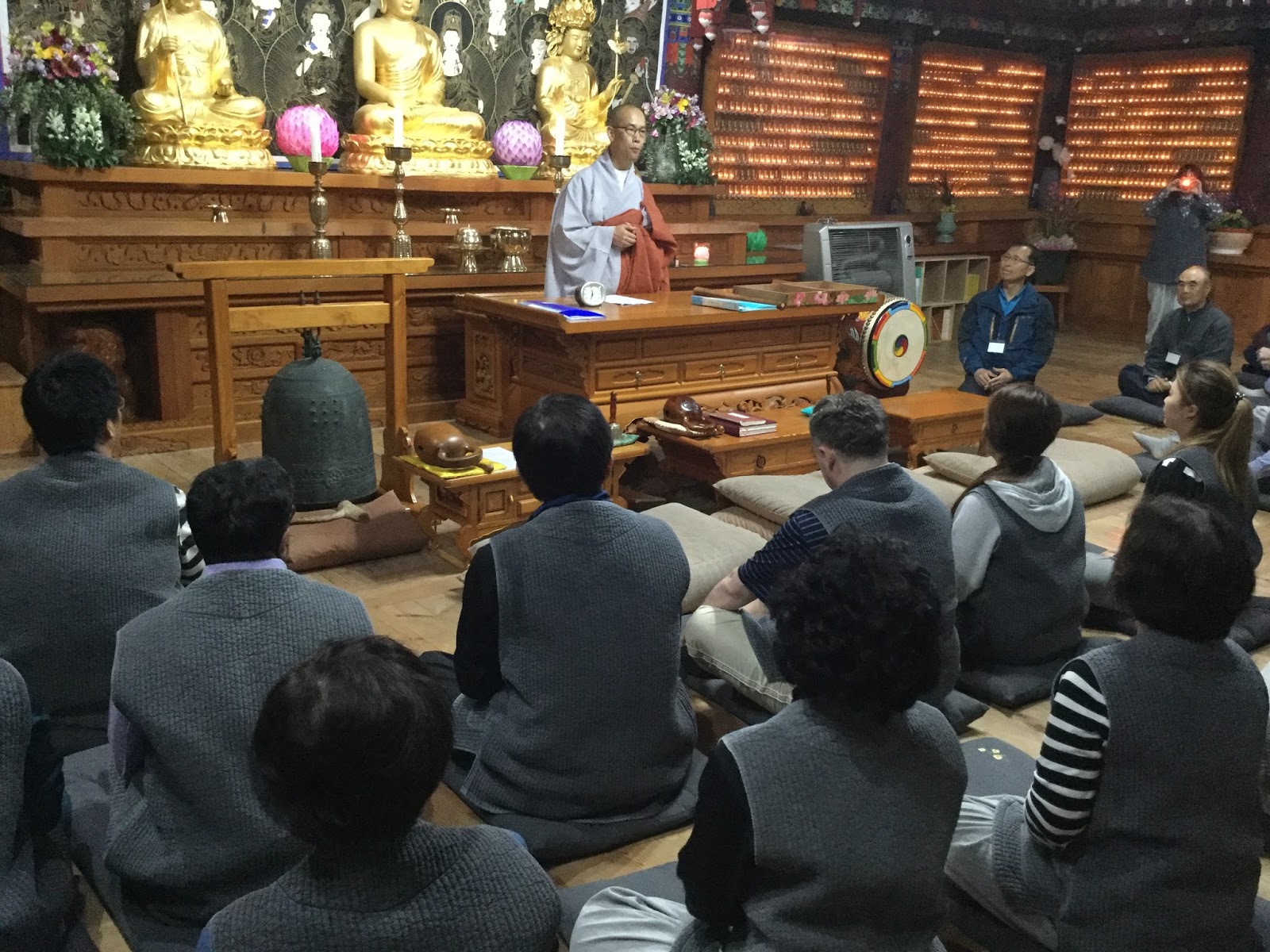
About 35 people participated in the temple-stay offered by Dongguk University Seon Center. As a guess, about half of the people were Buddhist and 11 of us were foreigners (USA, Poland, Brazil, Spain, China, Japan, India).


Amazingly huge! Dragons are the protectors of Korean Buddhism,
but I'd never seen a dragon sitting on the ground before. They're always been portrayed as celestial creatures
of the air as they represent the space between earth and heaven. 
The celestial phoenix also plays a central role in Korean Buddhism.
The blue and the yellow dragons over the Buddha. One day I'll understand the significance of these two colors which invariably play a central part in the Korean temples.
The Buddha of the main hall. I'm not sure if this is the famed medicine Buddha or not.
108 Prostrations

The number of 108 is a number important in Hinduism and Buddhism. The number represents the number of defilements in the mind, or as some look at it, the number of compartments in the mind. Each prostration opens a compartment and clears consciousness, and by bowing the full 108 times, the mind and the body become one. Consciousness is slowly restored this way. As one source says, "Our bowing takes away our karma mind, our thinking mind, and helps us to find our true nature and save all things from suffering". The last part is very disconnected, but ultimately the bowing is supposed to help the individual and the earth keep from suffering. I'll have to think about this. At the moment it makes no sense. Here's another quote related to bowing 108 times:
"The practicer of Buddhism is the never-ending humbling of the ego. Humbling yourself before the world, by lowering your body you realize that you are one with everything. Performing 108 prostrations is yet another path towards the realization of the True Self."

And then a look at the 108 bows as expressed as a mathematical equation:
We have 6 doors of perception: sight, sound, smell, touch, taste and thought.
There are 3 aspects of time: past, present and future.
There are 2 conditions of the heart/mind: pure or impure.
There are 3 possible attitudes: like, dislike and indifference.
Korean Buddhists use this formula 6 x 3 x 2 x 3 = 108 bows to cut through our Karma.
Supposedly temple-stay is about helping people find or restore their True Self. During temple-stay there are three meals (some temples offer only two, but Korean monks really like to eat so the two-meal temples are rare) and three meditations, one of which usually involves prostrating one's self 108 times.

The ceremony begins with the ringing of a large bell inside the main Buddha hall.
The repetitious ringing of the bell is to, as I understand, relieve the sufferers in hell.
Each strike is supposed to offer some relief. The ringing is performed while chanting. 
The head monk then moves in front of the Buddha statue and, while chanting (the lotus sutra?) begins the 108 bows.
At first the rhythm is slow and then it picks up.
Bow to the floor, left foot overlapping right foot slightly, lift hands palm upwards past the ears to lift up prayers or thoughts? Your forehead, elbows and knees (the five points of the body) are to touch the floor simultaneously.


And following the 108 bows when supposedly the mind and body are pure and unified, a Dharma talk is given.